


Robert Shenkman has joined the rarified club of players who have taken a set off World Champion Camden Riviere, despite ultimately failing to progress past the quarter-finals of the French Open in Paris on Tuesday. Meanwhile, Steve Virgona has kept his World Race chances alive by winning his quarter-final against Lewis Williams in a match that saw a bagel and three deciding games.
The first quarter-final pitted the Amateur Champion Robert Shenkman against the World Champion Camden Riviere. Shenkman’s retrieval skills and read of the court were tested immediately as Riviere drew him around the court as though a puppet on a string. Because Riviere always had him under pressure, Shenkman knew he needed to capitalise on any opportunity if and when it presented. But Riviere’s ability to turn an ordinary rally ball into something special allowed him to quickly push ahead in the match. Shenkman didn’t win his first game until he was 0/5 down in the first set. Riviere’s intensity dropped at the start of the second, losing the first game and having a six-deuce battle in the third. Still, Riviere never let the set go from his grasp, extending to a two-set lead.
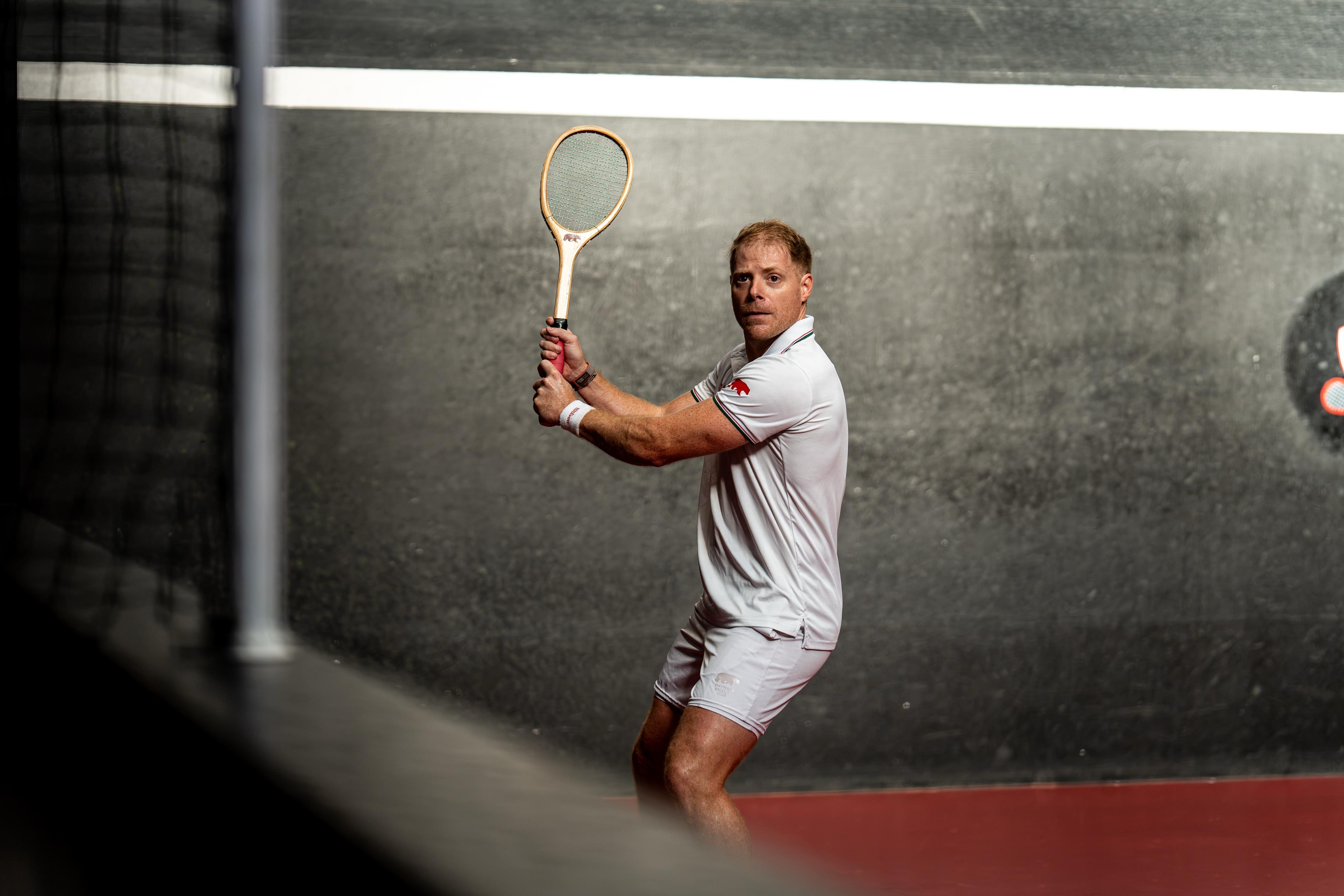
As the match drew into a third set, Shenkman was slowly learning how to deal with some of Riviere’s excesses, taking on a slightly tougher ball than he normally would in order to put some pressure on Riviere’s strokeplay. It worked out, as he was making few mistakes and several targets to boot, earning a narrow lead. He then beat a chase one when game point down at 3/2 with a dedans, moments later going to a 4/2 lead. A few tough balls later and he converted it into a three-game advantage, with Riviere missing his shots more frequently. Shenkman’s main wall was paying dividends, though he would eventually take the set with back-to-back grilles. Shenkman became just the fourth player to take a set from Riviere in the quarter-finals or earlier since the latter became World Number 1, joining Bryn Sayers from the 2024 US Open, Nino Merola from the 2023 British Open and Tim Chisholm (twice) in the 2016 British Open.
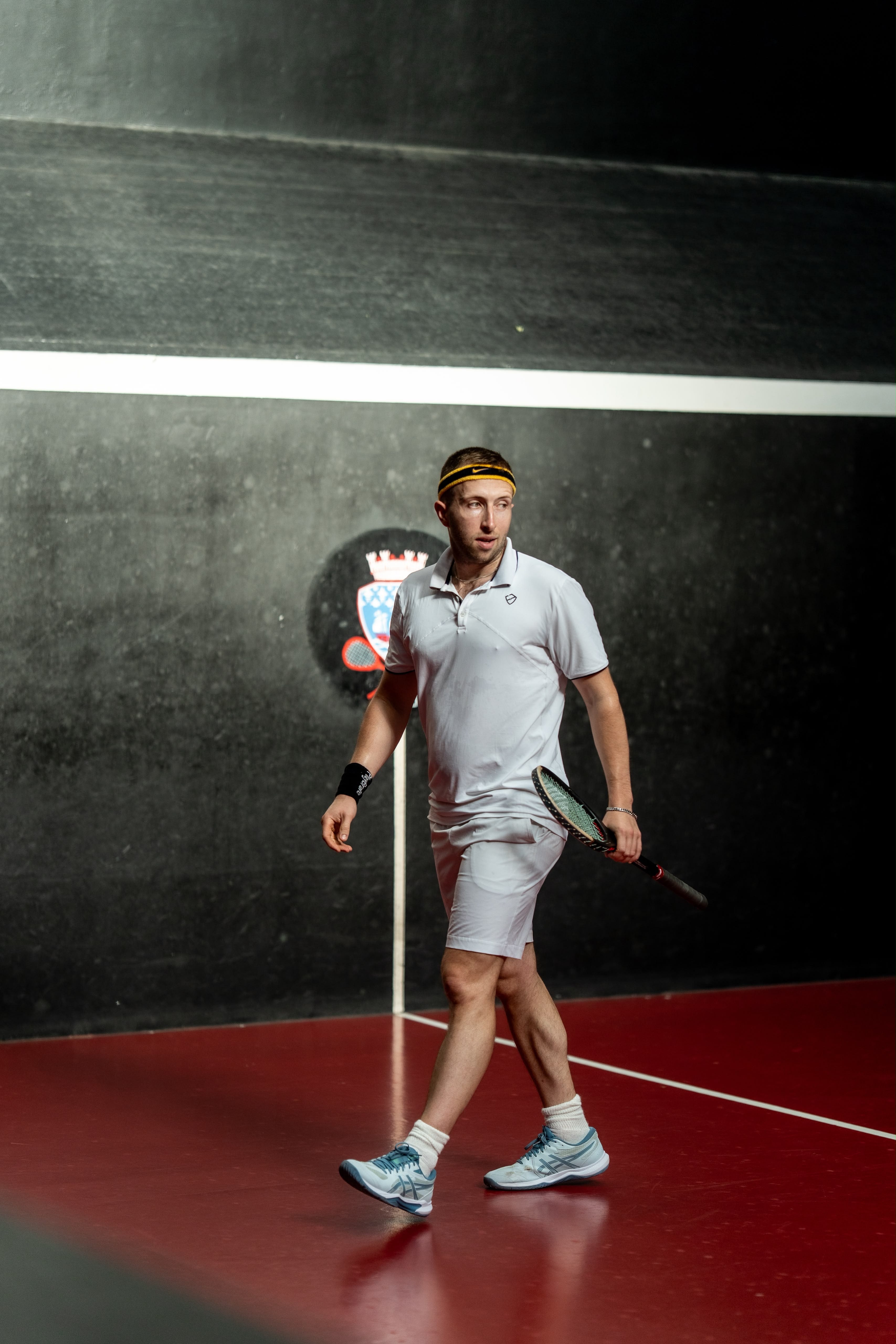
Riviere was not pleased at losing the third set and came out firing in the fourth. But Shenkman refused to give in, blasting main walls past Riviere to keep in contention through the nervy third and fourth games. Riviere eventually rediscovered the grille to break out a lead again. The World Champion enjoyed his front-runner status once again, pressing home for victory as Shenkman overextended himself trying to get back into the contest. Shenkman battled hard to the end, saving six match points before eventually succumbing.
The second quarter-final of the day was between Lewis Williams and Steve Virgona. Virgona had a slightly slow start, dropping the first two games as he sought to excise any errors from his game. Virgona took the next three games, as the match began to lull into a seemingly predictable stanza. Williams sought to shake up the flow by striking a couple of dedans to regain the lead. However, he struggled to make progress when at the service end, allowing Virgona to go up 5/4 instead. A lackadaisical game from Virgona followed, with Williams sending the set to a deciding game. A series of booming Virgona forehands then saw the Chicago professional win the last game to love, securing the set.
With the previous day’s five-set match still in the legs, Virgona couldn’t find his usual intensity to start the second set, as Williams played his way to a decent lead. The Brit was getting plenty out of the court, using the large openings to his advantage and extracting cut from the back wall. Towards the end of the set, Virgona started experimenting with different serving variations, moving away from his standard left-handed railroad. But it didn’t work, giving Williams a ball in space he could thump towards the dedans. He went on to win the set without dropping a game.
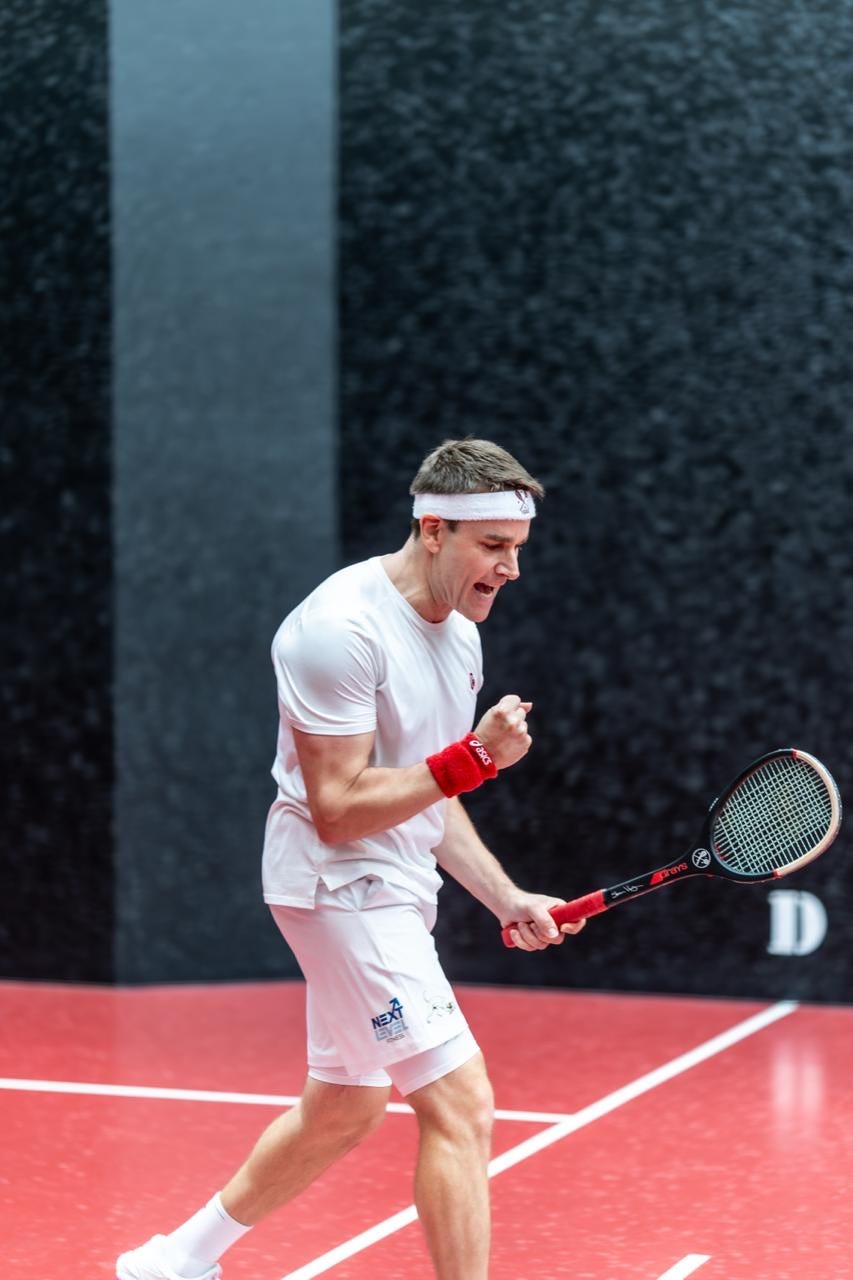
Virgona broke the drought in the first game of the third set but it was clear that he didn’t have his usual energy when moving around the court, often giving away balls under the grille if he didn’t think he could get there. Even so, he had to fight in order not to let the set slip away from him again, with the pair playing out a series of forehand-to-forehand rallies. Williams had points for a 4/2 lead but could not convert, letting Virgona tie it up at 3-all, 4-all and then 5-all, without putting his nose in front. Virgona hit another level for the deciding game, opening it with a forehand winning gallery and winning it to love.
The fourth set continued in much the same manner: Williams would push ahead by a game, then Virgona would battle it back. Despite most games going to deuce, neither player could find a way to break away, not helped by the fact both of them were finding it difficult to kill the ball or disengage from the cross-court rallies. The pattern broke in the 4-all game, where Williams’ force hit the bottom lip of the dedans to give Virgona a lead for the first time. It didn’t last, with Williams battling into a third deciding game of the match. Again, Virgona seized the initiative, as Williams was barely inches off target with his shots. He went 40-15 up, before winning the match on his first match point.
The third quarter-final was between the unseeded Vaughan Hamilton and the second seed John Lumley. Though Hamilton initially came out looking to play his shots, holding an early lead in the set, he got suckered into Lumley’s long rallying style. The pressure of wanting to end points led to some questionable shot choices. Lumley won four straight games to go 5/2 up, before Hamilton found some counterplay by making effective use of the winning gallery. He took another two games before Lumley could close out. In the second set, Lumley was much more aggressive, driving into the corners and sending Hamilton chasing after the ball in mad retrieval. Though Hamilton could get to most of them, Lumley’s relentlessness was enough to break away, with the scoreboard pressure doing the rest of the work. Hamilton’s attitude was little changed for the third set, which began with a violent swing at the ball. At first it didn’t pay off, conceding a three-game deficit. But eventually, Lumley became more conservative as the end of the match approached, while Hamilton kept swinging, hitting his targets. He brought it all the way back to 4-all, but Lumley had the serves to see the match out, moving on to the semi-finals.
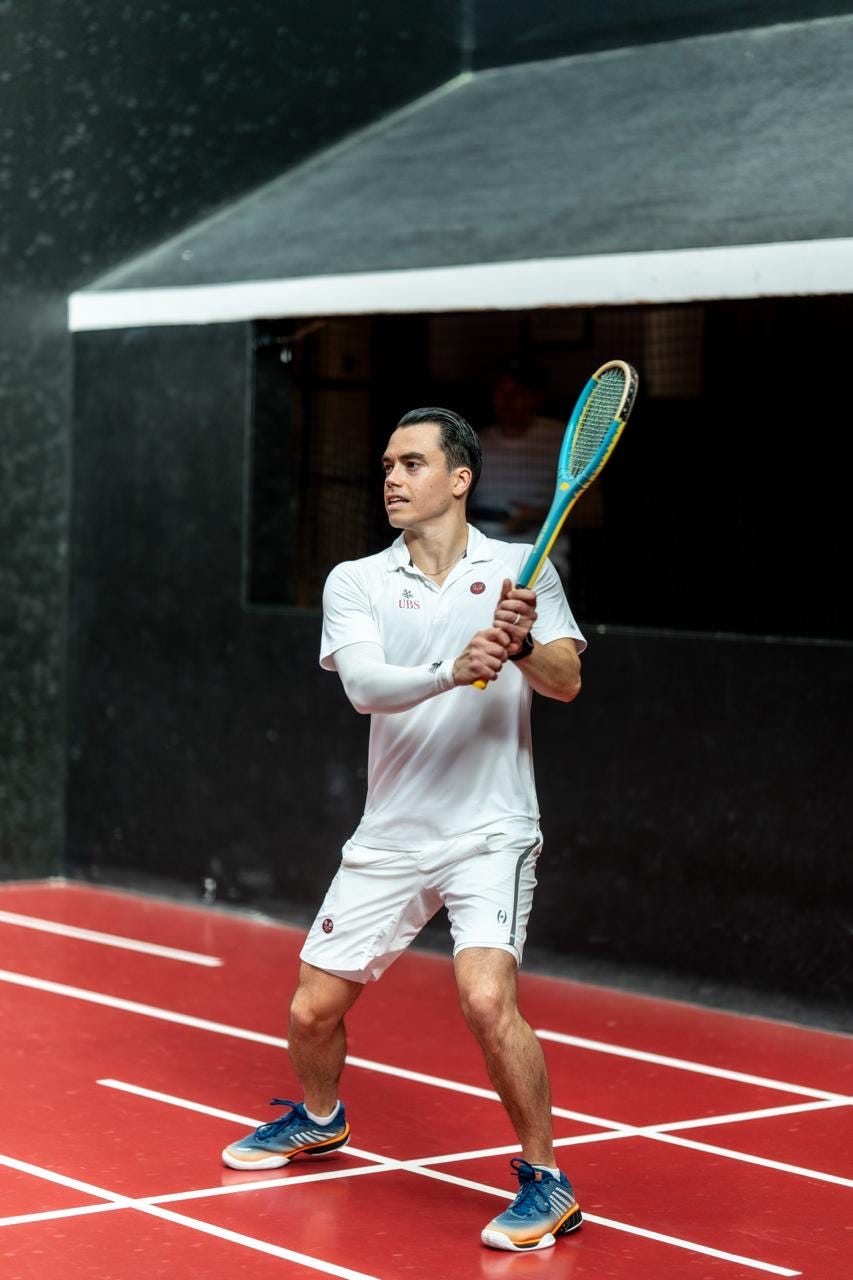
The cocktail match was between long-standing rivals and doubles partners Bryn Sayers and Ben Taylor-Matthews. There was little to separate them in the opening stanzas. Sayers went back and forth between his railroad and his high serve, trying to find a ball that would trouble his opponent. Taylor-Matthews was consistent, if passive, as it would often be Sayers who broke out of the cross-court exchange first. Sayers broke away first, running away with the set despite each of the games being close.
Neither player was having much joy from the service end as the bouncy court made serving tight difficult. Taylor-Matthews’s railroad proved stronger than Sayers’s high serve, which, given the steep penthouse, he could not get to run flush. The Westwood pro took the first three games of the second set. As he grew more confident with his serve he starved Sayers of the service end, with the latter’s only theory of gaining points coming from a force on the return of serve. Taylor-Matthews’s unerring control allowed him to start pressuring Sayers’s backhand, winning through the second set and building a lead in the third in the process. Though Sayers scraped back a couple of games midway through the third set, Taylor-Matthews was well and truly in control.
Sayers’s serving improved at the start of the fourth set, which, when coupled with a determination to drive the ball, saw him win the first two games. Taylor-Matthews responded to the increased pace by doing the same, pulling the score back level. Both were fighting hard, including a memorable diving get from Sayers that saw him tumble to the floor only to get up and continue a rally that ultimately ended in a Taylor-Matthews grille. Taylor-Matthews swept through the next five games to secure an unassailable lead. His victory set him up for a semi-final against John Lumley.
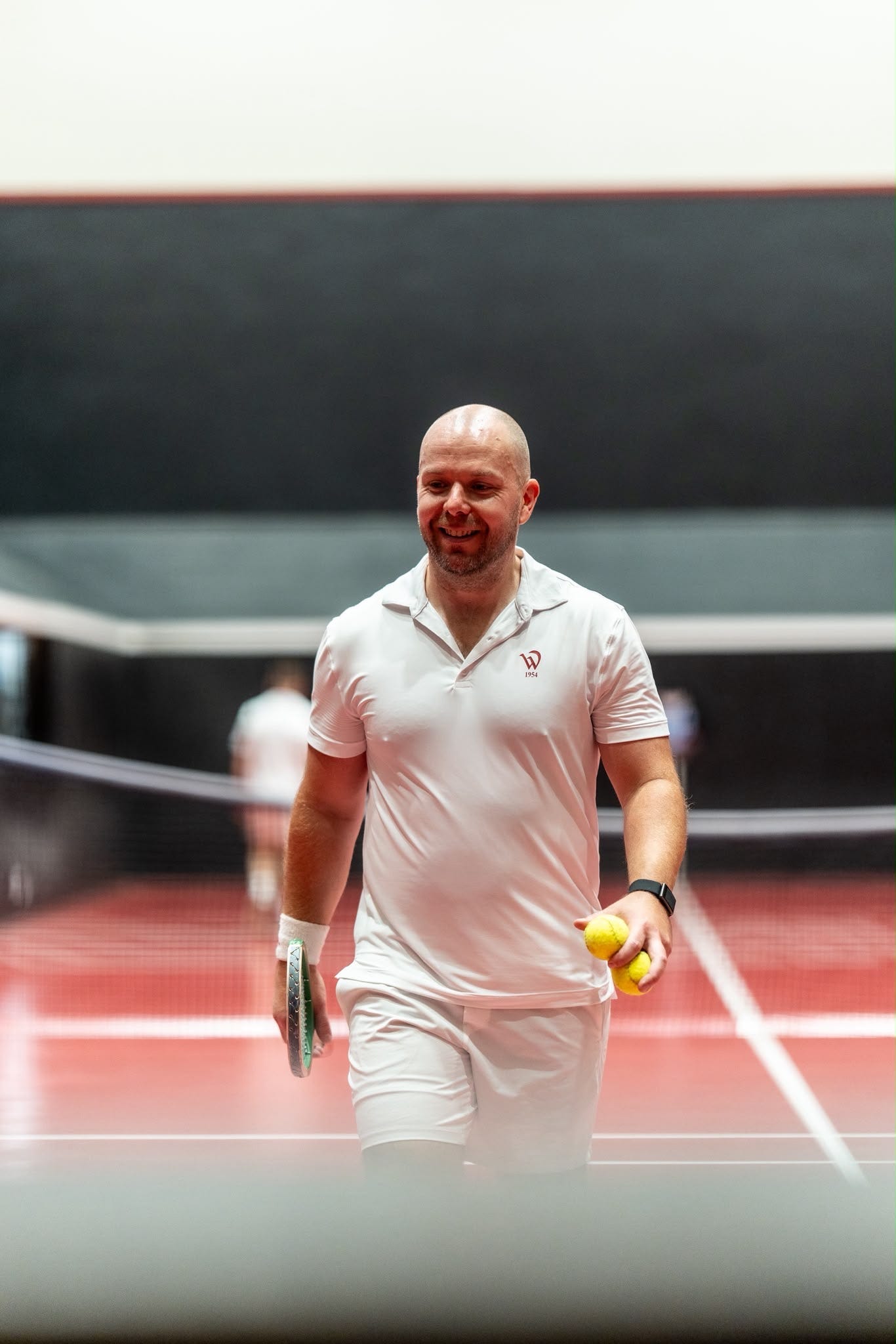
Taylor-Matthews and Virgona’s wins each guarantee them semi-final points in the World Race. Virgona’s victory was a must-win, as without it he would need to find a two-round difference over Taylor-Matthews at one of the two remaining tournaments in the cycle. Unless one or both of them reaches the final in Paris, Virgona will need to go a round further at both of the last two events to overtake Taylor-Matthews into the fourth position in the Eliminators — which would have been the case regardless of Taylor-Matthews’s result as the remaining tournaments carry a higher points weighting.
Play continues on Wednesday with the first doubles matches in the main draw. The singles resumes on Thursday with the two semi-finals, which will also see the first round of the women’s draw.
Match results:
10:00 AM: Camden Riviere (1) def Robert Shenkman (5) 6/1 6/2 2/6 6/2
1:00 PM: Lewis Williams (7) lost to Steve Virgona (3) 5/6 6/0 5/6 5/6
4:00 PM: Vaughan Hamilton lost to John Lumley (2) 4/6 2/6 4/6
7:00 PM: Ben Taylor-Matthews (4) def Bryn Sayers (6) 2/6 6/1 6/3 6/3
Order of play for Wednesday (all times CEST):
10:00 AM: John Lumley & Camden Riviere (1) vs Clément Depreeuw & Bertie Vallat
1:00 PM: Levi Gale & Lewis Williams vs Bryn Sayers & Ben Taylor-Matthews (3)
4:00 PM: Benedict Yorston & Zak Eadle vs Robert Fahey & Steve Virgona (2)
7:00 PM: Robert Shenkman & Vaughan Hamilton (4) vs Nino Merola & Henry Henman