


The British Open singles competition blew wide open in the singles semi-finals on Saturday, with Ben Taylor-Matthews and Bryn Sayers winning through to the final, defeating the previous year’s finalists John Lumley and Nick Howell respectively. Meanwhile, Claire Fahey has secured her 52nd Open title with victory over her sister Sarah Vigrass.
For the first time since 2017, Claire Fahey lined up against her sister Sarah Vigrass in a British Open final. However, this was the first time they had stepped onto the East court at the Queen’s Club to play it, with the previous editions having been held at Seacourt. Vigrass was back on court at the French Open in September, playing Fahey in the final but without winning a game. Fahey was determined to see this British Open final have a similar scoreline. She gave nothing away from the service end. She played clinically and with determination, barely making an error. Vigrass couldn’t even take a game to deuce until the sixth, by which point Fahey had already built an overwhelming lead in the set, winning it without losing a game.
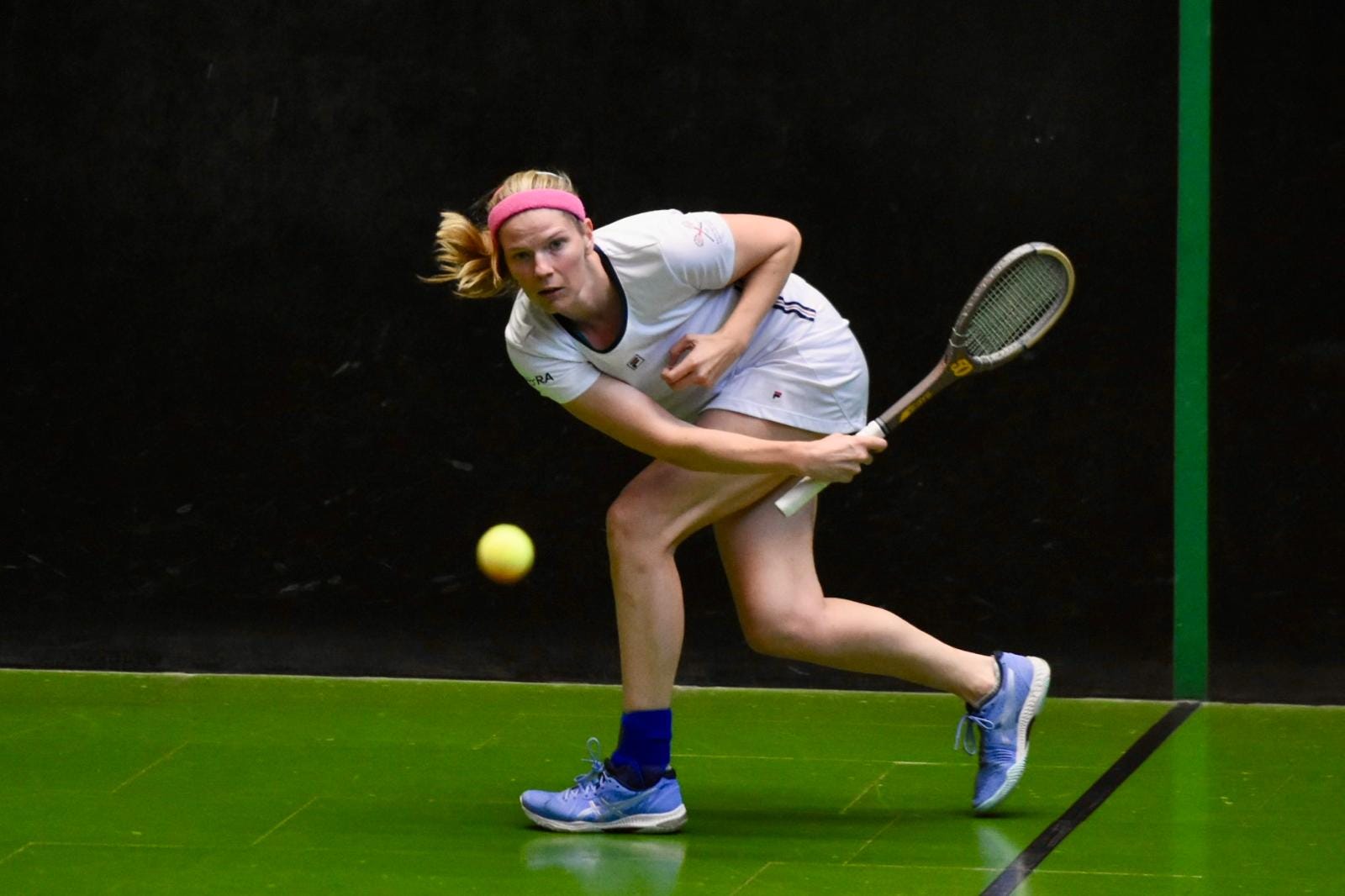
Both players lifted their standard more into the second set, especially Vigrass. Fahey was moving her around the court, but Vigrass was not bothered, injecting pace into the ball herself to trouble Fahey. Her best run of the match came early in the second set, when she leaned into her high serve and getting the ball to be flush on the back wall. An unreturnable ace helped her win her first game, and she took her second to make the set 2-all moments later. Yet despite the length she was generating, Fahey was able to close things down once again. The scoreboard once again started ticking along in her favour, shutting Vigrass out of the match. The standard of play remained high throughout, but Fahey was once again on another level. Vigrass’s tally of two games was the most that Fahey had lost in a women’s match since her World Championship defence in Newport in May 2025. She closed out the set to win the match and her 52nd Open title.
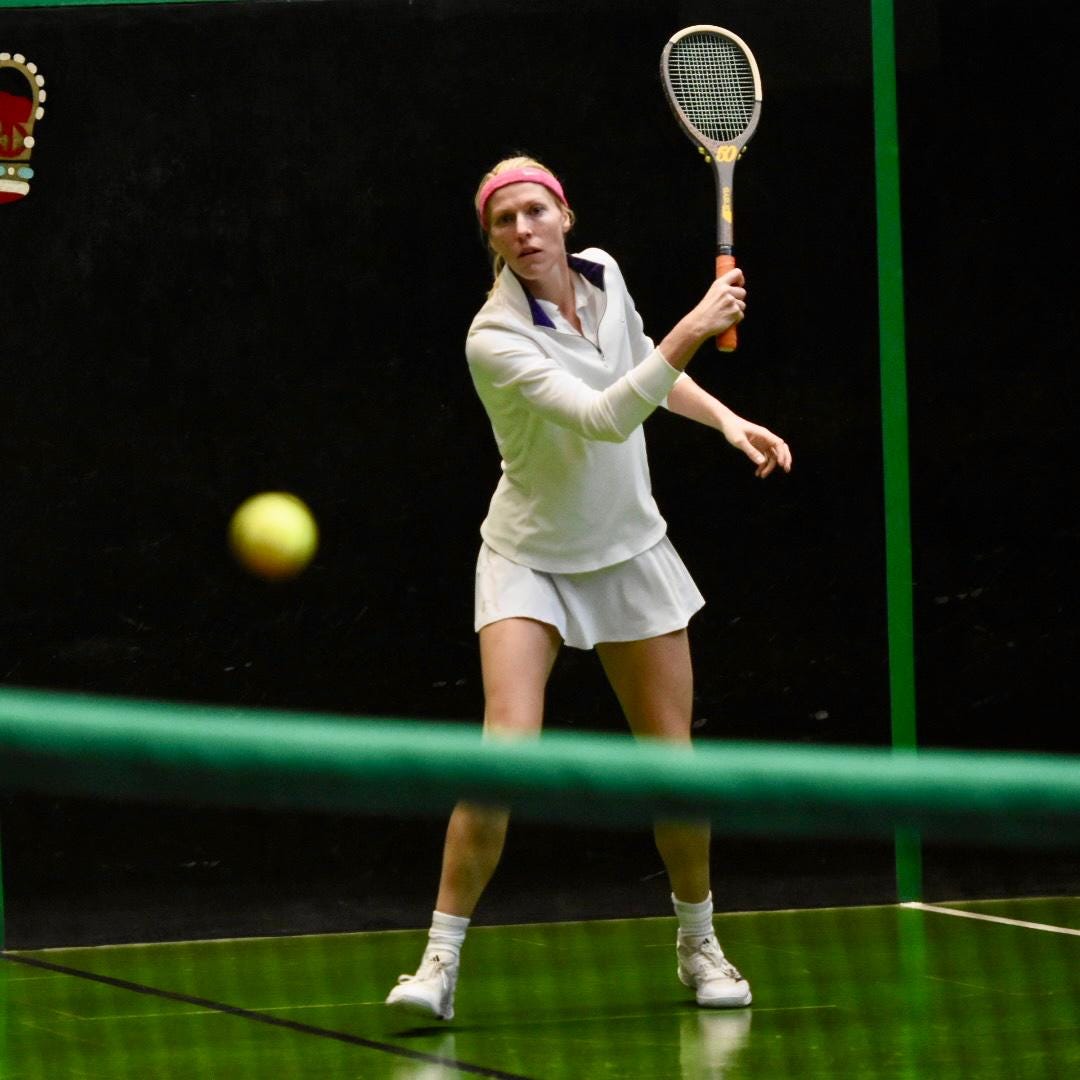
The open semi-finals followed, starting with the match between the fourth seed, Ben Taylor-Matthews, and the second seed, John Lumley. In the opening stanza, Lumley barely made a mistake, outplaying Taylor-Matthews on every ball. He looked well-prepared, dictating the play and putting Taylor-Matthews under severe pressure. He took the first four games before Taylor-Matthews registered a mark on the scorer’s sheet. Taylor-Matthews needed to find targets to get out of the rally but couldn’t. By the time Lumley was 5/1 ahead, he took his foot off the gas, but only marginally. Taylor-Matthews started taking the ball on from the receiver’s end. His variety in shot choice meant Lumley had to defend multiple different attacking options. Taylor-Matthews clawed his way back to 5/4. Lumley had two set points, attacking a 1 and 2 chase. Not for the last time in the day, the ball was called chase off. Taylor-Matthews saved the next with a winning gallery but Lumley sealed the set with a dedans.
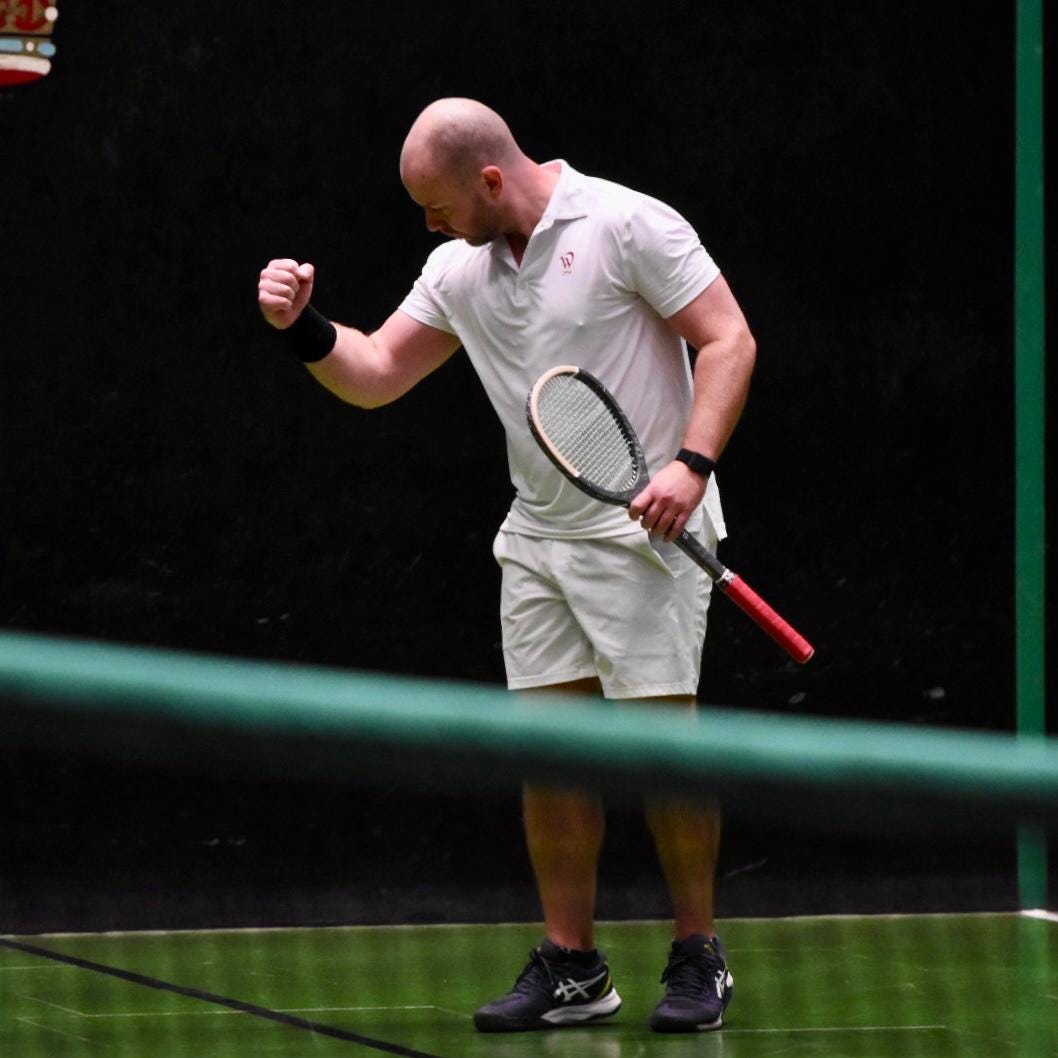
Now that Taylor-Matthews had established himself in the match, the second set was much tighter than the first. The play was characterised by long floor battles. For the first time in the tournament, the railroad came into vogue, with both players able to get the older balls to hug the wall more, restricting the play. Throughout the set, Lumley would win a game, then Taylor-Matthews would bring it back even. Lumley’s forces down the backhand side were strong, but Taylor-Matthews’s retrieving matched his play. The set reached a deciding game. Taylor-Matthews opened with two mid-length chases. He gambited on a second serve railroad on the first, and it paid off as Lumley put the ball into the high part of the net seeking last gallery. Lumley lost the next chase, and after the next few exchanges Taylor-Matthews headed back to the hazard end with three set points and a last gallery chase. This time, it was Lumley’s turn to save a set point with a winning gallery, but Taylor-Matthews sealed it on the next point with a perfect cut-volley, clenching his fist in celebration.
Taylor-Matthews was uplifted by the win of the second set, carrying the form into the third and quickly establishing a 2/0 lead. Lumley battled to recover to 2-all, but Taylor-Matthews firmly had the upper hand. He was in control of the rallies and regularly finding targets, particularly the grille. He also took on the winning gallery several times, rarely missing. The pressure he was applying forced Lumley to put more balls on the penthouse than he normally would expect. He opened up a decisive lead, eventually winning the set 6/3. This time, there was no celebration: there was a job to be done and it was as yet unfinished.
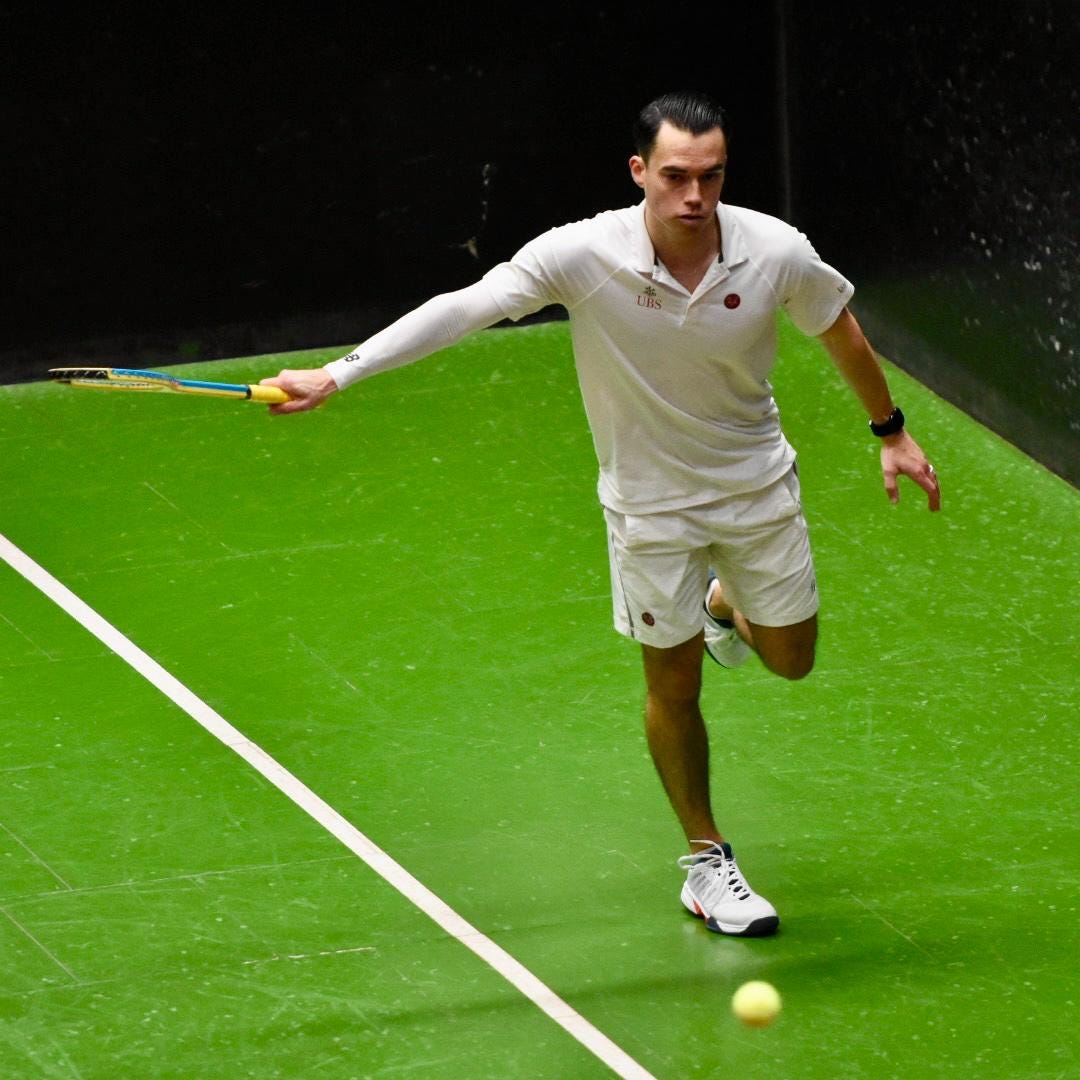
Lumley grabbed a lead in the fourth to go up 2/1. But Taylor-Matthews’s grille hitting continued to be sublime. His backhand down the line to beat Lumley in the forehand corner kept paying off, as the second seed was wrong-footed in expecting a continuation of the backhand exchange. The key game came at 3-all. Lumley was 40-15 up, but Taylor-Matthews brought it back to deuce with a forehand winning gallery from first gallery near the marker’s box. He completed the trifecta with a grille, then, after a chase, a dedans to take the game himself. One game later, and he held a 5/3 lead. But the defending champion wasn’t going to give up his title easily. He fought hard to bring the set back to a deciding game, hitting several grilles in the process.
Lumley opened the deciding game with a main wall dedans, picking off Taylor-Matthews’s fast railroad. Taylor-Matthews switched back to a demi-pique, but Lumley was able to cut-volley it down to better than chase 2. With the pressure on Taylor-Matthews, Lumley decided to engage the next rally in a backhand exchange. But Taylor-Matthews was slowly able to work his way across to the forehand side, hitting the grille. 15-all, and Lumley took on the boast several times in the following reste, with Taylor-Matthews at full stretch to keep the ball alive. Lumley spotted an opening and went for the dedans, but missed high, with Taylor-Matthews able to thread the ball down the backhand side to switch up the initiaitive, and when Lumley scrambled the ball back, the fourth seed slammed the ball into the grille for the second time. A good cut-volley from Lumley brought the error. Now at 30-all, another backhand exchange followed, with Taylor-Matthews lifting one for the grille again and causing a volley error from Lumley. Taylor-Matthews was match point up, but a chase better than 2 was still pending. Taylor-Matthews had three goes at beating the chase. Lumley left the third and Taylor-Matthews raised his arms in celebration but the marker called chase off. On the next serve, still match point, Lumley’s demi-pique was short on the stroke line. Taylor-Matthews lunged at it, putting it up on the penthouse. He had to scramble the ball back off the tambour, putting it down Lumley’s forehand. Lumley went for the grille but hit the back wall. Taylor-Matthews sent down a backhand drive straight at Lumley, whose backhand volley could only put the ball in the side galleries to lose the point. Taylor-Matthews was through to his second British Open final, taking down the defending champion the process.
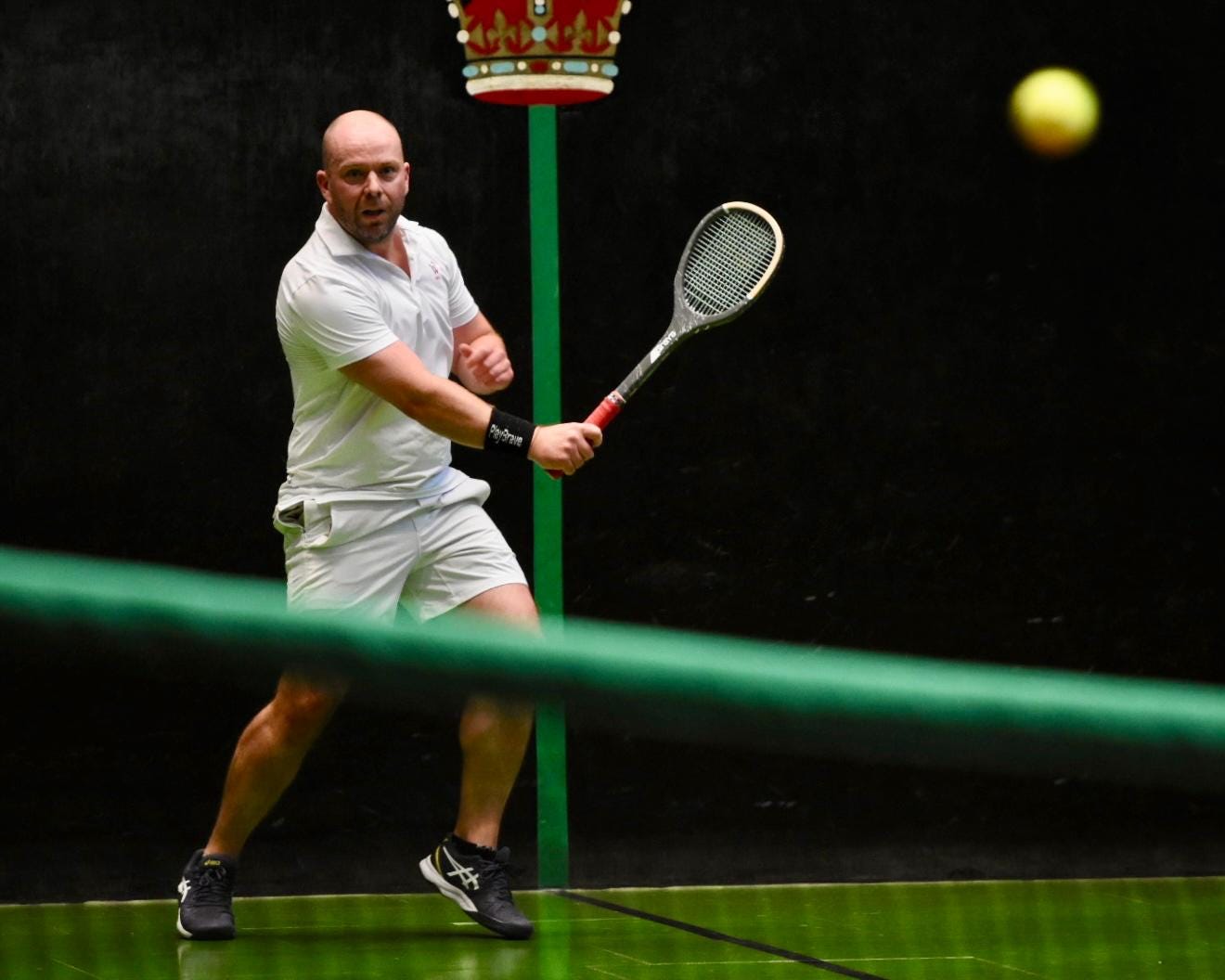
The second semi-final was between Bryn Sayers and Nick Howell. Sayers was solid from the start, playing on his home court and reading it well. He was making few inaccuracies, keeping the ball tight to the wall and keeping the pressure high on Howell. Howell lacked half a yard of foot speed, often not quite getting to the ball and giving up on balls hit hard at the back wall. Sayers went 3/1 ahead before they exchanged a pair of games. But Sayers was clearly the stronger in the set, going 40-0 ahead in the 5/2 game and sealing the first set without much trouble.
Sayers’s concentration lapsed early in the second set — loud groans of exertion were echoing through from the members’ match on the West court, causing a disruption in play. Sayers broke from his steely demeanour to crack a few jokes, but when play resumed he wasn’t able to regain the same composure he had in the first set. Howell sensed a slight weakness in his opponent and lifted his own game. He picked up his foot-speed around the court, retrieving the ball as well as anybody in the top 10. His play from the hazard end was particularly strong, finding the dedans from any open ball. Chases didn’t matter to him, but when they did come they were often short. He went on a five-game streak, and though Sayers pulled one back, Howell wrapped up the set shortly thereafter.
Sayers was back on form for the third set. It was the closest play of the match. Sayers was experimenting with his serve, throwing up all manner of variation of high serve but also leaning on his relatively new left-handed railroad or left-handed side-wall. The tension was high, as each point seemed to matter as the tactics switched up multiple times across the course of the set. Sayers broke a narrow lead to 5/3. Howell looked like he might push it to a deciding game, but Sayers killed off any such notions with a dedans — outhitting Howell in that category across the set.
Howell took a timeout before starting the fourth set, as he had been clutching at his back through the latter stages of the third. When play resumed, Sayers kept the pressure high, hoping to kill off the match. Howell wasn’t retrieving as well as he had earlier in the match, giving Sayers the opportunity to go all out. He pushed ahead to a decisive lead. Down match point and a hazard second chase, Howell struck chase off to keep the set alive — the third such instance in the day’s play. But Sayers was able to find another chase soon after, and after Howell’s shot went long, he turned to thank his supporters in the crowd, as he reached his first British Open final since 2017. After shaking hands, he broke into a massive grin, knowing what opportunity lay ahead.
Play continues with the women’s doubles final and open doubles semi-finals on Sunday. The British Open singles final will take place on Monday evening and presents Taylor-Matthews with a big opportunity to win his first Open title, while Sayers looks to add to his win from 2012. The head-to-head record and home court advantage strongly favours Sayers, but Taylor-Matthews will take strength from their most recent encounter at the French Open quarter-finals where he won in four sets.
Match results:
12:00 PM: Claire Fahey (1) def Sarah Vigrass (4) 6/0 6/2
2:00 PM: Ben Taylor-Matthews (4) def John Lumley (2) 4/6 6/5 6/3 6/5
4:00 PM: Nick Howell (3) lost to Bryn Sayers (6) 2/6 6/2 4/6 2/6
Order of play for Sunday (all times GMT):
12:00 PM: Claire Fahey & Tara Lumley (1) vs Katherine Carney & Nicola Doble (2)
2:00 PM: Henry Henman & Nino Merola (7) vs Robert Fahey & Nick Howell (2)
4:00 PM: John Lumley & Camden Riviere (1) vs Vaughan Hamilton & Robert Shenkman (5)