


Great Britain have qualified for the final of the Bathurst Cup, knocking out defending champions Australia on the back of Robert Shenkman’s win over Oliver Pridmore in four sets in the 1st singles. Meanwhile in the women’s event, the Rest of the World team halved their deficit against Great Britain with two long, gruelling doubles victories.
With the USA already holding an unassailable 3-0 lead over France in their semi-final, the two reverse singles matches were dead rubbers. As a result, following Bathurst Cup rules, the format was reduced to a best-of-3 set match. Noah Motz was a fairly relaxed figure in his match against Jean-Baptiste Rossi, leaning into his exhibitionist streak with behind-the-back or between-the-legs as he channeled his inner Edmond Barre. However, Rossi was out to play, scampering all over the court and covering everything that Motz could throw at him with his round-arm, ambidextrous style. Motz stalled, while Rossi strung together three straight games. Across the passage of play, the bouncy Paris court saw each winning opening struck from a ball off the floor. Rossi won the first set as Motz never really found his groove. It took Motz firing three back-to-back grilles at 1/2 down in the second set for him to rediscover his form. From there, he didn’t lose another game in the set, finishing with back-to-back main wall dedans. The third set was a tough battle, with the Parisian heat rising, both players were keen to finish things quickly. They fought to 3-all, but Motz stepped forward to finish off the match, securing the last three games and another victory for the USA.
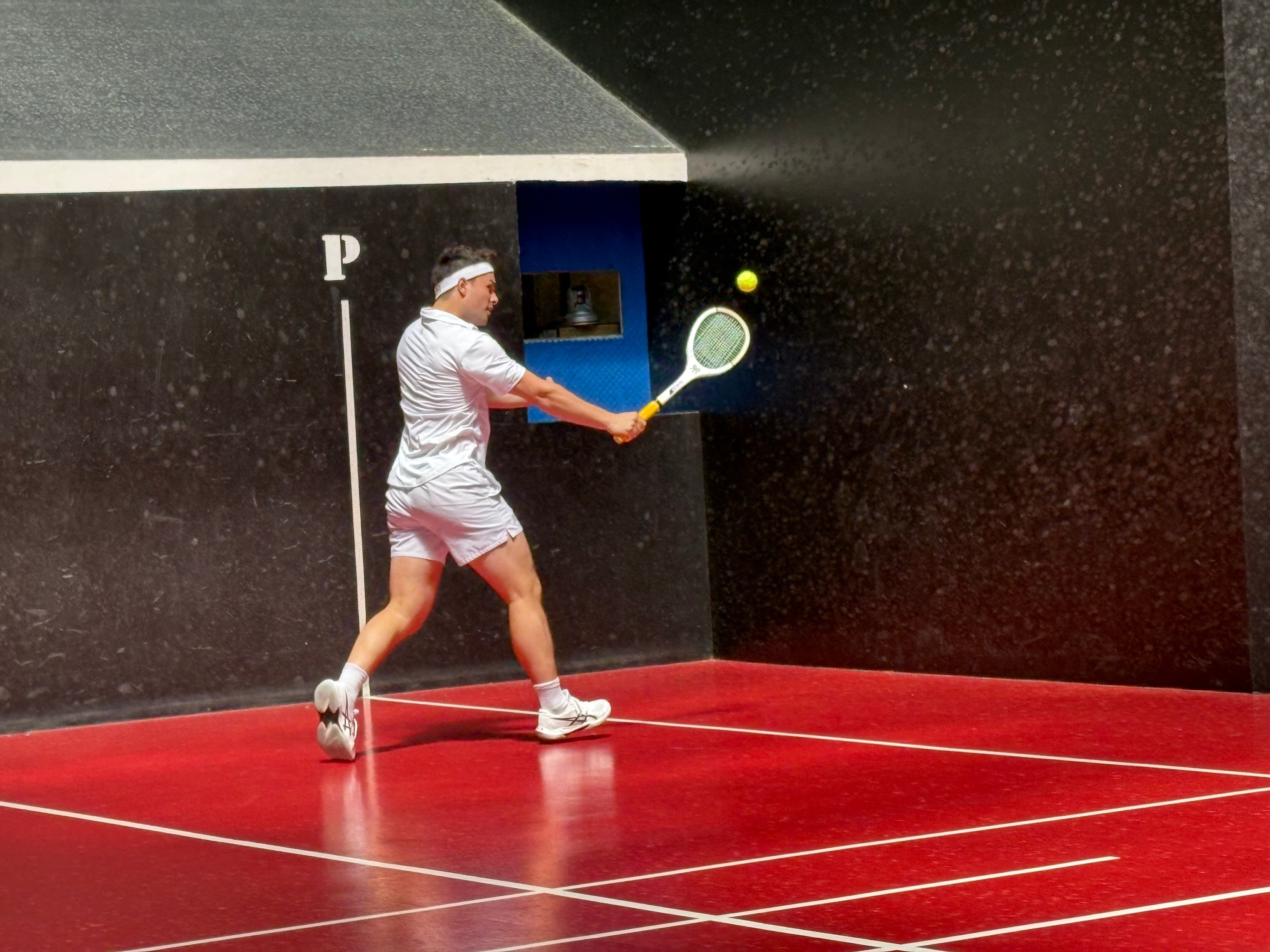
The last rubber of the fixture saw America’s Freddie Bristowe play France’s Clément Depreeuw. Bristowe was in full control of Depreeuw’s serve, pressuring the Frenchman from the very first stroke of the reste. From the service end, his main weakness was hitting too many hazard chases, both in general play and directly off the serve, as his enthusiasm for boasting and slamming the ball around got the better of him. It mattered little, as he was in control regardless of the side of the court he was on. The closest Depreeuw came to winning a game was at 40-0 up in the 0/5 game of the second set, playing a first gallery chase, he hit the back wall of the last gallery only for the ball to bounce out to chase the line.
The women’s match resumed with the first of two days of doubles play. In the second string doubles, British Open finalists Georgie Willis and Jess Garside teamed up to play the Rest of the World’s Saskia Bollerman and Xanthe Ranger. Bollerman took command of the match early, not letting Garside or Willis make any progress at the service end. She was aided by some punishing cut-volleys from Ranger, beating the Brits into the corner. The Brits’ cause wasn’t helped when Garside wore a ball to her hand. Willis needed to step up to save situation and she did, rallying out with Bollerman up and down the main wall. But by that point, Bollerman and Ranger had already built a 4/0 lead, which proved too strong for the Brits to chase down.
By the second set, the Brits had fully wrestled the initiative. As Garside’s volley came good, she and Willis were able to push on to a three-game lead. But the run couldn’t last, with Willis’s backhand starting to struggle. Bollerman was excellent at picking volleys out of the air, with Garside and Willis unable to challenge her up against any of the walls. They pulled the score back to level. In the back end of the set, Bollerman was winning her service games against Willis, but Garside was winning hers against Ranger. It went to a deciding game, playing chase the line, when a ball trickled over the net. Bollerman ran forward to cover it, but left Ranger exposed at the back of the court for Willis to pick off. That shot proved the difference, with the Brits winning the set moments later, with Willis letting out an almighty scream.
Britain carried on into the third set, again establishing a three-game lead. But Bollerman again had to step up to recover the situation for the Rest of the World — knowing that a loss would put overall victory almost out of reach. A tight battle for the 3/1 game saw the Rest of the World back into contention for the match. The service end was the only way for either team to make progress — especially as winning openings were few and far between — making each of the regular hazard chases ever more excruciating for the players. The teams were in a deadlock, with multiple deuces featuring in every game from 3-all to 5/4 to the Rest of the World. A confident leave call proved fatal for Britain, with Bollerman beating a chase 8 on the floor to bring up match point. They only needed one opportunity, sealing the match and the first point for the Rest of the World. All players walked off court exhausted, with the match taking two and a half hours to complete.
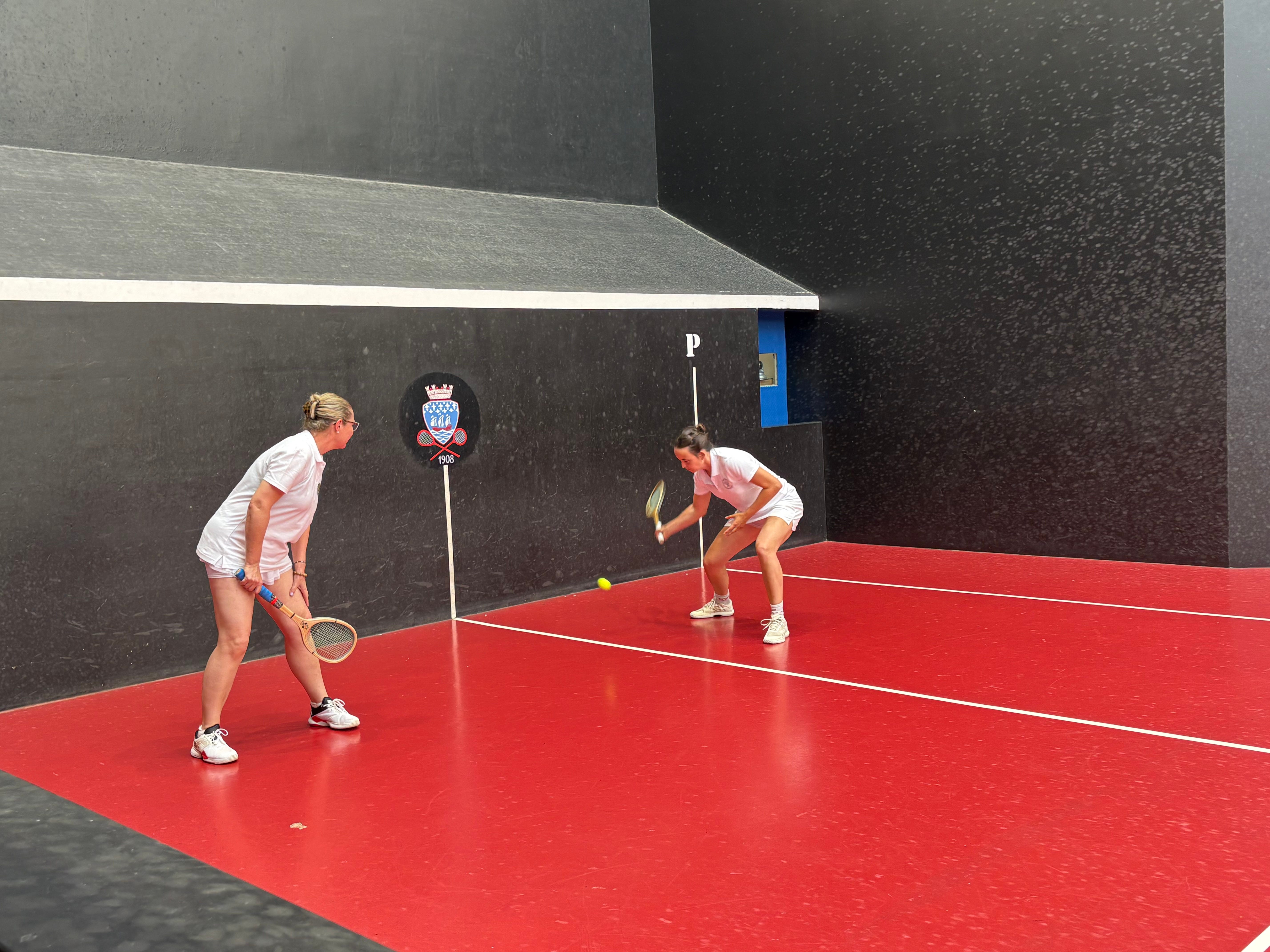
The first-string doubles followed, with a cameo appearance for the Rest of the World by Lea Van Der Zwalmen, who missed the singles matches. She partnered with Frederika Adam, while Britain subbed in Nicola Doble in place of Katherine Carney to partner Tara Lumley. For Britain, the objective was clear: hit the ball at or through Adam to keep the play away from Van Der Zwalmen. Through the early stages of the match, the Rest of the World pair didn’t get the balance right, with Adam dropping back too far and neutering Van Der Zwalmen’s greatest strength — her world-class backhand. Van Der Zwalmen had to assert herself in order to pick up more of the play. Yet Lumley was getting the better of the Van Der Zwalmen service games, with the pairs exchanging games through the back half of the set until they reached a deciding game. The game hinged on Adam’s volley. She got two clean ones away to earn set points, but framed it on each of the first three set points. Finally, one went over, which Doble put into second gallery, which Van Der Zwalmen could beat on the floor to claim the set.
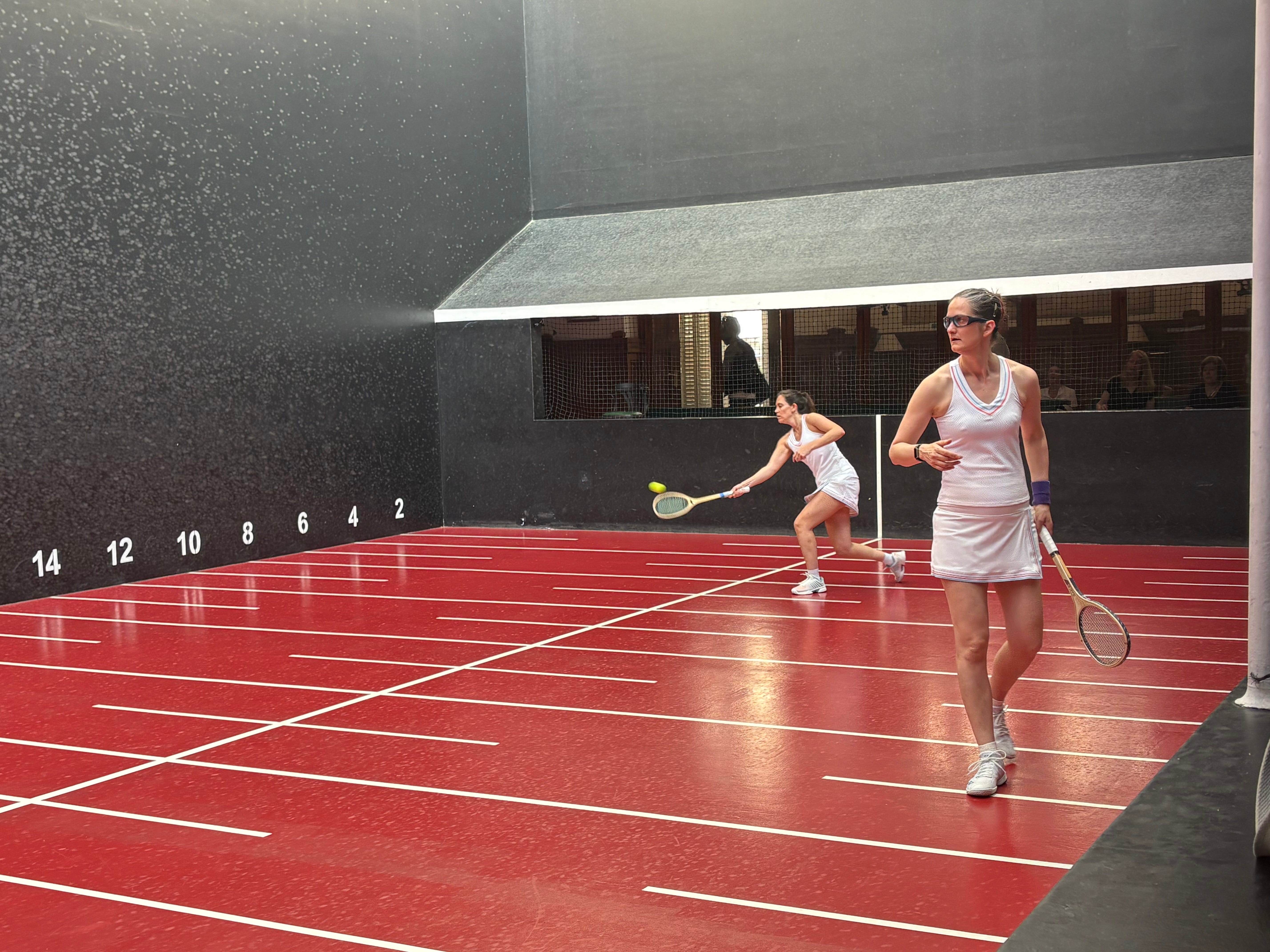
Lumley and Doble lifted for the second set. Together, they were out-rallying Van Der Zwalmen and often out-serving her as well. The Frenchwoman could not control the play like she had through the first set. As a result, Adam become more exposed as well. Doble was getting plenty of weight out of her volleys while Lumley looked at home at the back of the court. Britain led the set throughout, evening the match at 1-all.
The third set was a slow grind. Changes of ends were frequent, with the teammates running errands up and down the side galleries to top up water bottles and fetch sustenence. Van Der Zwalmen and Lumley were locked in an engrossing battle over who could better control the service end. But once again, the match hinged on Adam’s volley, which snuck the Rest of the World team a slight advantage in the set. Finding the final point was tough work, with Lumley and Doble fighting to the end. Adam found enough good volleys coupled with Van Der Zwalmen’s powerful backhand to take the match after a gruelling two hours, keeping the Rest of the World alive in the fixture.
It was well past eight o’clock that Robert Shenkman and Oliver Pridmore took to the court for the Great Britain vs Australia singles matches. Britain led the fixture 2-1, needing to win one of two matches to ensure progression, while Australia needed to win both rubbers. Pridmore unleashed on Shenkman’s serve, aiming to bust the ball out of its stitches. He outright refused to get into the positional rallies Shenkman prefers, instead ripping winners and daring Shenkman to retrieve them. Shenkman had to hold himself back to avoid getting pulled into the aggressive play. Pridmore’s plan hinged on the bet that he would hit the winners more often than he would give up a loose ball. At first, it worked, building out a lead in the set. But Shenkman dug in, refusing to give up on any ball, and battled back to 5-all. The final game was a battle of long chases, with Pridmore framing a ball off the neck of the racket and lobbing into the dedans to secure the set.

Pridmore was still dictating the terms of the engagement into the second set even if he wasn’t in full control of the proceedings. His shots weren’t as menacing, allowing Shenkman to pick off targets and apply some pressure the other way. After taking an age to reach 1-all, Pridmore’s dam burst and Shenkman came flooding through. He took the last 5 games of the set in quick fashion, leaving Pridmore with plenty of questions to answer. As the third set rolled around, it was now Shenkman who was in command of the play, putting the ball in difficult areas that Pridmore kept trying to blast his way out with little success. It didn’t work out well; he did not picking up another game until 0/2 down in the fourth set. There wouldn’t be another, as Shenkman secured the fixture victory for his team, sending them into the final to face the USA.
With the match result beyond doubt, both teams substituted in their reserves for the second string singles. Off the bench for Great Britain was Benedict Yorston, replacing Bertie Vallat, while for Australia, Paul Rosedale stepped in for Michael Williams. A small contingent of supporters for each country stayed to watch, with the match starting around eleven o’clock in the evening. Rosedale found it difficult to control the ball on the bouncy Paris court, meaning Yorston faced no difficulty in chasing everything down to spoon back over the net. Rosedale had little go his way through the first set — apart from saving set point with a tambour winning gallery — as Yorston raced ahead. However, by the second set, Yorston grew ill-disciplined, ceding straight three games to Rosedale, who put together a good string of targets. Yorston quickly recovered by refusing to accept the physical reality that it was possible for a ball to strike the ground twice. Unless he hit an opening, Rosedale couldn’t find a way to end the rally in his favour. Such was Yorston’s keenness to win that he sprinted around the last change of ends. He won the last six games of the match to put the icing on the cake of Great Britain’s victory.

Play continues on Thursday. Great Britain will play the United States in the first two singles rubbers of the final, while Australia will play France in the third-place playoff match. In the women’s event, the doubles matches continue, with the reverse doubles pairs.
Match results:
USA Men def France Men 5-0
11:00 AM (2 vs 1 reverse singles): Noah Motz (USA) def Jean-Baptiste Rossi (FRA) 4/6 6/2 6/3
1:00 PM (1 vs 2 reverse singles): Freddie Bristowe (USA) def Clément Depreeuw (FRA) 6/0 6/0
GB Women lead ROW Women 4-2 (six rubbers remaining)
3:00 PM (2nd doubles): Georgie Willis & Jess Garside (GBR) lost to Saskia Bollerman & Xanthe Ranger (ROW) 3/6 6/5 4/6
4:30 PM (1st doubles): Tara Lumley & Nicola Doble (GBR) lost to Lea Van Der Zwalmen & Frederika Adam (ROW) 5/6 6/2 3/6
GB Men def Australian Men 4-1
6:00 PM (1st singles): Robert Shenkman (GBR) def Oliver Pridmore (AUS) 5/6 6/1 6/0 6/1
8:00 PM (2nd singles): Benedict Yorston (GBR) def Paul Rosedale (AUS) 6/2 6/3
Order of play for Thursday (all times CEST):
11:00 AM (2 vs 1 reverse singles): Michael Williams (AUS) vs Jean-Baptiste Rossi (FRA)
1:00 PM (1 vs 2 reverse singles): Oliver Pridmore (AUS) vs Clément Depreeuw (FRA)
3:00 PM (1 vs 2 reverse doubles): Tara Lumley & Nicola Doble (GBR) vs Saskia Bollerman & Xanthe Ranger (ROW)
4:30 PM (2 vs 1 reverse doubles): Jess Garside & Georgie Willis (GBR) vs Lea Van Der Zwalmen & Frederika Adam (ROW)
6:00 PM (1st singles): Robert Shenkman (GBR) vs Freddie Bristowe (USA)
8:00 PM (2nd singles): Bertie Vallat (GBR) vs Noah Motz (USA)