


Levi Gale has reached his second British Open quarter-final after winning the final game in the fifth set against Robert Shenkman in dramatic fashion at the Queen’s Club on Monday. Meanwhile, the other seeds all progressed comfortably in straight sets, while in the women’s qualifying, Sabrina Didizian came through both Ulla Petti and Araminta Oldham to reach the main draw for the second straight year.
The second round kicked off with a match between Levi Gale and Robert Shenkman. Gale, having played out a long five-setter in his first round match the previous afternoon, showed no signs of fatigue as he came out firing. Shenkman was searching for long rallies but Gale was not going to oblige. Instead he played with a level of aggression that caught Shenkman off guard, forcing him onto the back foot and getting the errors. Although Shenkman won the first game of the match, Gale went on a tear, winning game after game as all of the luck went his way. He was winning points from both ends of the court, forcing well at the dedans and taking his opportunities whenever presented. He went on an eight-game streak, taking the first set in the process.
Too often, Shenkman’s retrieval was putting easy balls up on the penthouse or sending backhand volleys out of court, allowing to Gale pull out a two-game lead in the second set. Shenkman had to battle hard to wrestle the match into his preferred attritional style. Refocusing on his basics, he fought back three games in a row. The set hinged on the seventh game, a long deuce battle won by Shenkman as he started throwing in some flush high serves. With Shenkman leading 5/3, Gale put in a trio of dedans to keep his set alive. He saved a set point in the 5/4 game to send the set into a deciding game. Gale went 40-0 ahead, thanks to a ball running flush off the tambour and a volley error from Shenkman. Shenkman looked like he might defend some of the set points, but instead lost a second gallery chase on the floor, with Gale taking a 2-0 lead.
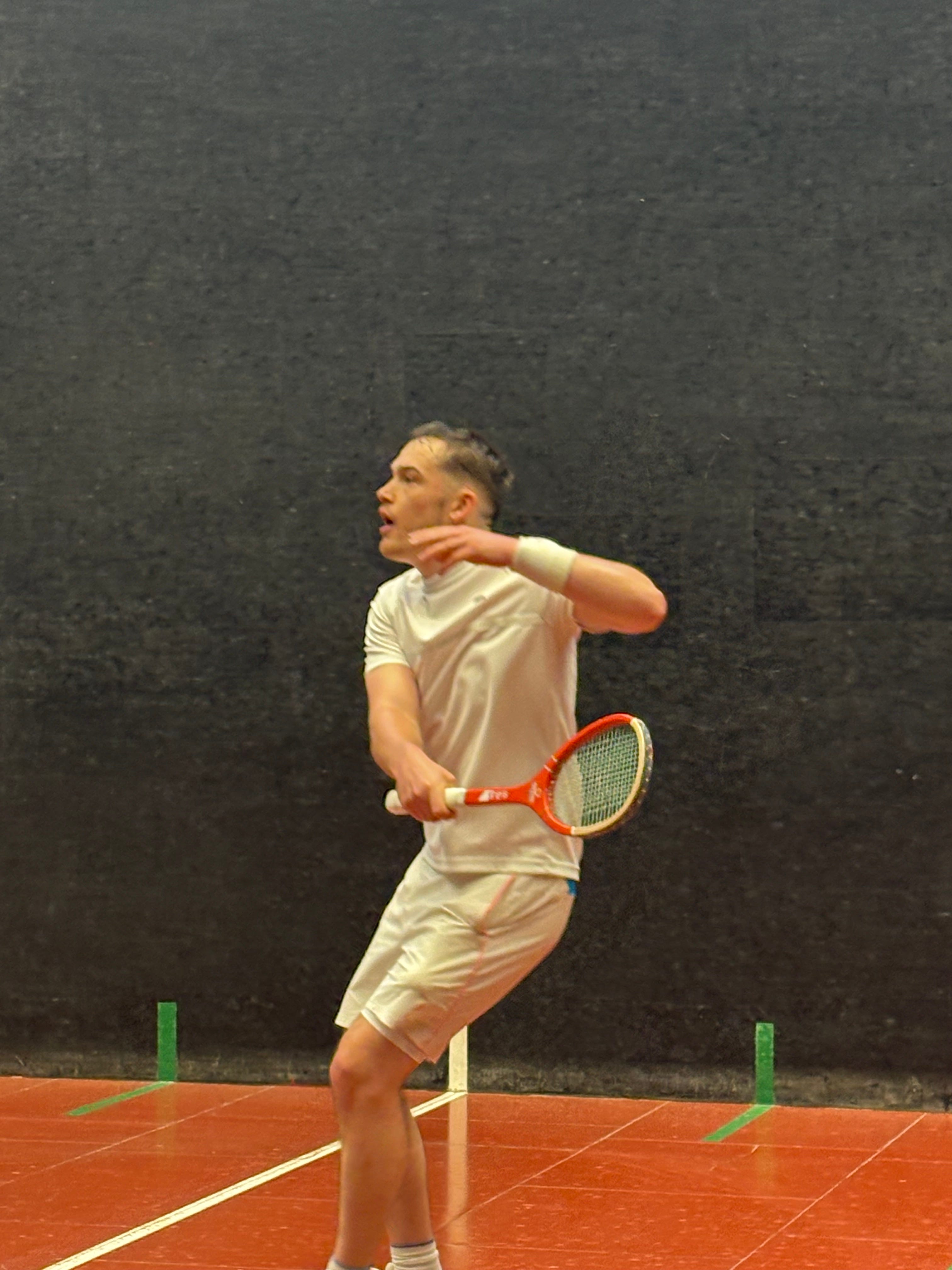
Shenkman never stopped fighting through the third set but could never find a way to fully break away. Gale’s forcing and retrieving meant he was always able to accumulate points. Shenkman could not find a way to generate winners as each time he thought he had struck one, Gale would grunt loudly and run over to slap it back. Gale held a narrow lead throughout the first half of the set, but he couldn’t push on for victory, not helped by the fact he kept missing the dedans wide with his force. As a result, Shenkman was able to keep him in the longer rallies, edging a 5/4 lead himself. Shenkman had a set point but Gale defended it with a flush tambour, then struck two grilles and a dedans of his own to send the set to another deciding game. Shenkman opened with a grille, but got struck by a ball off the dedans edge. He brought up a set point with a ball kicking out of the back nick that Gale had to stretch to fetch. After the shot, Gale clutched at his back, whincing. Shenkman won the set after a change of ends, beating a worse than 3 chase.
Gale took an injury timeout before starting the fourth set. Upon the resumption, Shenkman was directing the play, nudging the balls into the corners and making Gale play fetch. When Gale did hit an inaccuracy, Shenkman was willing to open up and hit for a winner. Shenkman very quickly had a lead in the set, and Gale didn’t fancy having to fight his way back into it. Once he got the serve at 0/4 and 0-30 down, he picked up twelve balls out of the dedans tray and fed them gently into the net, conceding the set with double faults.
The gambit didn’t pay off, at least initially, with Shenkman immediately regaining the serve and going ahead in the fifth set. Gale didn’t pick off another game until the fourth game of the fifth set, having to do it all from the service end as chases were few and far between. Gale’s last remaining tactic was to launch everything at the dedans. He pulled back four games as Shenkman struggled to adapt to the change in tempo. Shenkman went 5/4 up, but after Gale beat a better than 2 chase he let out a primordial scream as the match went to a deciding game. Shenkman went 30-0 up with some long, scrappy restes, but Gale brought it back with a pair of forces. At 30-all, with a chase pending, Gale sent a force onto the dedans bandeau. It ballooned in the air and then struck the ledge of the first gallery. It shot up into the underside of the first gallery penthouse, then hit the bottom ledge a second time. Shenkman was up covering, but could only put the ball into the net. He dropped his head to his knees for several beats before trudging down the other end. Match point up, Gale struck a main wall tambour, letting out another massive scream, tossing his racket to the side in celebration as he had won the match to reach the quarter-final.
Meanwhile, the women’s British Open kicked off on the West court with the qualifying singles matches. The first match was between Alex Brodie from the Queen’s Club and Trudi Machin from Wellington. Brodie had the stronger start, using her high serves and volley drives to beat Machin with pace and take the first game. Slowly but surely, Machin began to take control, attacking both corners and winning back the serving end. Despite Brodie finding results with chaos balls and high pace forcing, she couldn’t convert it into games on the scoreboard. Machin stretched from 2-all to 4/2 before Brodie reset, finding some joy from the service end. She began to back herself in the longer rallies, bringing it to 4-all. Machin then tightened up her game and reduced her error count while Brodie lost confidence in her return of serve, resulting in a 6/4 win for Machin in the first set.
The second set went to plan for Machin, who played her consistent floor game and trusting that Brodie wouldn’t be quite consistent enough to win the important points. Machin’s approach helped her to a 4/1 lead. Brodie decided on a new plan of action, mixing in aggressive targets with tight balls on the floor, fighting back to 4-all. Machin broke back in the ninth game, but Brodie would not let up, continuing to find her targets and sending the set to a deciding game. Machin did not fancy a third set, getting long and short chases early in the game to convert the set, coming out victorious in the tight encounter and moving on to the second qualifying round.
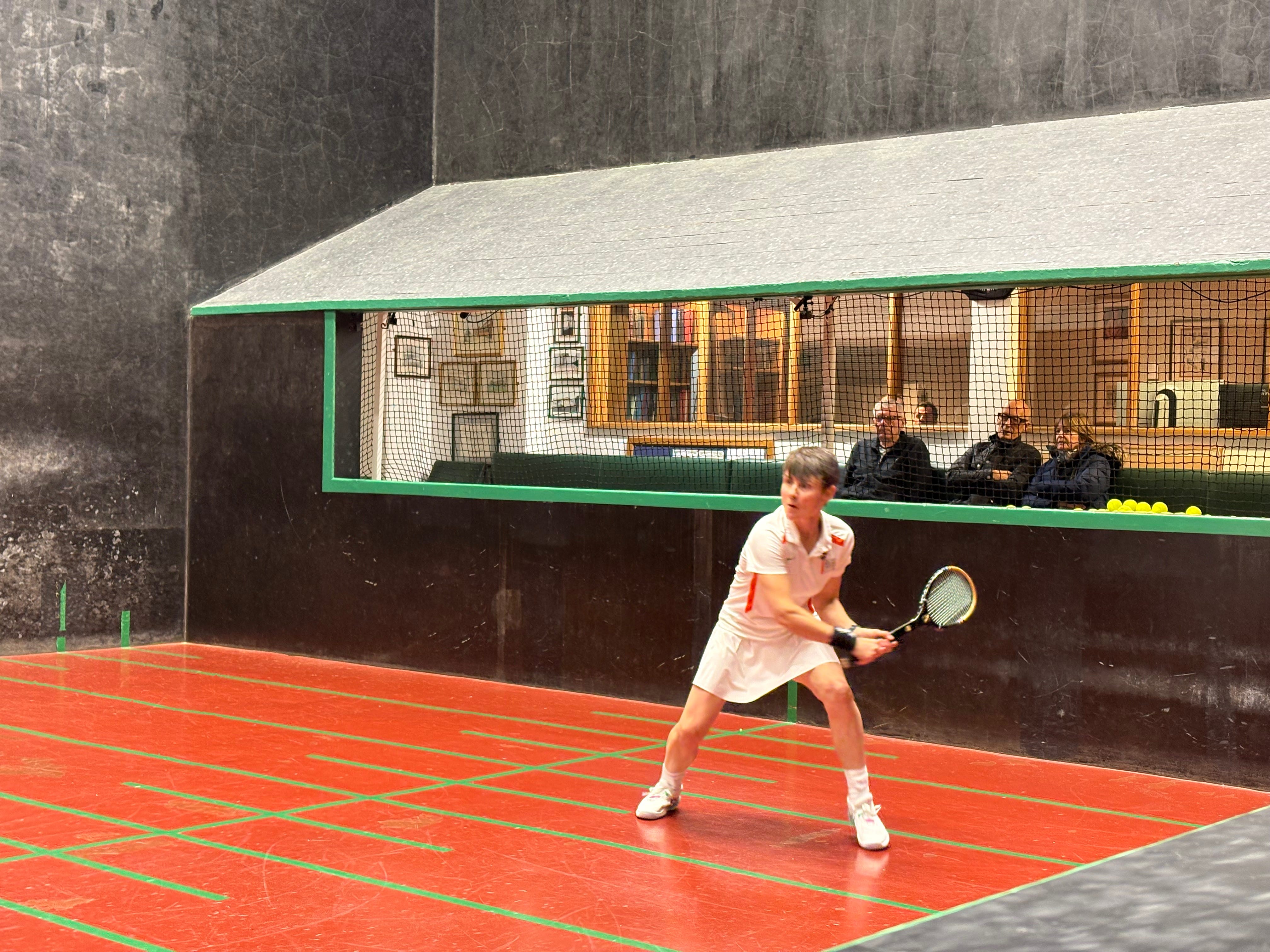
Next, Sabrina Didizian, another Queen’s Club member, played Ulla Petti from Leamington. Petti came out swinging, getting a couple of dedans early to take the first game. However, Didizian was in control on the floor, regularly finding chases to win and control the serve. They traded games to 2-all in some tight exchanges but Didizian began to pull ahead, deceiving Petti in the backhand corner in and around the tambour. Her volleys were consistent and she found the dedans regularly. Didizian won four games in a row to take the first set.
In the second set, the games were tighter as Petti began to find winners of her own around the tambour, but Didizian still went 3/2 up. Petti was not giving up though, finding her cut volley and increasing her deception, battling to a 5/3 lead. Despite Didizian pulling a game back, Petti finished the set confidently, winning the set and taking the match to a decider. She continued her tactics from the second set to get to a 2/0 lead before Didizian flipped a mental switch. She started to get more bite on the returns to ask Petti some questions and was much more clinical in her shots into the grille corner. Didizian raced to a 5/2 lead before starting to get nervous. Petti pulled back a game, saving 2 match points, before finally succumbing in the third set 6/3.
Back on the East court, the second match of the day took place between Westwood pro Ben Taylor-Matthews and Prested pro Vaughan Hamilton. Both players were unsettled in the early stages of the match, with Hamilton extending an early 3/1 lead as Taylor-Matthews threw several cut-volleys into the net. But Taylor-Matthews did not panic. He soon relaxed into his natural game, controlling the rallies with his characteristic nonchalance. He put on four games in a row, with Hamilton bringing back a solitary game but unable to stop Taylor-Matthews taking the first set. Into the second, Taylor-Matthews was in complete control. There was little Hamilton could do to interrupt his run, and as the scoreboard ticked up in Taylor-Matthews’s favour, the errors started pouring in from Hamilton. The second set passed by in barely a quarter of an hour. Continuing in the third set, every stroke Taylor-Matthews made was deliberate and purposeful, picking off quick restes as Hamilton floundered. Hamilton forced his way through to pick up a single further game, but Taylor-Matthews’s place in the quarter-finals was never in doubt.
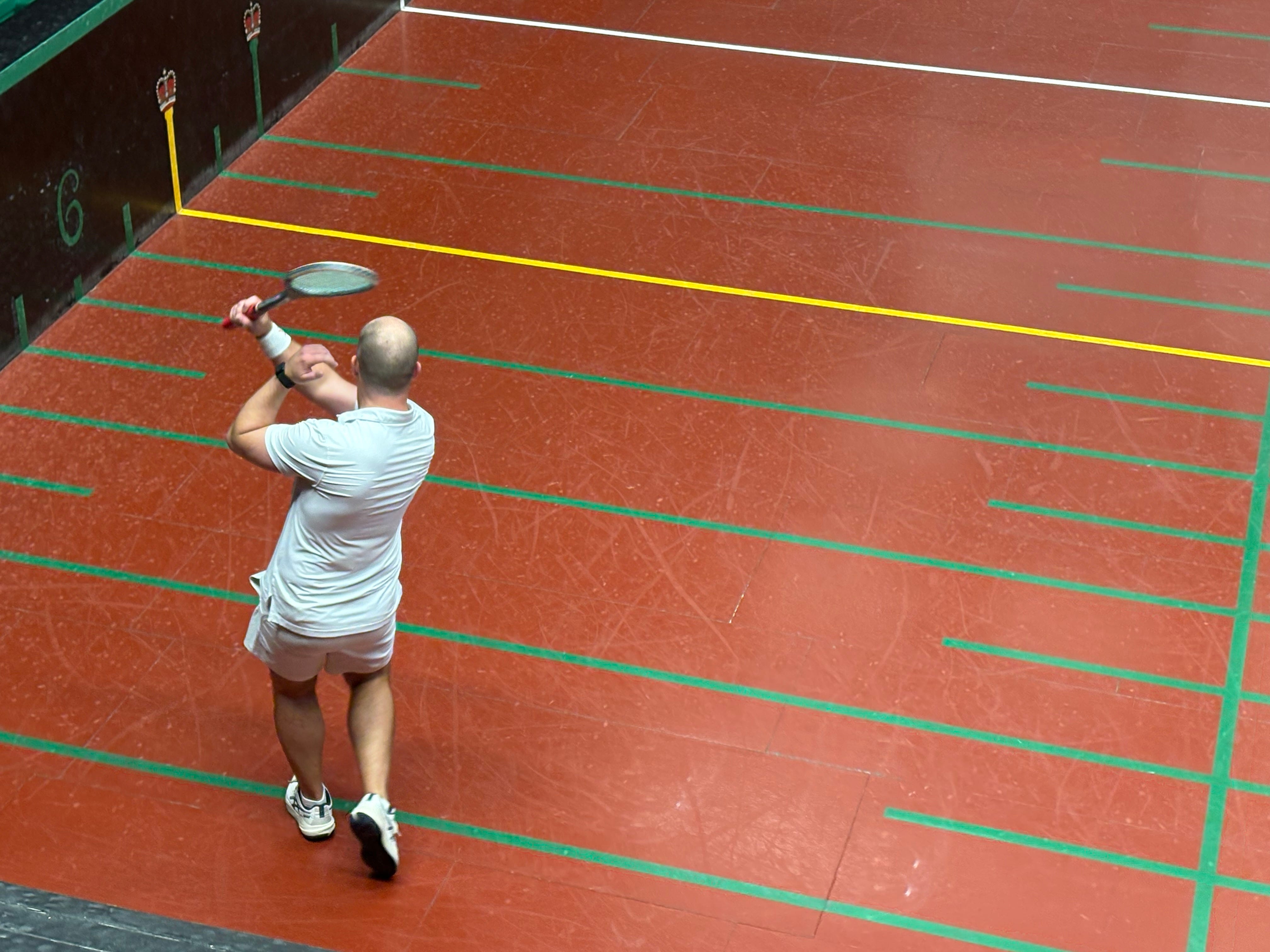
Following on was the match between the sixth seed, former World Champion Robert Fahey, and the amateur qualifier Jamie Giddins. Fahey was fully in control of the play early in the set. He kept the points as quick as he could, with his cut-volley in particular a highlight. Before long, he led by four games. Despite the pedigree of his opponent, Giddins was keen to take the fight to Fahey, as both of them were enjoying the thrill of the battle. Giddins beat Fahey a couple of times with main wall dedans, picking up a couple of games in the middle of the first set, but Fahey had enough buffer to win it without feeling under pressure. Giddins kept fighting hard, never giving up on any balls and constantly asking Fahey to play one more ball. He reached 2-all in the second set before Fahey stepped up a gear. His shots had an increased intensity, sending Giddins diving all over the court to keep the ball alive. Fahey’s only wobble came at 4/2 in the second set: after reaching out for a high volley he stumbled backwards into the back wall and lost his balance, splaying out on the ground in front of the marker. Though the rest of the set wasn’t as clinical as he would have liked, he still managed to win the games required to wrap it up. The third set played out similarly to the second, with Giddins able to battle to 2-all again before Fahey pushed ahead. As the set reached its conclusion, Fahey was getting more clinical with his shots, getting well-tuned up in preparation for the battle still to come. Giddins had to pull off some miraculous shots to stay in the contest, winning the penultimate game. However, it was not enough to push Fahey any further, who locked in his place in yet another quarter-final.
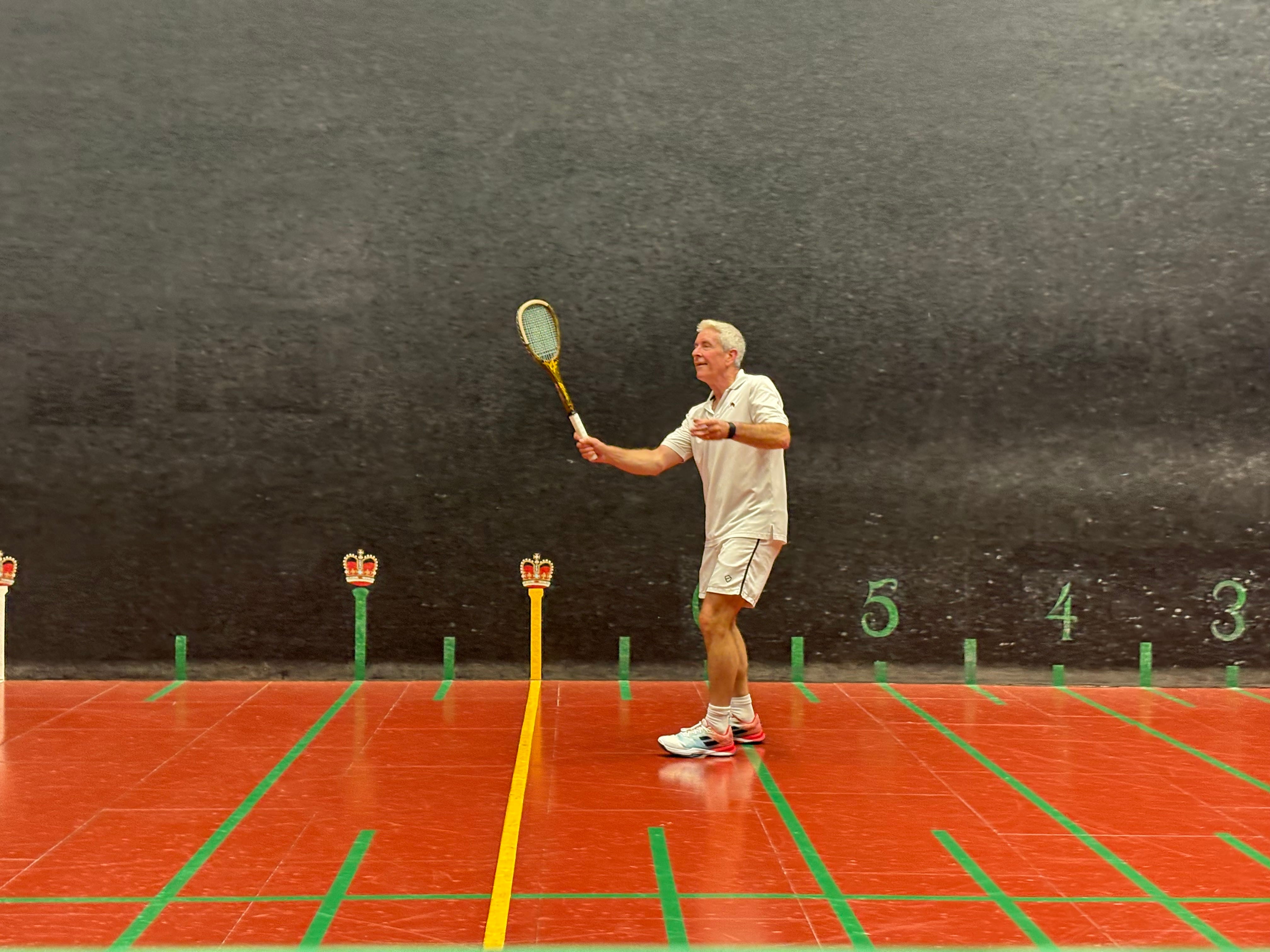
Back on the West court, Machin returned to the court to face Izzy Marshall. Machin had a clear plan to attack the corners and get back the serving end quickly, but she ended up making too many errors. Marshall absorbed the pressure from the serving end, biding her time and lapping up the easier balls and benefiting from Machin’s errors. Marshall finished off the first set very quickly, winning without dropping a game. Machin grew more determined in the second set and pushed Marshall into another tough deuce battle, but this time Marshall was the one who was a bit loose with her length, as Machin took it to 1-all. However, the second set was one-way traffic. The result was never in doubt as Marshall won the second set in a solid performance, progressing through to the main draw.
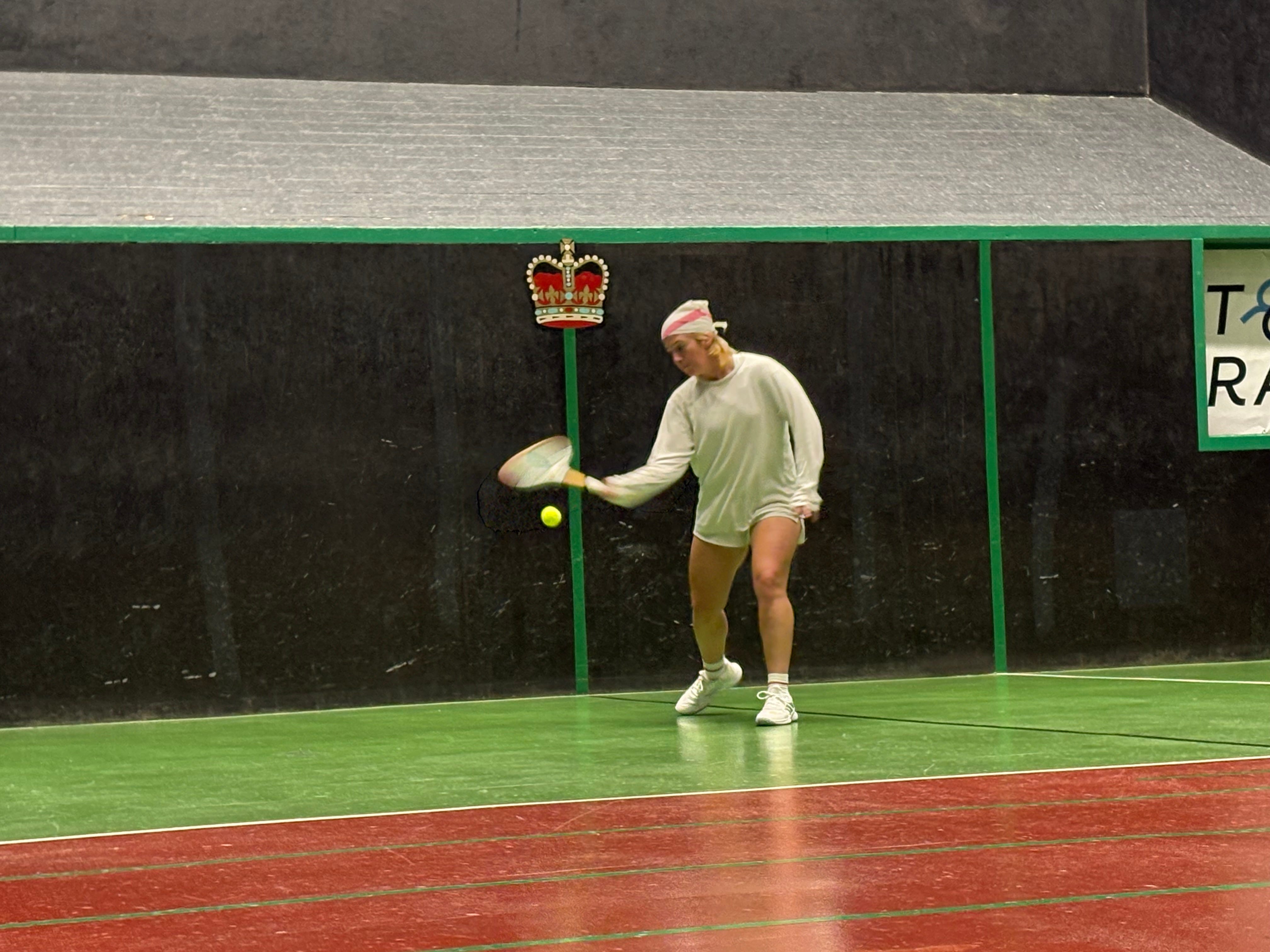
The last of the women’s singles qualifying saw Didizian battle against Araminta Oldham. Oldham attacked the forehand corner, holding the ball as late as she could to create uncertainty. As both players struggled to put the ball away, the opening games became a battle of consistency. With a three-set match already in the legs, Didizian’s footwork was sluggish on the hazard end, but Oldham wasn’t quite able to capitalize. Finishing the point was challenging on a bouncy court with new balls. Didizian stretched ahead from 2-all to 4/2, but lost the next two games to return of serve errors and inconsistent shot quality. Oldham kept feeding the ball to Didizian’s forehand volley, allowing Didizian to dictate the play. She went ahead 5/4, holding three set points. Oldham kept fighting, hitting back-to-back grilles. The crowd were urging a hat trick, but Oldham could only put the next forehand into the net, with the set going to Didizian.
The second set did not go to plan for Oldham. Didizian’s tight drag restricted Oldham’s return of serve, and when she did get into the long rallies, Oldham was finding the penthouse more regularly. Oldham’s backhand was also proving a good target. Didizian took full advantage, with Oldham only able to pick up a single game in the set. Didizian’s win saw her progress to the main draw for the second consecutive year.
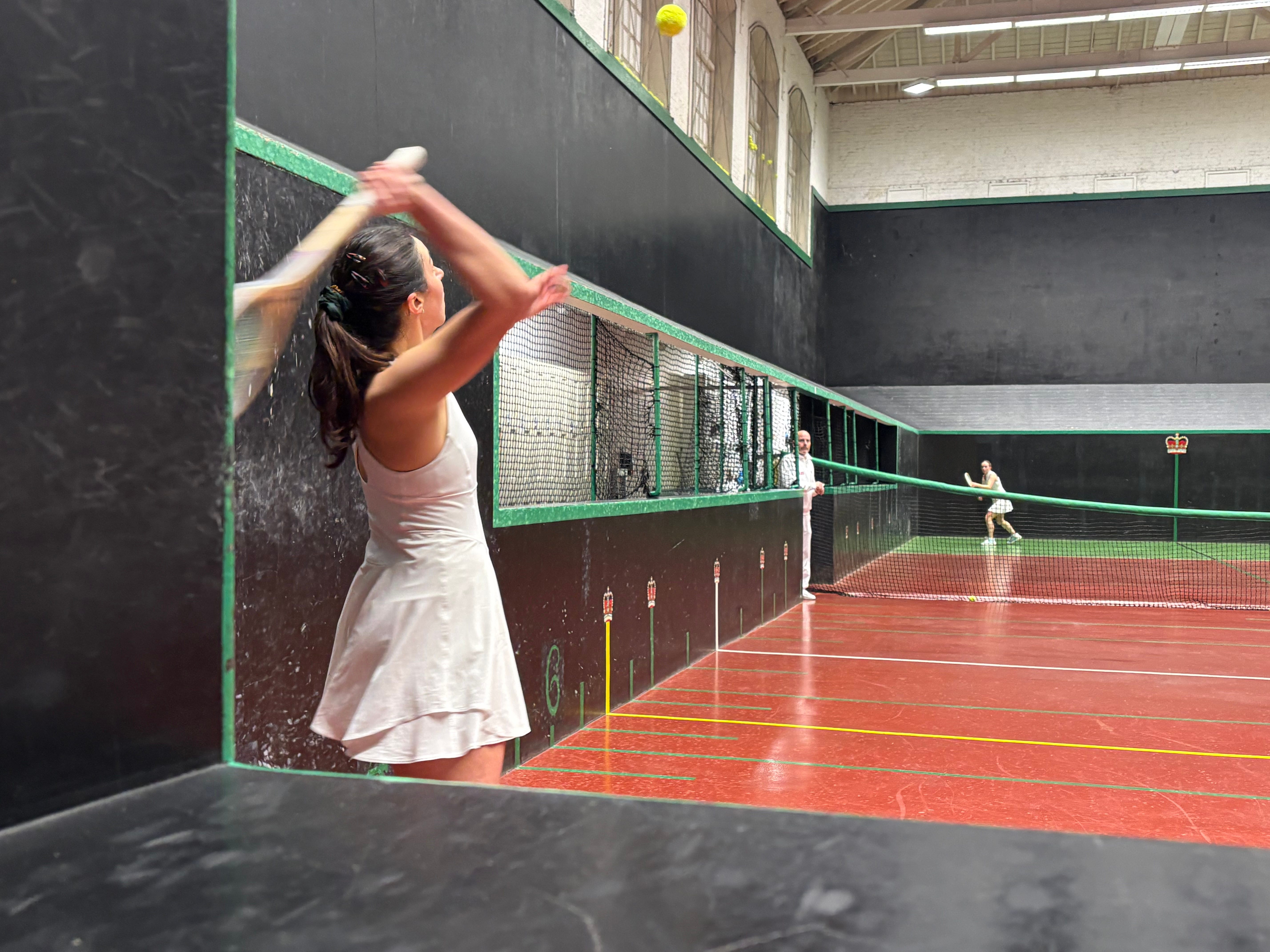
The last match on the East court was an all Queen’s Club affair between professional Bryn Sayers and amateur Bertie Vallat. For the first time in the tournament, both players were keen on serving railroads, though notably Sayers was sending his down as left-handed serves. Sayers opened the match with a winning gallery, something that would become a target over the early stages for the home pro. He took the first two games but Vallat’s solid retrieval saw the next three go to the amateur. Sayers, cool as ice, regained the serve and pressed on. In a long run with few chases, Sayers picked up the last four games he needed to win the set.
In the second set, the play continued to be dictated by the service end player, who had the receiver immediately under pressure. Though Vallat took an early lead, he could not hold it, with Sayers slowly gaining the upper hand from both ends of the court. His serving was exceptional, mostly sticking to his left-handed railroad, but also throwing in a few flush high serves for good measure. Vallat treasured whatever time he did spend on serve, exercising an efficient conversion rate into games. Though Vallat held a narrow one-game lead, he was increasingly animated and expressive as the constant workload of dealing with Sayers’s pressure was taxing. Vallat had a couple of set points in the 5/4 game, but turned down the option of hitting the hazards to defend second gallery. Instead, Sayers extracted an error down the backhand side, sending the set to a deciding game. Sayers set a couple of chases that Vallat couldn’t beat, setting up two set points. Vallat fended one away with a main wall dedans, and then struck a cut volley that Vallat thought was a stroke but was called a worse than one chase, to his dismay. Nonetheless, he defended it as the game went to deuce. Sayers wasn’t going to give Vallat another chance, pressing Vallat around the court until he eventually won the set.
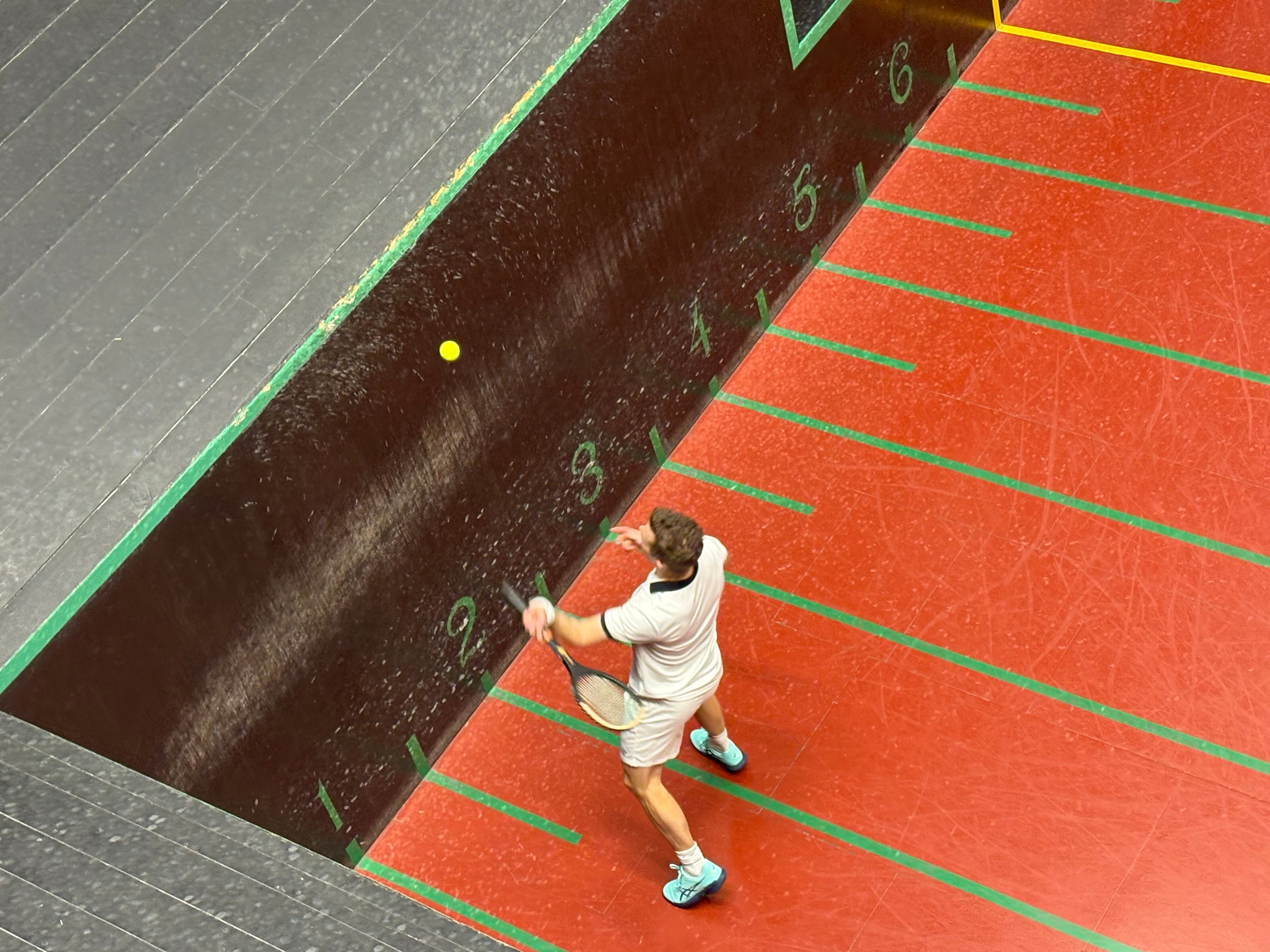
Sayers took the confidence from being two sets to the good and applied it to the third. Every ball was played with a positive intent to try and beat Vallat on the floor, and it paid off more often than not. Sayers immediately took the lead in the set and carried it all the way through. Vallat’s fight never died, but it was not enough to stop Sayers winning the match and moving on to the quarter-finals.
Play continues on Tuesday with the remaining second-round matches. The Women’s main draw singles begins on Wednesday alongside the open doubles.
Match results:
Queen’s East:
12:00 PM: Levi Gale def Robert Shenkman (8) 6/1 6/5 5/6 0/6 6/5
2:00 PM: Ben Taylor-Matthews (4) def Vaughan Hamilton 6/4 6/0 6/1
4:00 PM: Robert Fahey (6) def Jamie Giddins 6/2 6/2 6/3
6:00 PM: Bertie Vallat lost to Bryn Sayers (7) 3/6 5/6 1/6
Queen’s West:
1:00 PM: Alex Brodie lost to Trudi Machin 4/6 5/6
2:30 PM: Sabrina Didizian def Ulla Petti 6/2 4/6 6/3
4:30 PM: Izzy Marshall def Trudi Machin 6/0 6/1
6:00 PM: Araminta Oldham lost to Sabrina Didizian 4/6 1/6
Order of play for Tuesday (all times GMT):
Queen’s East:
12:00 PM: John Woods-Casey vs Lewis Williams (9)
2:00 PM: James Medlow vs John Lumley (2)
4:00 PM: Oliver Pridmore vs Steve Virgona (5)
6:00 PM: Nick Howell (3) vs Henry Henman
Update 17 Nov 2026: An earlier verion of this article stated that Levi Gale reached his first quarter-final as a result of his win over Robert Shenkman. This has been corrected as he also reached the quarter-finals in 2025