


The Seacourt Silver Racquet has continued to thrill the crowds on Hayling Island with five of the six first round matches on Friday running to third sets — three of which finished in a deciding 5-all game — to go with one three-setter from Thursday.
The round of 16 matches resumed with Seacourt amateur Luke Danby playing qualifier and Hatfield professional, James Law. Danby was restricted by an elbow injury, preventing him from fully winding up and slapping the ball around. Further, Danby wasn’t seeing the ball onto the strings as well as he would have liked, muscling the ball over with the frame. Law sensed his opponent’s weakness, launching drive after drive at the dedans trying to force a volley error from Danby. Danby obliged, swinging at everything with a lawn tennis forehand techinque. When it came off, Law was immediately under pressure again, often finding the high part of the net as he tried to caress the ball back down the line. Law let a 3/1 lead slip, then a 5/3 lead, as Danby was able to force the set into a deciding game. Law beat two 2-and-3 chases to begin the game, then struck a one yard chase, which was enough to secure the set.
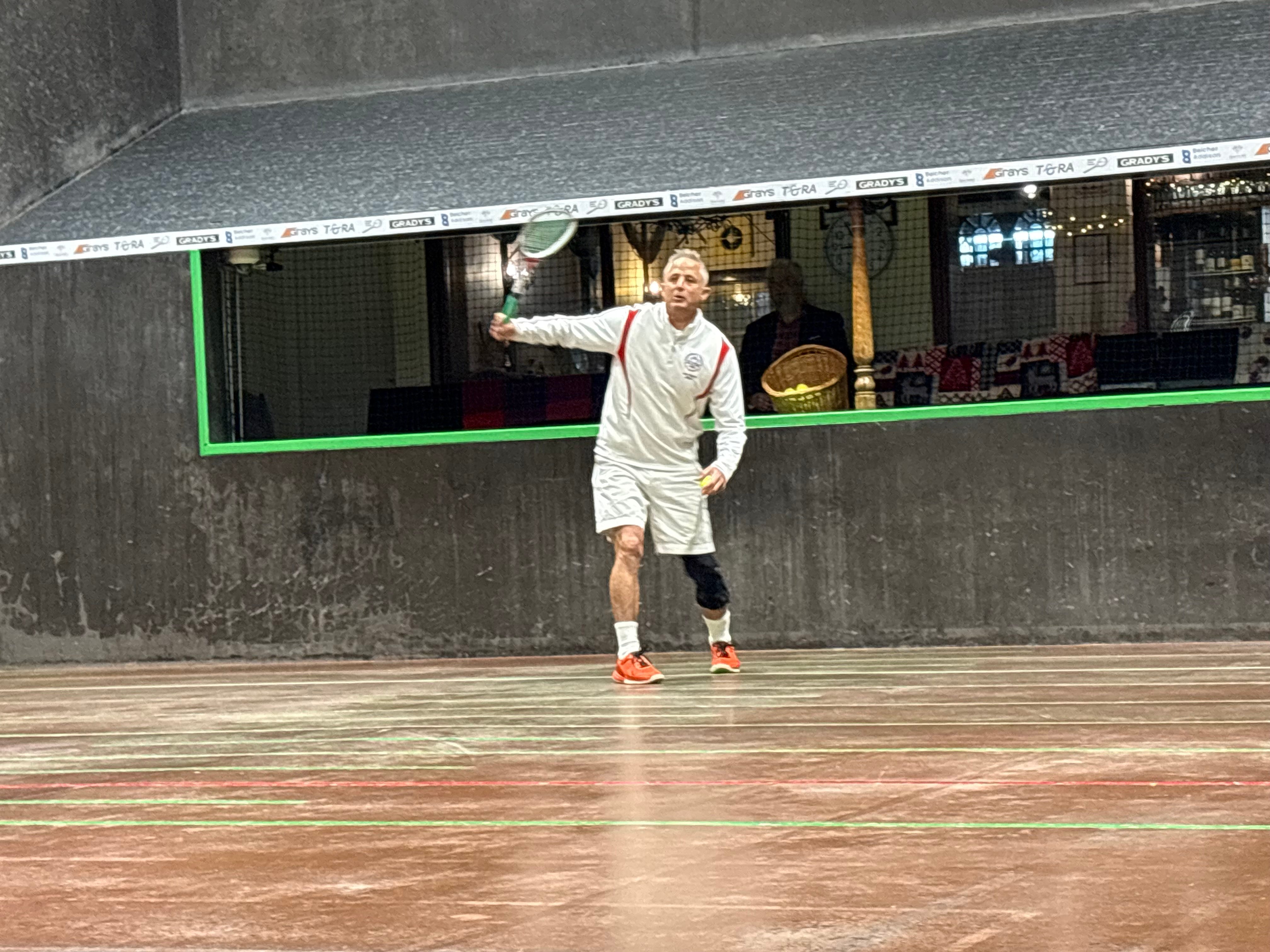
Danby’s level lifted in the second set, seizing the initiative from both ends of the court and sending Law deep into the corners. the Hatfield pro had to dig deep to stay in the set, trailing on the scoreboard throughout but maintaining touching distance. Law brought it to 4-all by just barely slotting a ball into the dedans to beat a 1-and-2 chase. It would be the last game he won, as Danby bossed the rest of the match from the service end. Danby won eight straight games as Law fell away, taking both the second and third sets easily.
The second match of the day saw the Royal Tennis Court professional Jack Josephs play the Oxford professional Nick Jamieson. Both players being early in their career had the retrieval skills to keep the rallies going but lacked a fully developed set of weapons to seize full control of the match. Jamieson took an early lead in the first set as Josephs took some time reach his full flow. Even though Josephs was looking stronger in the back half of the set, Jamieson had enough of a buffer to hold on for the win.
Josephs built a lead from the start of second set as Jamieson missed a few key shots at crucial moments. In particular, he suffered from playing one too many low percentge shots on game point, while Josephs picked up his target-hitting game. Jamieson tried a couple more tactics to disrupt Josephs’s flow but to no avail. Josephs took the set comfortably.
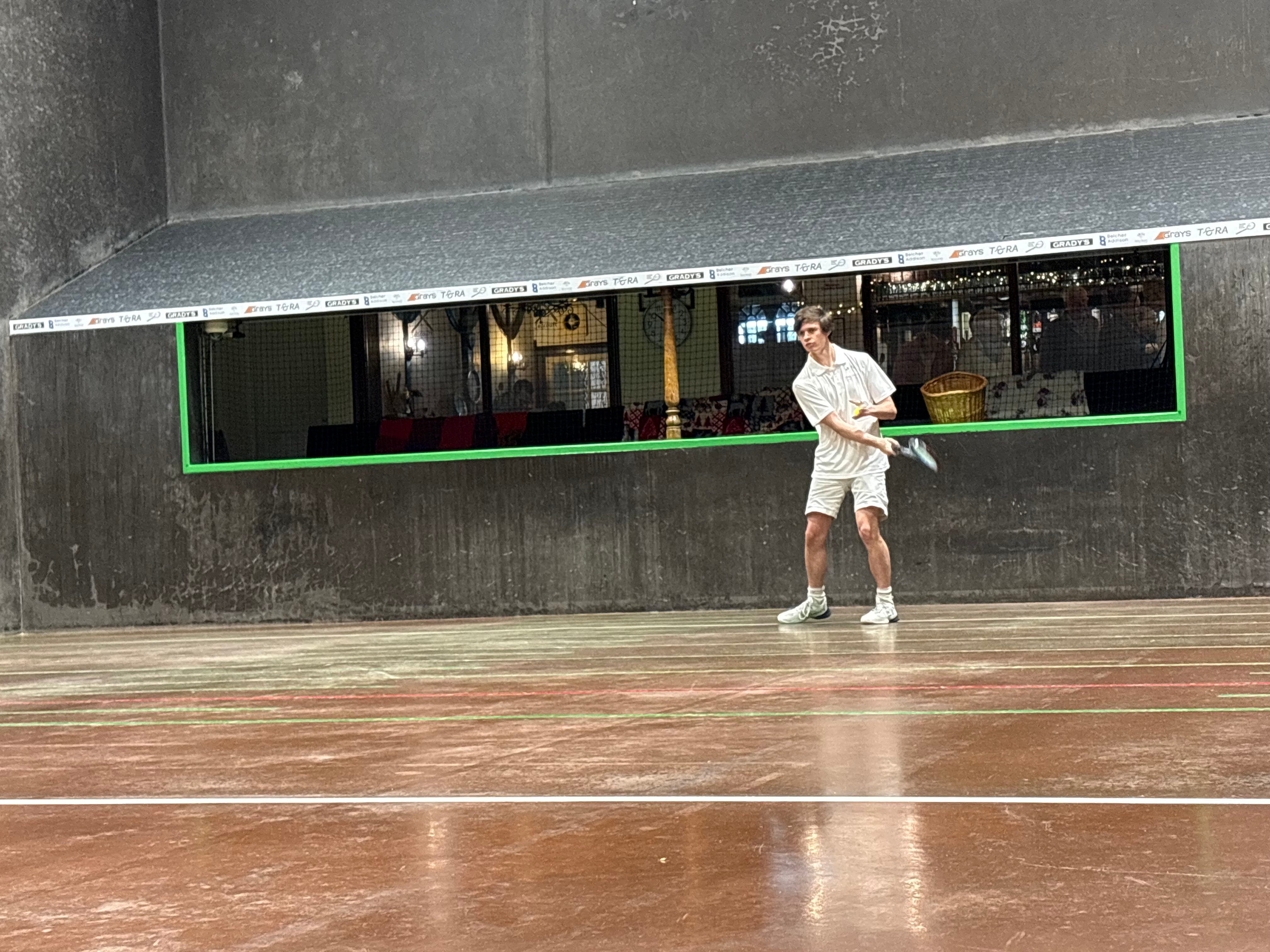
Josephs was cruising at 3/1 up in the third set, benefeting from a lack of intent from Jamieson’s strokeplay. With his back to the wall, Jamieson threw caution to the wind, becoming more willling to push Josephs around the court. Josephs was scooping back balls in response, with the purpose slowly disappearing from his shots. Jamieson strung together three straight games for the first time since the end of the first set to reach 4/3. However, the errors started to creep back in, allowing Josephs to recover to 4-all then 5-all. Josephs, at the service end, kept putting pressure on Jamieson’s backhand retreival, playing behind the tambour. Jamieson was able to fend off most of them, earning three match points. But the shots onto the tambour did Jamieson in, as he had to run around one too many to play off the battery wall. The match went to a deciding point, at which time Jamieson, having spent the whole game playing to Josephs’s forehand, stuck a ball down the backhand for a worse than 2 chase. Josephs hit the ball long on the back wall, with Jamieson raising his arms in the air in celebration.
The next match was between the Prested professional Levi Gale and the local Seacourt amateur Tom Weaver, playing a handicap of Owe 1/2 15-Rec 1/2 15. Gale approached the handicap by slamming the ball around, boasting it off every surface to try and beat Weaver into submission. But the strategy came with enough risk that Weaver was able to launch himself at anything loose, earning enough errors that, combined with the handicap, kept the first set close. Going into the deciding game, Weaver built a small buffer with his forcing, but Gale wasn’t to let it go easily. He battled hard to recover, taking the set to a deciding point. After Weaver put the ball on the back penthouse, Gale forced at the open dedans on the backhand side, but barely missed low. Changing ends, Weaver’s backhand boast drew the error from Gale, winning the set.
The scoreboard failed to show any separation between the two through the second set as well. Gale continued to play all out aggression while Weaver continued to hold on just long enough to keep in touch with Gale. Gale finally broke Weaver’s vigil broke at 3-all as Weaver made a series of untimely errors. Gale then went up 5-3 40-0 before Weaver conceded the set by slapping two balls into the net and calling it a double fault.
Weaver’s gambit paid off as he went on to establish a lead early in the second set. Gale had to graft to keep himself in contention, but the key moment came in the deciding point of the fifth game. Weaver struck a lofted ball into the grille — a rare outcome in the game — and turned to the crowd with a big fist-pump and a loud “'c’mon.” The next three games all went to a deciding point as well, but now the odds were not in Gale’s favour. The mountain had grown too difficult to climb, and Weaver was hitting the ball better and better as he approached the finish line. Weaver won two of the last three games to secure his progression to the quarter-finals.
Into the afternoon session, and Bristol professional Zak Eadle took to the court to play Radleian amateur Benedict Yorston. Eadle wasn’t interested in playing the long, ground out rallies that Yorston was offering, instead offering to smack the ball at the dedans at every opportunity. To his credit, Yorston was mostly successful in preventing Eadle from forcing, either through wilely serving or hitting a good line and length. Yorston edged ahead late in the set, winning 6/4.
Eadle’s radar was more on target at the start of the second set, pushing ahead to a three game lead. But it didn’t last, with Yorston restablishing control soon after and nagging Eadle until his radar lost its lock. Visibly frustrated, Eadle determined the best course of action was to hit it harder. It paid off, as the pace of the ball was causing Yorston to make more errors. Eadle took the last three games of the set to send the match into a third.
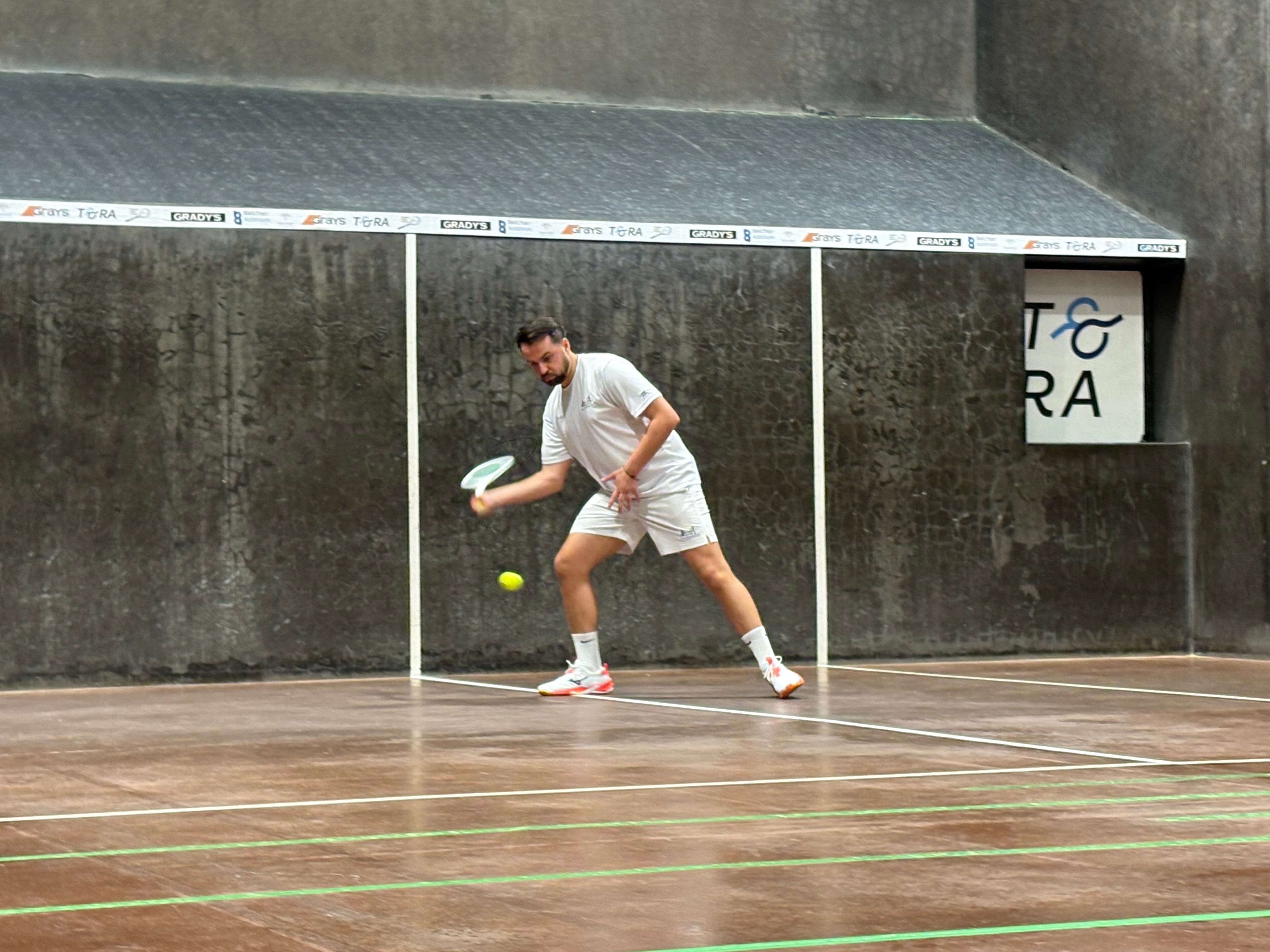
Eadle’s pattern of hot and cold streaks continued into the third, where he struck a cold vein. Yorston maintained his composure throughout, continuing to make Eadle play one more ball than he wanted to. Eadle stayed in the set courtesy of a controversial out-of-court call above the dedans penthouse and out of view of the marker. Eadle stopped play, assuming the ball had gone out, while Yorston played on. The decision was resolved in Eadle’s favourt, helping him win the seventh game to reduce the deficit to 3/4. Further controvesy followed at game point in the following game. Eadle struck a ball at the grille which seemed to strike the bottom lip of the bandeau, then the edge of the grille and out, without touching the backplate. Yorston played on, hitting the ball for a short chase, while Eadle stopped again, appealing to the marker to give him the point. After a long deliberation and hearing the arguments from the players, the marker played a let, with Eadle winning the subsequent point and levelling the match at 4/4, letting out a big celebration. Yorston didn’t let the fact that both calls had gone against him bother him, refocussing on his plan A to win the ninth game. The tenth game went to a game point — indeed a match point to Yorston — and Yorston left Eadle’s railroad for a hazard chase but the serve landed in the stroke area by a half a yard. Eadle took the advantage in the deciding game bu taking a flush back wall shot and boasting it into the winning gallery. He then slotted a ball into the dedans to beat a worse than a yard chase and set up four match points. He took the match on his second with another ball into the dedans, securing his spot in the quarter-finals.
The penultimate match was between Oxford’s Craig Greenhalgh and Prested’s Vaughan Hamilton, with Hamilton oweing a point every game. Hamilton built a 3/1 lead in the first set on the back of his cut-volley troubling Greenhalgh’s forehand. Greenhalgh then struck back with three straight games of his own, using the handicap to his favour and elliciting a series of errors from Hamilton. Hamilton recovered the serve and used it to regain the initiative in the match. Though Greenhalgh had several points to push the set into a decider, Hamilton saved them all and went on to win the first set.
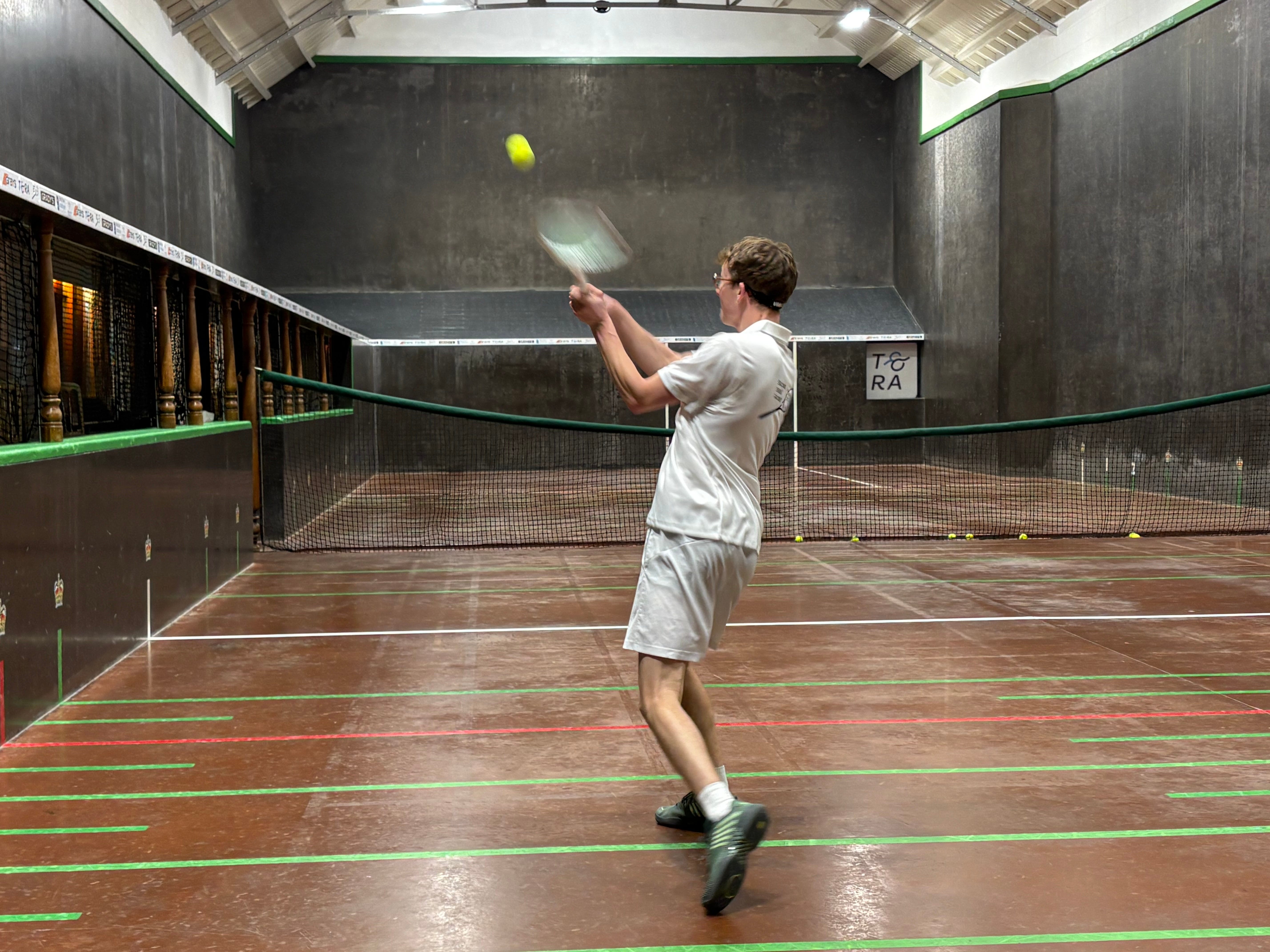
However, Hamilton’s fortunes would change midway through the second set as he began clutching the side of his back, taking an injury timeout in the sixth game due to experiencing spasms. Play carried on but Hamilton was visibly struggling between each point, especially whenever he wound up for a force or a boast — which had been his go-to strategy up to that point. It was uncomfortable viewing, as he clutched his back or contorted himself trying to get relief from the pain. Hamilton was doing everything in his power to wrap up the match as quickly as possible, playing out quick points and big shots even if it meant adding to the strain. Greenhalgh responded by trying to drag out the backhand exchanges as long as possible, knowing that every minute spent on court increased his chances of winning. Greenhalgh went up 5/3 before Hamilton’s pain relief medication started to kick in. It was too late to save the set, as Greenhalgh won the set two games later, sending the match into a third.
Aside from Greenhalgh taking the first two games of the third set, neither player established any sizeable lead. Hamilton maintained the edge in the rallies, but the handicap kept Greenhalgh interested throughout. His movement was now largely unrestricted, chasing the ball all over the court. The final few games were tense, with both players launching at the ball but neither could stamp their authority on the match. A missile into the winning gallery from Greenhalgh took the match into a deciding game. Hamilton found two short chases early in the game, then started slamming balls at the grille, finding the final points needed to take the match.
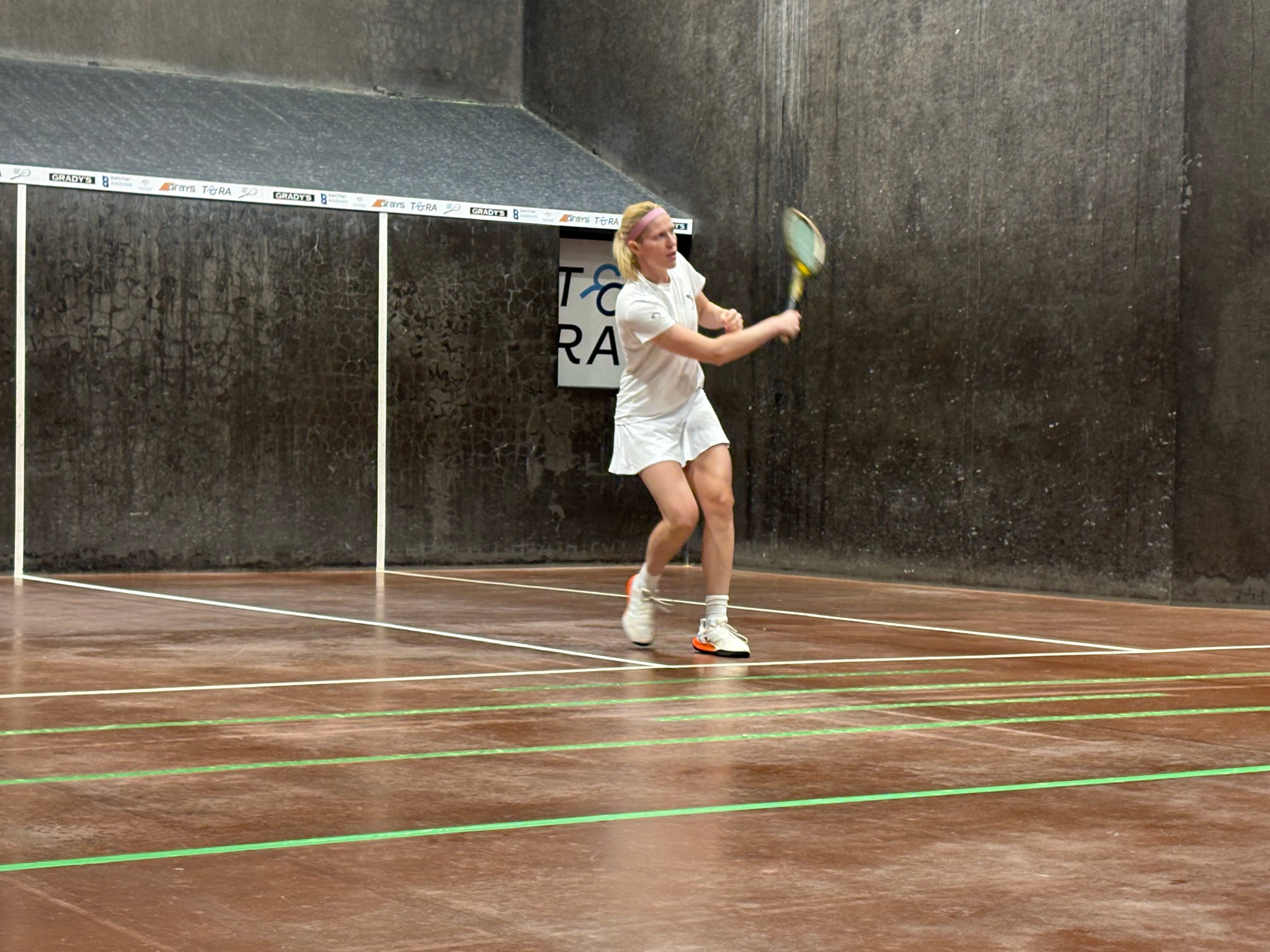
The last match of the first round was between Claire Fahey and Adam Player. Fahey had Player under pressure from the start, mixing up her pace between fizzing cut shots and slammed forces. Player kept the rally going as best he could but never gain the initative, needing the handicap at his back to win games. Fahey had her first set points in the 5/2 game, but was unable to find a decent finish, putting more balls into the net than she her usually high standards would expect. Player had several points to force a 5/4 game, but Fahey made sure to close out the set. Fahey’s second set was much more clinical, cutting out the unforced errors as she cruised to the only straight-sets victory of the day.
Play continues on Saturday with the four quarter-final matches, with the semi-finals and final taking place on Sunday.
Match results:
9:00 AM: Luke Danby (Love) def James Law (Love) 5/6 6/4 6/0
10:30 AM: Jack Josephs (Love) lost to Nick Jamieson (Love) 3/6 6/2 5/6
12:00 PM: Levi Gale (Owe 1/2 15) lost to Tom Weaver (Rec 1/2 15) 5/6 6/3 2/6
1:30 PM: Zak Eadle (Owe 1/4 15) def Benedict Yorston (Love) 4/6 6/4 6/5
3:00 PM: Craig Greenhalgh (Love) lost to Vaughan Hamilton (Owe 15) 4/6 6/4 5/6
4:30 PM: Claire Fahey (Love) def Adam Player (Rec 1/2 15) 6/3 6/1
Order of play for Saturday (all times GMT):
10:00 AM: Luke Danby vs Henry Henman
12:00 PM: Will Flynn vs Nick Jamieson
2:00 PM: Tom Weaver vs Vaughan Hamilton
4:00 PM: Claire Fahey vs Zak Eadle