


Alex Duncliffe-Vines has won his first British Open Singles title, following a two-and-a-half hour, six-game battle against defending champion Richard Owen at the Queen’s Club on Sunday. Meanwhile, Claire Fahey reversed the scoreline from her disappointing 2025 final to beat defending champion Cesca Sweet to take her sixth overall women’s Open.
The women’s final was a rematch from 2025, with first seed and defending champion Cesca Sweet taking on second seed and 2024 World Championship challenger Claire Fahey. The match started a quarter hour late with Fahey arriving late due to traffic issues affecting the roads into the Queen’s Club. Fahey started hand-in, with the opening exchanges being a rather tetchy affair. Unless the serve was an ace, the rally quickly neutralised, with the hand-in player not able to press home an advantage from a weak return. Fahey broke the deadlock with a series of excellent along-the-wall backhands that were more reminiscient of squash. As she settled in, Fahey was more willing to play with power around the angles of the court, beating Sweet for pace. Once Fahey led 7/4, she went on a big hand-in run, moving to take the game in a third of the time as it took her to win the first seven points.
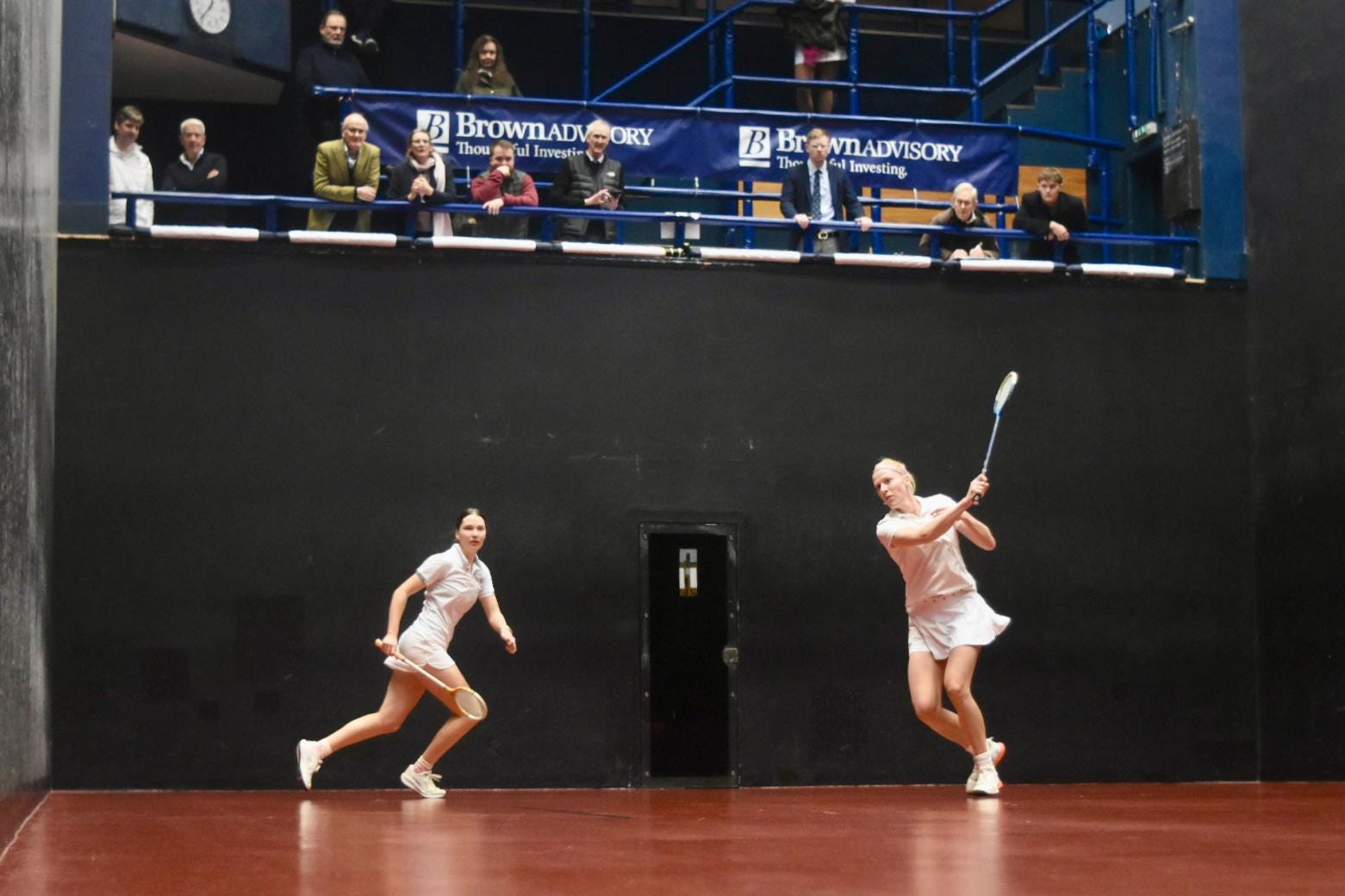
Into the second game, Sweet was struggling to tame her forehand, too often setting Fahey up for an easy finish. More and more, her shots were landing high on the back wall, giving Fahey plenty of choice as to where to send the ball. A nervey moment came at 3/1, where Fahey turned and chased down a particularly wild serve and failed to take a let, while Sweet failed to drop back and was saved only by the fact that Fahey unconventionally played the ball down the middle rather than at the wall. From then on, the tension on court was higher as the crowd watch on with a quiet hum. Sweet needed the help of the glass back door to recover the serve, as she wasn’t able to match Fahey in the rallies. Sweet’s only points came from serving aces, as once Fahey was able to put the ball back into play, she was quickly able to recover the serve.
The point of the match came right at the start of the third game, culminating in a full stretch get from Sweet that barely made the distance to the front wall. Nevertheless, it would be one of the few successes for Sweet in the game, as a confident and controlled Fahey marched through the game, her serving significantly improved on past performances. Sweet only found herself in the box twice in the set, winning a total of two points. Fahey played hand-in for the last 14 points of the game, securing her victory and her sixth British Open title. It marked her first win since 2023 having been the losing finalist on the last two occasions, and puts her clear ahead of Lea Van Der Zwalmen as the most prolific player in the history of the event.
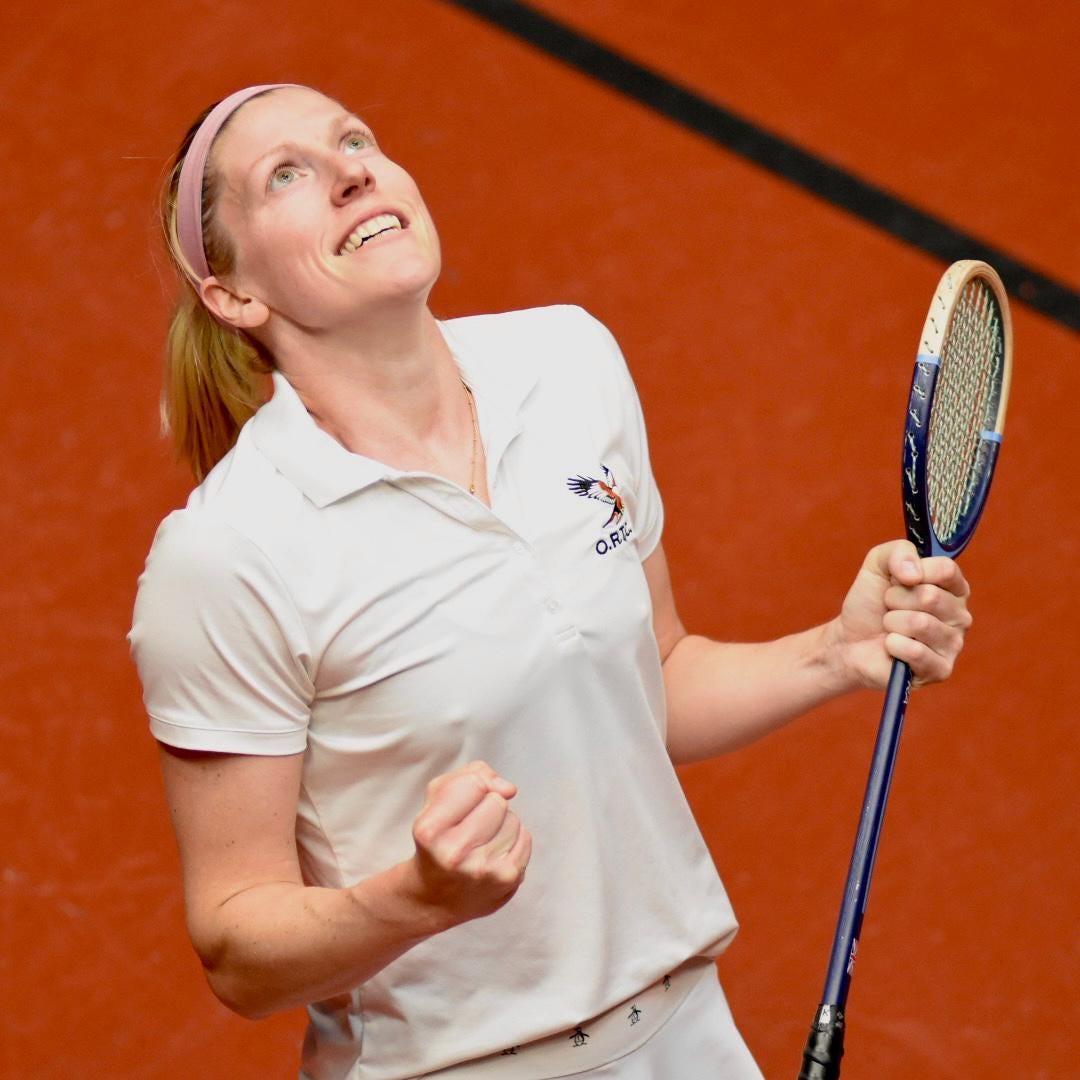
“This feels a lot better than I ever imagined,” said Fahey after her match, “I needed something pretty special against a competitor like Cesca. Thanks for coming up here. I know we’re always going to have a great battle. I hope we’ll have many more.”
After a break, the galleries filled again for the Open final between defending champion Richard Owen and 2018 finalist Alex Duncliffe-Vines. Owen had cruised to the final without dropping a game, while Duncliffe-Vines’s record’s only blemish was dropping the first game against Tarquin Sortir in the quarter-finals. Both players had won through the unsual situation of playing unseeded players in their semi-finals, as the draw had been littered with upset results.
Duncliffe-Vines started hand in, setting off a tense series of exchanges at the players battled over the center line of the court, sending the ball up and down the middle. Duncliffe-Vines got the best run of the first game in early, earning a 6/1 lead as Owen took a while for his shot execution to settle. The defending champion had to grind hard in an attempt to claw back into the game, winning just one point from the left box but still able to have Duncliffe-Vines straight out each time as he battled back to 7-all. With both players now properly in their strides, any slight mistake was being punished with a near un-returnable winner. The left box was still proving problematic for both players, unable to carry a run as they edged forward point by point. Duncliffe-Vines had game point at 14/12 and again at 14-all but couldn’t convert either, opting to take a set to 3. Owen finally broke the left box curse to win all three points without losing the hand, finishing the game with a rocket of a serve that had Duncliffe-Vines defending off his body.
Neither player was able to establish control of the match in the start of the second game, locking horns as they both backed in behind their power game. Even so, the best shots were the soft ones, taking the pace completely off to play a well-crafted drop shot. The players exchanged points evenly through to 8-all, before Duncliffe-Vines finally broke through. Duncliffe-vines was hitting his serve harder and harder, putting more onto the defensive instead of allowing him to play in to the rally. He finished the game with an eight point run, levelling up the match at 1-all.
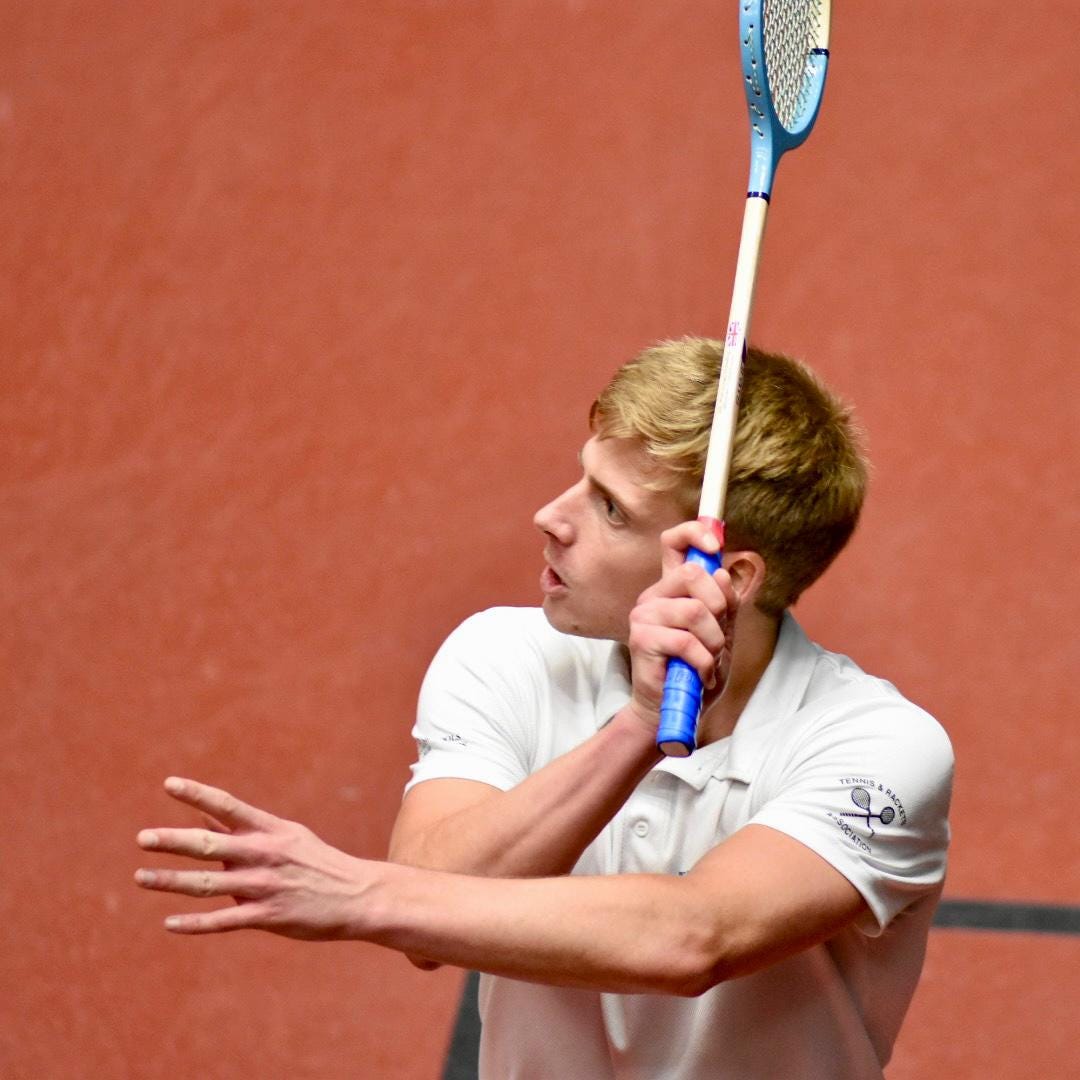
Going into the third set, Owen was increasingly frustrated with the referee’s not-up calls. Although initially it looked as though it threatened to wreck Owen’s concentration, he was able to channel it into productive rackets play. He put in the longest run of the match so far to go up 9/3. He had Duncliffe-Vines on a string, maneouvering him around the court at will. Duncliffe-Vines slowed Owen’s progress briefly, recovering from 5/14 to 10/14 but the deficit would still prove too much for Duncliffe-Vines. He lost the third game ball attempting a behind-the-back shot, before promptly snapping his racket cleanly over his knee before storming for the door.
Now onto his fourth racket having snapped two strings earlier in the match, Duncliffe-Vines took to the court for the fourth set with a renewed determination to take the game to Owen. He built a 5/0 lead across four hands. It took Owen switching to serve from the left box to break onto the scoreboard. Another broken string at 6/1 meant Duncfliffe-Vines was now onto loaned rackets. The new bat seemed to work wonders, as he ran through the remainder of the game without being put out. Owen conceded defeat, playing a fault on game ball into the floor to quickly move on to the fifth game.
Owen went searching for counterplay to begin the fifth game, cycling through tactics to find something to break Duncliffe-Vines’s control of the play. But Owen was also finding it harder to control his own shots, barely holding on to the game as Duncliffe-Vines tried to keep his own emotions in check. Duncliffe-Vines was marching between points as quick as possible, sensing blood as Owen’s movement around the court was increasingly rigid and hampered. Duncliffe-Vines once again took a seemingly close 9/6 game and turned it into a convincing 15/6 scoreline with an unstoppable run to close the game.
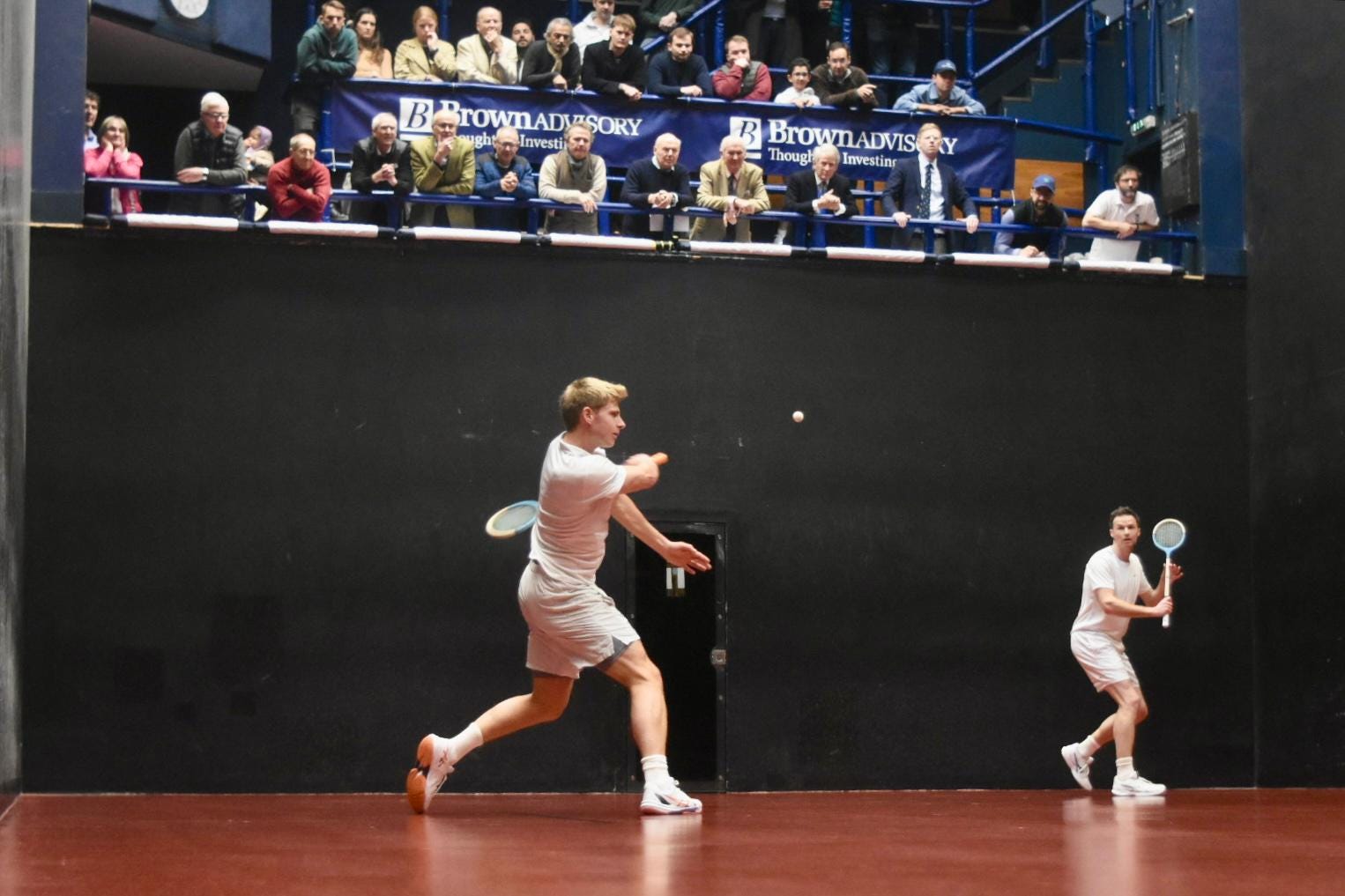
Owen took a 10-minute injury timeout between the fifth and sixth games. Upon the return, it took just one ball before Duncliffe-Vines was onto his sixth racket. Duncliffe-Vines was keen to exploit any deficiencies in Owen’s movement by dragging him around the court — and forward in the court — as much as possible. Again, the early phase of the game was fairly even on the scoreboard but that was as much due to Duncliffe-Vines’s bad luck rather than Owen getting on top. Duncliffe-Vine dug in, and, by the end of the game, the points were going his way again with Owen unable to find a good finish. Duncliffe-Vine won the game with ace from the left box that rolled out of the back nick, securing his first British Open singles victory.
The attention of the rackets world will next move to Chicago for the US Open, scheduled to take place in late February.
Match results:
12:00 PM: Cesca Sweet (1) lost to Claire Fahey (2) 4/15 6/15 2/15
2:30 PM: Richard Owen (1) lost to Alex Duncliffe-Vines (3) 17/14 8/15 15/10 1/15 6/15 8/15