


Pete Dickinson has defeated Zak Eadle, recovering from a seemingly lost position in the middle of the second set as the US Open qualifying got underway at the Racquet Club of Chicago on Monday. Meanwhile, John Woods-Casey survived a first-set scare from Ned Batstone, with Henry Henman the only player to come through the day without dropping a set.
The tournament got off to a shaky start, as the first match was awarded as a walkover to Wellington’s Adam Player by Tuxedo’s Max Trueman. Trueman was delayed arriving into Chicago, as a storm system hit the Northeast, grounding flights out of New York.
The first match to actually be played was between Henry Henman and Tony Hollins, with Henman making his US Open qualifying debut. Henman barely missed a ball through the first set, soaking up ball after ball that Hollins was throwing at him. However, it was still Hollins who held the initiative, sneaking the odd target in and cashing in on the few shots that Henman missed. As Henman grew more comfortable in the match, he was more willing to throw in a few more expansive shots. The balance of the match turned, with the increased pace of Henman’s shots taking time away from Hollins. After the two had battled to 4-all in the first set, Henman laid down eight of the next nine games. He ultimately secured a comfortable match win, moving on to the second qualifying round to be played later in the day.
The second qualifying bracket started with the match between Pete Dickinson and Zak Eadle. Eadle opted for stand-and-deliver tactics, launching balls at the targets or cutting heavily into the corners. At first, Dickinson tried to match Eadle for pace, but Eadle was easily winning the battle. In a flash, Eadle was 5/1 up with set point. But Dickinson changed tack, absorbing the play and focusing instead on putting every ball back into play and waiting for Eadle to overreach. Eadle did win the set 6/3, but Dickinson had now found a successful formula for winning points.
Dickinson continued his nagging play into the second set. Though Eadle’s target hitting did see him build a 4/1 lead, he could not sustain his accuracy, sending balls onto the high back wall while Dickinson kept troubling him around the tambour. Eadle couldn’t find the last two games he needed as Dickinson kept clawing his way back into contention. By the end of the set, Eadle’s forces kept finding the net as he tried to blast his way out of the hole he was in. Dickinson remained calm, claiming six straight games to win the second set and take an early lead in the deciding third set.
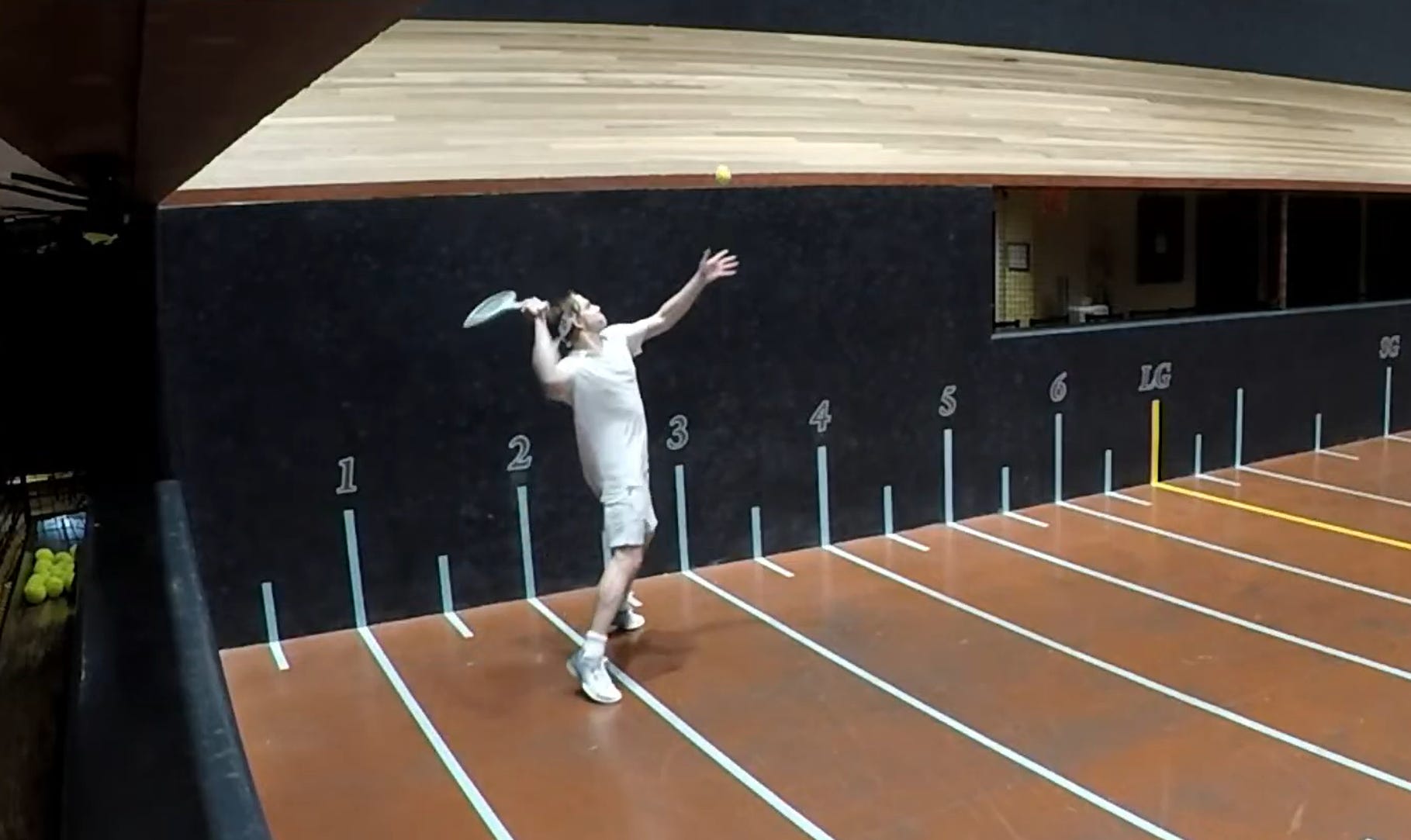
By then, Dickinson’s confidence was growing, becoming more willing to throw in a few more expansive shots to his play. As a result, Eadle became pinned down at the service end, trying just to keep the ball in play and unable to direct the ball into the more difficult areas of the court. However, the approach brought with it risks, causing enough errors to keep Eadle interested in the set. From 2/5 down, Eadle brought back a couple of games as Dickinson went searching in his final push for the finish line. He missed a chance to send the set to a deciding game, instead ceding the match as Dickinson won a long deuce exchange in the 5/4 game. Dickinson’s win sent him into the second qualifying round to play Tim Chisholm the following day.
The last of the first round matches was between Royal Tennis Court’s Jack Josephs and Petworth’s Tom Durack, with the former making his first appearance in US Open qualifying. The play was tactical, with Durack trying to manoeuvre Josephs around the court and tuck him up against the side walls. Josephs’s response was to keep the ball in play as long as he could, even if he wasn’t reaching for winners himself. Josephs took an early 3/1 lead, But Durack was always threatening, controlling the play as Josephs could never really give him a difficult ball to have to deal with. Durack controlled eight of the next nine games to take the first set and a 3/0 lead in the second.
Quickly running out of road, Josephs needed to shake up the play. It didn’t need much, as Josephs started throwing in the occasional attacking shot that would draw a weak defense from Durack. From then on in the rally, he had the advantage, able to press on to win the point. It helped that Durack’s play became more desperate in response, trying to force a conclusion to points when the ball was not there. Josephs won five straight games to take a decisive lead in the second set, sending the match into a decider. Durack tightened up his game, refusing to let Josephs take control. The RTC pro’s lack of incisive weapons cost him dearly, as Durack was able to out-rally his opponent. Durack wrapped up the final set easily, moving on to the second round of qualifying to face Vaughan Hamilton.
The second round then kicked off with two matches in the first qualifying pathway to be played on Monday, with the two matches in the second qualifying pathway to wait until Tuesday. John Woods-Casey played Ned Batstone in the first match: Woods-Casey entered as the first seed in qualifying while Batstone received a bye through the first round owing to the reshuffle caused by fourth-seed Barney Tanfield’s withdrawal pre-tournament. Woods-Casey opened up with a series of expansive shots seeking to put pressure on Batstone early, but became undone by a series of racket errors, striking the frame of his racket seemingly as often as the middle of his strings. Batstone remained calm and positive, putting just enough pressure on Woods-Casey’s play to continue to draw errors but not enough to risk throwing points away himself. He took the first set, having led for its majority.
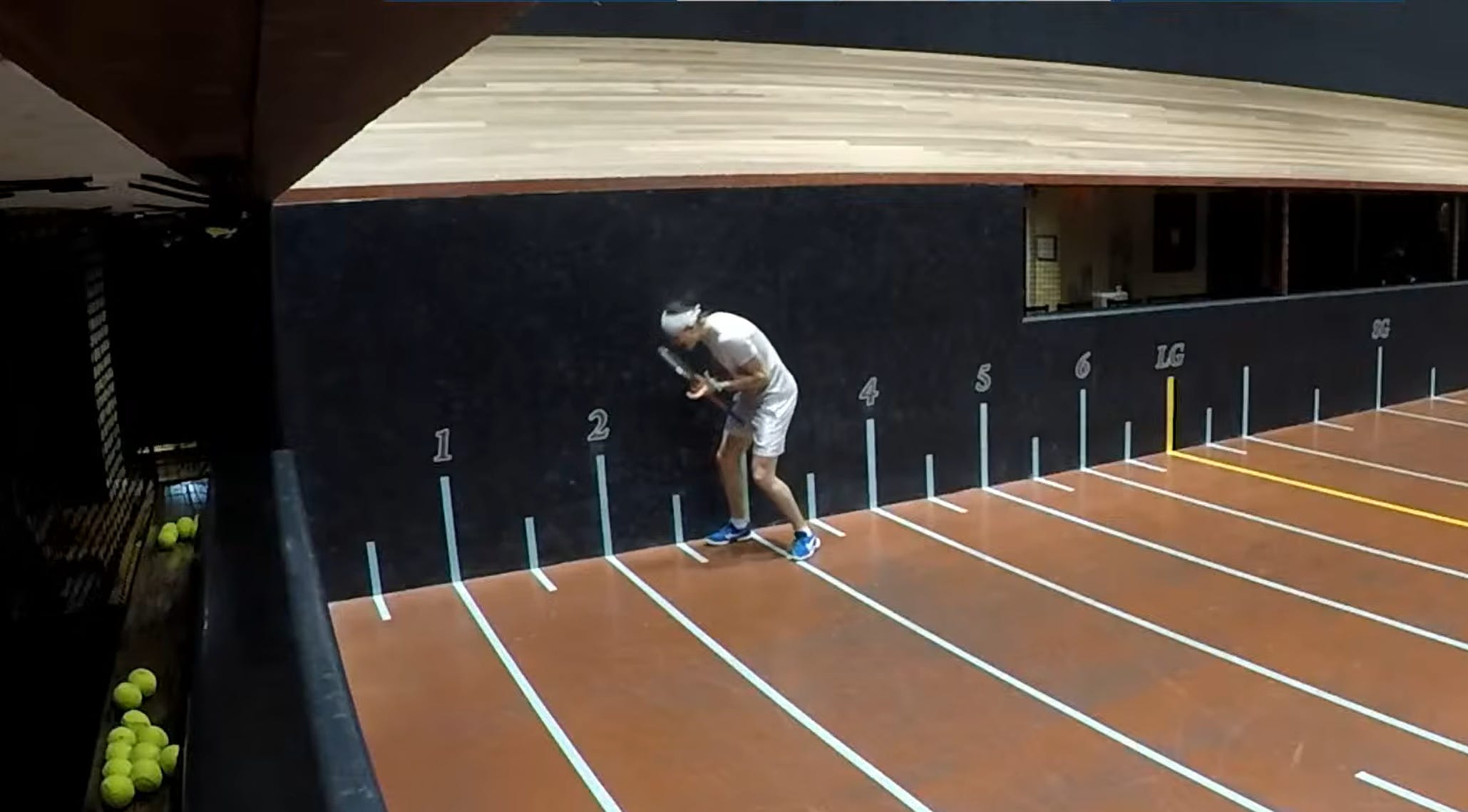
Woods-Casey tightened up his game for the second set, focusing on hitting the ball cleanly and with control. For Batstone, consistency alone was no longer enough to win games, having to take increasing risks in order to stay in touch with the surging Woods-Casey. He reduced the deficit from three games back to one, but Woods-Casey held firm to take the set. Into the third, Woods-Casey’s high serve was proving particularly effective, drawing Batstone into a loopy volley and giving the Australian an easy follow-up ball. Woods-Casey was clinical on the follow-up shots, building the point gradually and making it harder and harder for Batstone on each stroke before he cracked. Batstone’s only remaining counterplay came from the service end, but his strings there were proving increasingly short as Woods-Casey marched to a three set victory.
Woods-Casey’s final round opponent would be either Adam Player or Henry Henman, who took to the court for the last match of the day. Henman’s control of the ball was key, able to mix up the placement, pace and spin with ease, picking off targets and ripping the ball into the corners. Player’s best response came with his target hitting, but even so he was not given much to work with. He picked up a brace of games towards the end of the first set as Henman slipped into a brief fallow patch, but the neo-pro quickly recovered. Henman won his second match of the day in straight sets, locking in his spot in the final qualifying round.
Play continues on Tuesday with the remaining second round singles qualifying matches plus both third round singles qualifying matches, followed by the only doubles qualifying match of the draw. The main draw singles matches will begin on Wednesday.
Match results:
11:15 AM: Max Trueman (6) lost to Adam Player w/o
12:30 PM: Henry Henman def Tony Hollins (5) 6/4 6/1
1:45 PM: Pete Dickinson def Zak Eadle 3/6 6/4 6/4
3:00 PM: Jack Josephs lost to Tom Durack 4/6 6/4 1/6
4:15 PM: John Woods-Casey (1) def Ned Batstone 4/6 6/4 6/2
5:30 PM: Adam Player lost to Henry Henman 3/6 3/6
Order of play for Tuesday (all times CDT):
10:00 AM: Tim Chisholm (3) vs Pete Dickinson
11:15 AM: Vaughan Hamilton (2) vs Tom Durack
12:30 PM: John Woods-Casey (1) vs Henry Henman
2:00 PM: Tim Chisholm (3) vs Vaughan Hamilton (2)
5:00 PM: Jack Josephs & Zak Eadle vs Tom Durack & Adam Player