


The British Open main draw kicked off with its annual Super Sunday showcase, with eight matches across both courts at the Queen’s Club. The young superstars were ascendant, with the likes of Henry Henman, Oliver Pridmore, James Medlow, Bertie Vallat and Vaughan Hamilton securing their places in the second round, with Levi Gale beating out Max Trueman in five sets.
The main draw of the British Open began on the East court with a match-up between Prested’s Levi Gale and Tuxedo’s Max Trueman. Both players were keen to set the tone early, attacking the ball and blasting the ball at the main wall. With both players going all out, it was only a matter of time before one of them made an error. Gale had a slight weakness on his backhand volley which Trueman tried to target but Gale was quick enough on his feet to turn it onto his forehand. Gale was getting good cut out of the court, as well as a good line on his cut-volley. From 2/1 in the first set, he quickly pushed ahead to win the set 6/1, winning set point by beating a worse than a yard chase with a straight dedans.
Into the second set, and a roof leak was starting to drip onto the service penthouse, causing a wet spot to grow. It didn’t bother the players, especially Gale. He was able to scramble everything back, leading Trueman to overextend his attack, resulting in errors. Before long, Gale had a 5/1 lead and the match looked like it would be completed in good time. He had a set point at 5/2, and a juicy ball off the back penthouse to target the grille. But Trueman put in his best defence of the match to save it. A few games later, Trueman set up more set points with a double fault around the back penthouse, but he managed to defend all three to send the set to a deciding game. Trueman finally got one of his high serves to stick right to go 40-30 up, winning a come-from-behind set and evening up the match.
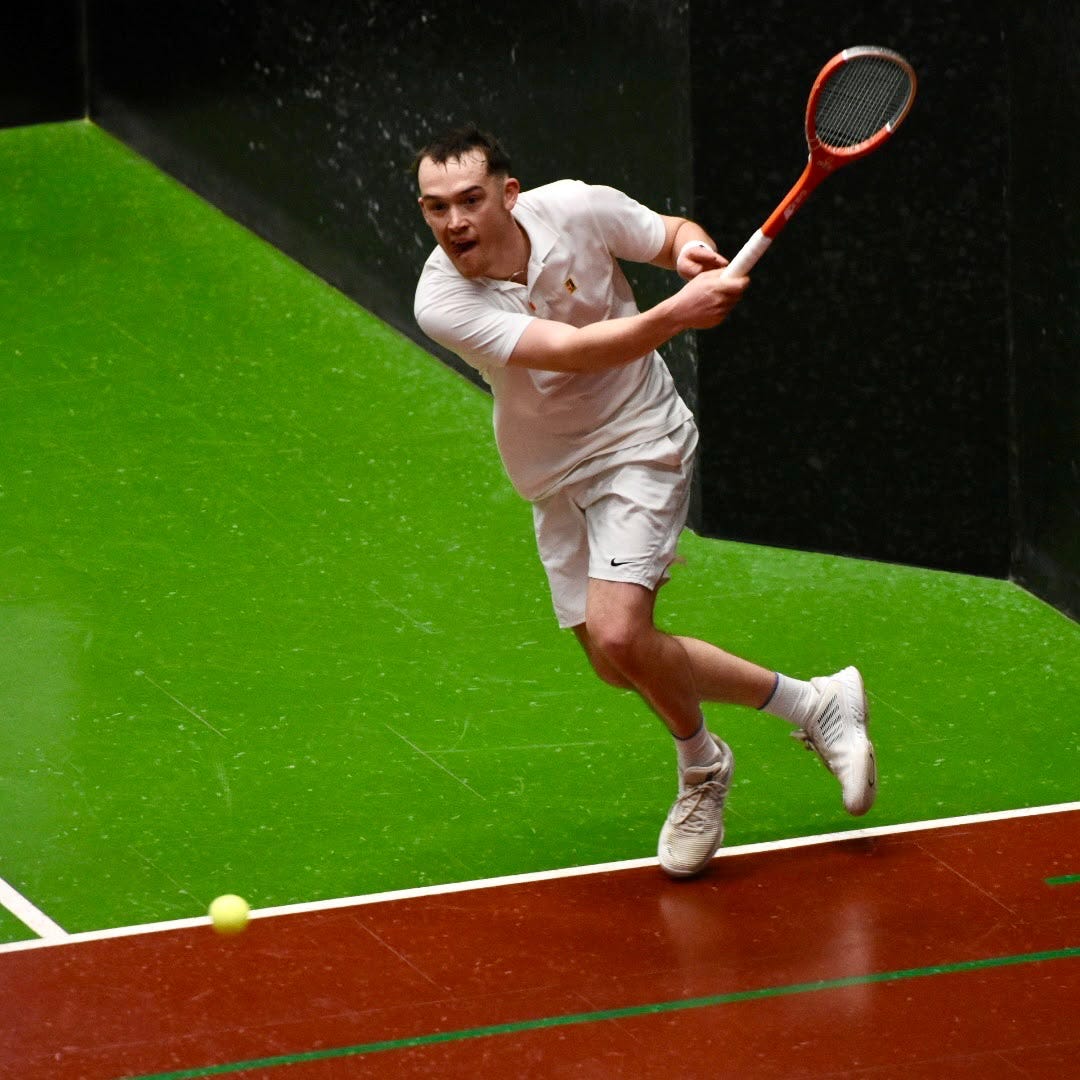
Gale was shellshocked by the loss of the second set, as Trueman quickly established control of the third, extending out a 3/1 lead. Gale could no longer just sit in and wait for the errors, having to play more attacking shots to try and break Trueman’s spirit. Trueman persisted with his high serve for the bulk of the set, and indeed the rest of the match, but never truly got it to stick tight again. Gale battled back four games in a row to go 5/3 ahead. He again had set points, the first foiled by a ball that stayed low off a length for a better than 5 chase, which Trueman defended. On the next set point he ended a long rally with a better-than-a-yard chase, but put his serve on the back penthouse for Trueman to smash into the dedans. He had further set points in the 5/4 game but couldn’t convert them either, with the set going to a deciding game again. Trueman took the advantage, first with a winning gallery and then with a ball that rattled around the sides of the grille. He then set up his own set point with a ball off the bandeau which he boasted into Gale’s forehand, the latter kicking his racket in disgust. Upon a change of ends, Trueman took the set and the lead with a cut-volley winner.
In the fourth set, Trueman kept trying to float his high serve in to trouble Gale, but was having more joy with his second-serve bobble. He had points for a 3/0 lead, but Gale battled back to win the game instead. The following game, he also had points for a 3/1 lead, but then Gale picked up six points in a row to even the score at 2-all. The rest of the set proceeded in a similar way, with Trueman getting ahead in the games but Gale battling back instead. The two were inseparable as the scoreline passed 3-all and then 4-all. Eventually, Gale saw set point in the 5/4 game, and again he had a high ball off the penthouse. This time, his shot went long into the hazards, but he was able to finally convert it after the change of ends with a ball into the last gallery. With his confidence back, Gale came out firing into the fifth set, as Trueman was a deer in the headlights. Gale could sense the finish line was close, putting on the first four games of the set as he fought hard for every ball. He was able to form a lock on the service end, using it to build the pressure on Trueman. Finally, Trueman cracked, overextending himself again as he tried to find any counterplay, but it just saw games go to Gale. Gale finished the set having dropped just the single game, keeping his track record of wins in the British Open first round intact as he secured his progression.
In the first match of the day on the West Court, Jamie Giddins, a local amateur from Queen’s, took on Alex Marino-Hume, the pro at Sydney who began his tennis career at Lord’s and Middlesex. Giddins was nervous at the start, faulting on his first serve. By contrast, Marino-Hume had a clear plan to hit the galleries early and find the right end of the court. To make matters worse for Giddins, he looked for the volley return on the receiving end and was punished badly by Marino-Hume. The extra time off the back wall gave him the chance to dictate the rally, going 2/0 up. However, Giddins tightened up his return of serve and his retrieving improved to bring it to 2-all in two closer games. The scoreline proceeded to spiral from there, as Giddins used a shorter railroad to great effect. He also backed his athleticism to get him out of trouble and win the rallies on the serving end, going 5/2 up. Yet Marino-Hume would not give up easily, finding his targets more and proving Giddins’s court coverage futile, going to 3/5. From there, Marino-Hume’s confidence grew, going to 4/5 after saving two set points, pushing the set to 5-all moments later. However, for Marino-Hume, playing a deciding game from the hazard end was too tough a challenge, going 40-15 down before finally going to the serving end. Giddins won the first set with an aggressive cut volley.
The second set stayed tight. Giddins gave Marino-Hume a thorough examination on his backhand, with a really tight first game going to Giddins. Nevertheless, Marino-Hume started to find his range in the backhand rallies, with Giddins making more errors. Soon, Marino-Hume found himself 3/1 up. Yet, Giddins still dug in and played more bread-and-butter tennis, hunting the backhand and finding slow balls around the tambour. The approach had a decisive impact, getting Giddins to 3-all, where a long deuce battle ensued, eventually won by Giddins. It was a mental blow for Marino-Hume as his head dropped slightly as he made more and more mistakes. Despite sneaking a game with the help of some high serves, the result of the second set could only go one way, with Giddins winning 6/4.
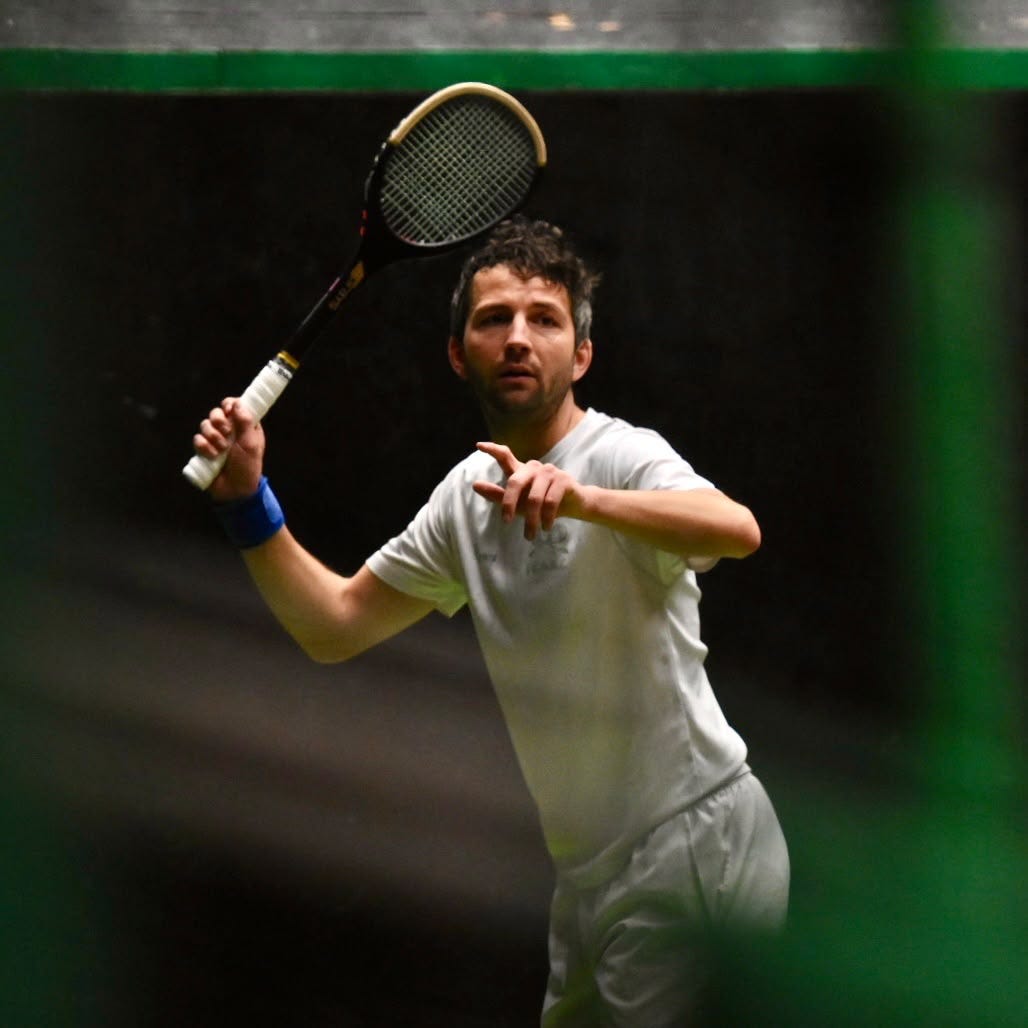
In the third set, Giddins refined his tactics, getting galleries quickly and trusting in Marino-Hume’s occasional misreading of the grille corner to get the first game. Despite Marino-Hume not finding winners in the grille corner himself, sheer grit kept him in the contest before finding winners under the winning gallery to build a 2/1 lead, taking advantage of Giddins’s floaty retrievals. Unfortunately, that was where the fun ended for Marino-Hume. Giddins became more aggressive in playstyle and continued to find the tambour, with the slight increase in level proving decisive. Even with some high serves and attempts to claw the set back, Giddins won five games in a row to win the third set and win the match.
Following on the West court, the Prested pro Vaughan Hamilton, fresh from reaching the final of the Eastern Open, played the Seacourt neo-pro Will Flynn. It was always going to be tough for Flynn, having played the previous fortnight in Cambridge and suffering a double-bagelled defeat. The first set went as planned for Hamilton, racing to a 5/0 lead. Hamilton served more, was beating Flynn from the receiving end, and found ways to limit his biggest strength: the force. Flynn pulled back a game with some impressive shooting into the dedans, but the result of the first set was never in doubt. The second set continued to go well for Hamilton, as he built up a 4/1 lead. However, he began to lose concentration, and Flynn pounced upon the opportunity. Flynn started to hit his signature force more, found galleries, and played heavy cut shots into both corners. Hamilton was misreading these due to the new balls that weren’t quite cutting as much as he expected. Flynn pulled the set all the way back to 4-all before Hamilton regained his rhythm, found some longer chases to get the serve and close out the set.
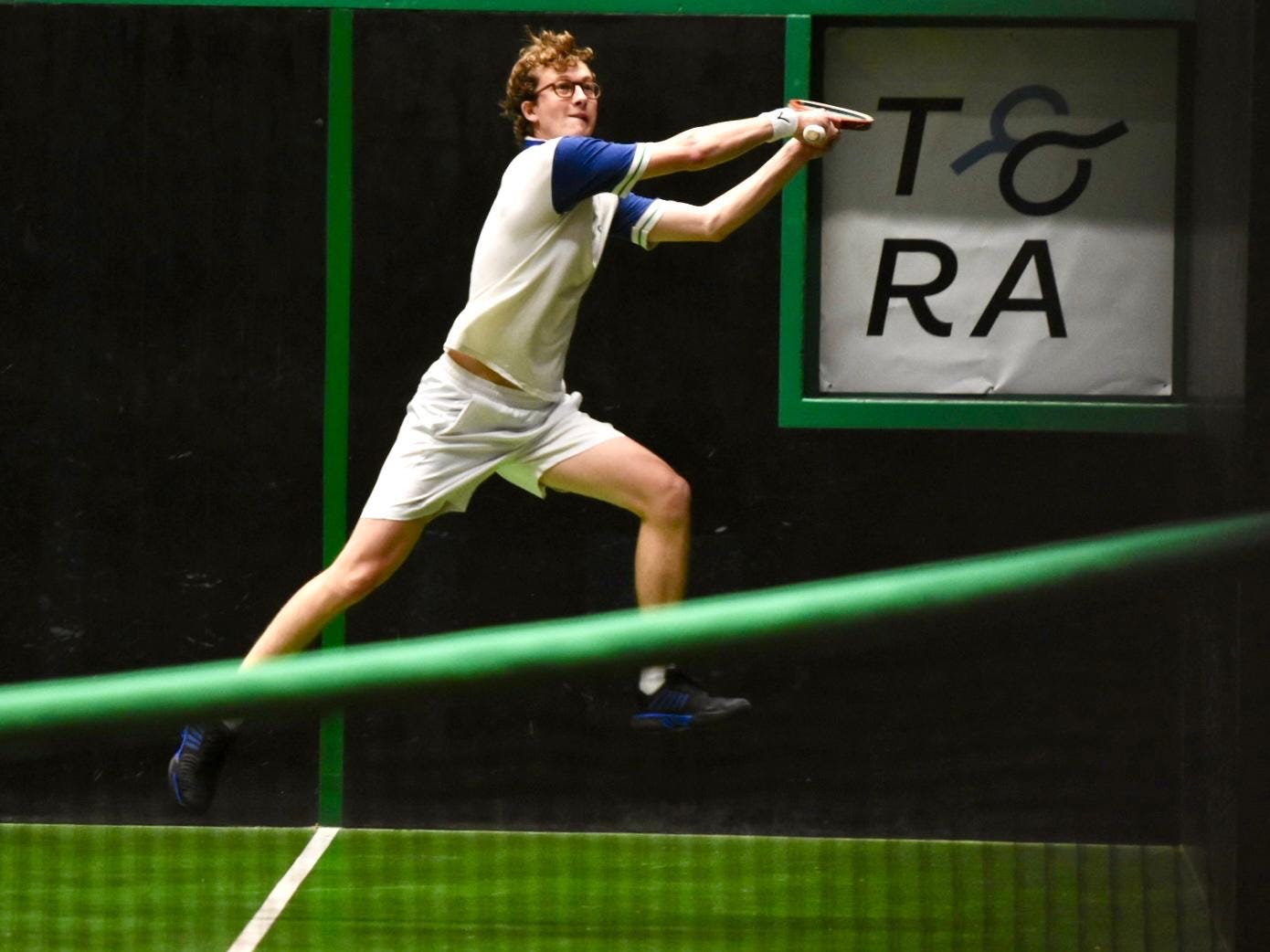
In the third set, Hamilton found his groove again, finding his long chases and attacking relentlessly from the serving end to go 2/0 up. However, Flynn found another string of targets to halt the flow and bring back a game. Hamilton just kept going, though, picking up three games in a row by playing textbook attacking tennis. He trusted that Flynn wouldn’t be able to put enough pressure on him for him to make any errors. Flynn desperately pulled another game back by finding some targets and diving in front of the grille and tambour multiple times but it wasn’t enough. Hamilton took the set 6/2 in another three-set victory.
The second match on the East court was between the Radley pro Nino Merola and the local Queen’s Club rackets pro and qualifier James Medlow. Merola got off to to a very sluggish start, winning just a single point across the first three games of the first set. Though he soon settled into the match, the early deficit was costly. The next four games were evenly exchanged, but that only put Medlow within a game of the first set. He had a couple of set points, but lost them to weak shots. Merola won back a game, but Medlow took the set moments later. Merola’s woes continued into the second set, dropping the first three games as his unforced error count mounted. At 0/3 down, something switched for Merola. His error count dropped to near zero and he began commanding the play more. He pushed Medlow around the court, extracting winners on the forehand side under the winning gallery. Merola took four games in a row, and though Medlow was able to take it to 4-all, by now Merola’s surge was unstoppable. He won the last two games needed to seal the set and level the match.
Into the third set, and Medlow was once again able to re-establish control of the play. From the hazard end, his forcing was on point, while from the service end he was able to use the tambour to keep the pressure on Merola in order to win points. Merola couldn’t extract short chases, having to settle for galleries or overhit drives meaning Medlow was always a chance to beat the chase. Medlow’s lead slowly compounded as the set went on, particularly helped by his strong service-end play, while Merola’s hunt for the winning gallery often pushed balls onto the penthouse. Medlow took the set 6/2.
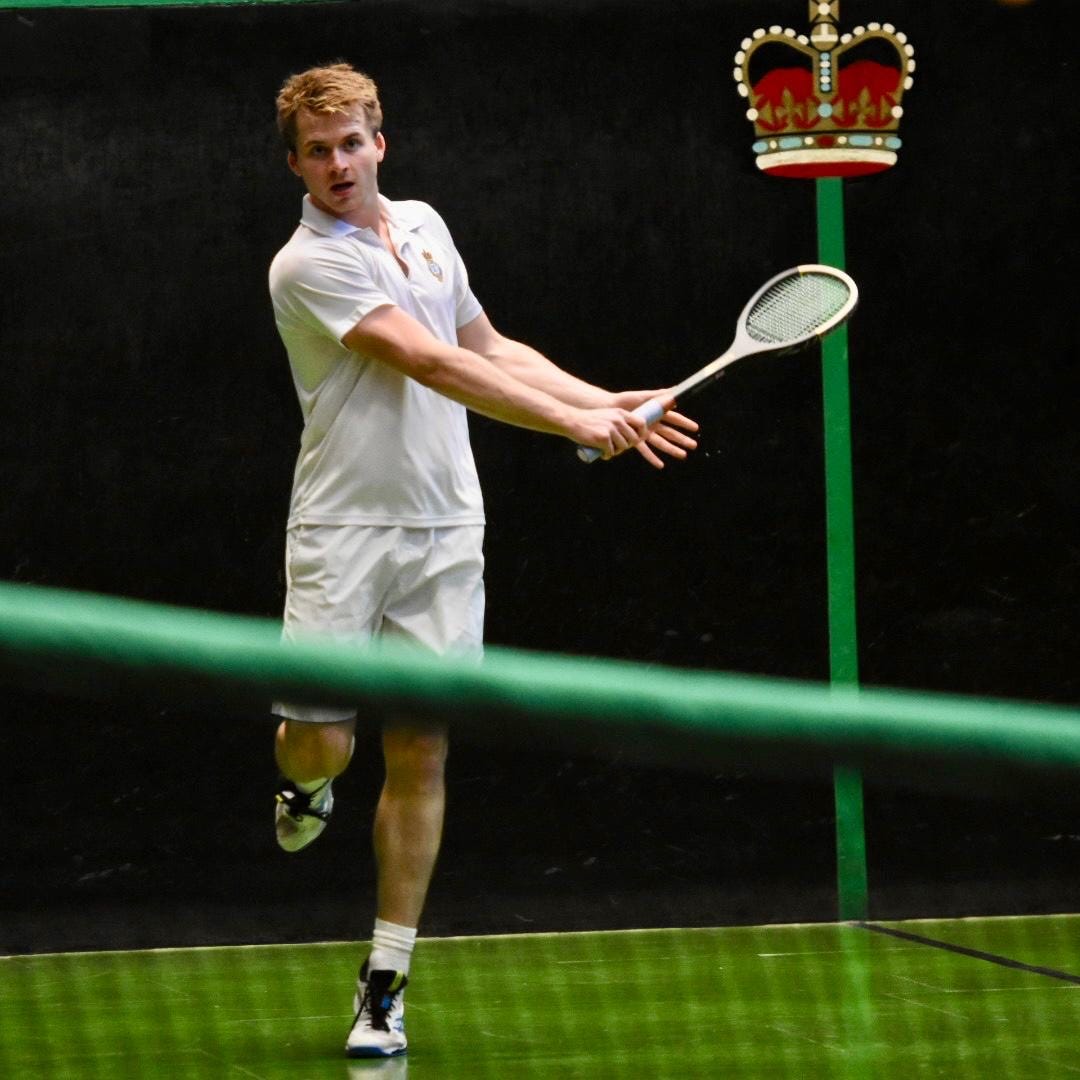
Then in the fourth, Merola hit another golden streak. He refound his target hitting once again, and eliminated the errors from his play. The result was a series of backhand rallies where Merola seemed to have an edge. Merola went 4/1 up by beating a short chase with a force that caught Medlow napping. Throughout the set, Merola kept drawing Medlow out of position then following up with a solid but not excessive ball at a now-open target. He had two set points in the 5/2 game, but gave them away to a pair of unforced errors that were his worst shots of the match. Medlow picked off a couple of cheap games to bring the score back to 5/4 before Merola could finally win the set, defending chase better than 3.
A break preceded the fifth and final set. Once play resumed, it was the tightest the match had been, with no player clearly in the ascendancy. Often, one player would go 40-0 up in a game only for the other to fight back to deuce, and often go on to win it. Merola went ahead 4/3 with some more good target hitting. He had a chance to turn it into a 5/3 lead while playing a worse than the door chase, missing the last gallery by a few inches. Instead, Medlow fought back to win the next two games instead, holding a 5/4 lead. In the tenth game, he beat two short chases — one on a volley error and the other on the floor — to bring up match point. He sealed the match after a Merola backhand error, moving on to the second round for the first time in his young career.
By this point in the day, the West court was still running to schedule. Darren Long, the head pro at Moreton Morrell, played Oliver Pridmore, a highly talented young amateur from Hobart. The first game was slightly loose, but Pridmore found his range quicker and hit a better length. Despite great retrieving from both players, Pridmore went up 3/0 in three comfortable games. Long was still making errant shot choices, yet hitting his targets precisely enough to steal back a game. Pridmore pushed on, unperturbed, his athleticism simply meaning he could get more balls back than Long was expecting and forcing an error. Deep in the set, Long still did not have an answer for Pridmore’s cut volley. Pridmore won the set 6/1 in under half an hour.
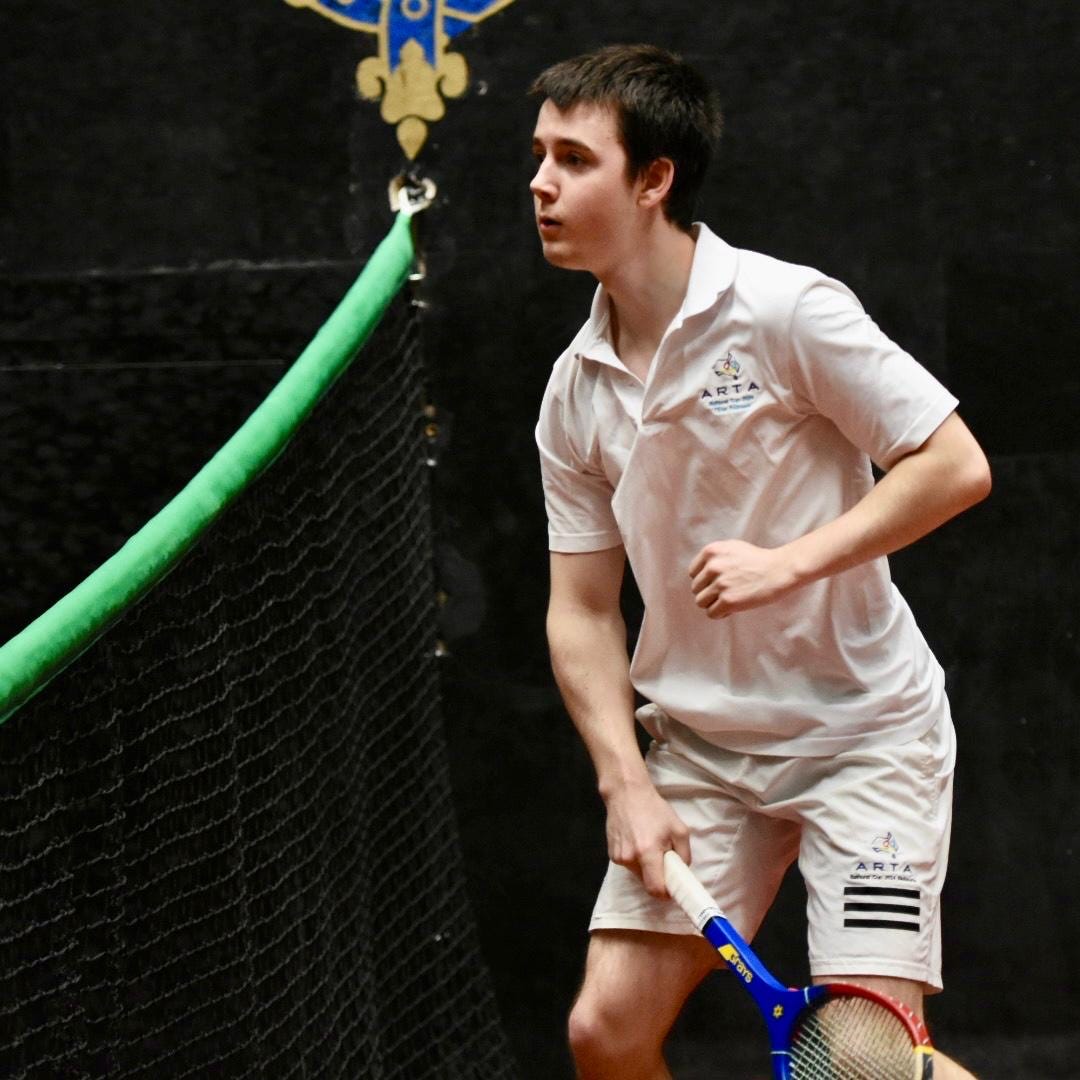
Long started the second set with newly-found determination to hit the grille. Pridmore continued to attack the forehand corner but Long weathered it to take the first game. Undeterred, Pridmore continued to just play consistent textbook tennis. Long couldn’t hit enough targets to win that battle, as Pridmore pushed out three straight games. Long stole a game back to make it 2/3, yet Pridmore counterpunched straight away. Things were now looking bleak for Long. However, he took the initiative after Pridmore framed a lob return into the bottom of the net, losing confidence in his play. Long forced and boasted his way through the next few games to go 5/4 ahead. Pridmore began to refocus again to force Long to hit the back wall on the full, giving Pridmore chances and making the set go to a deciding game. Faced with 3 set points against him, Pridmore’s court coverage proved decisive as he scraped to win the set and take a 2-0 lead. By the third set, Long’s head dropped, and the pattern of the first set returned. Pridmore hit a better length to go 3/0 up. Long stole back a game after some dedans shooting but then lost control of the set completely. He was dealing exclusively in targets, treating the cut shot as a last resort. It didn’t work out, with Long only winning one further game as Pridmore took the match.
Still running ahead of time, the Ladies World Champion Claire Fahey took on the Melbourne pro John Woods-Casey in the final match of the day on the West court. It was a very high-quality match involving lots of fantastic rallies. Fahey started strong, hitting a grille on the very first ball. Fahey was also being very aggressive with her forcing, finding immediate success into the top corner of the dedans, going 3/1 ahead. Woods-Casey sped up his railroad and began to find the back wall nick, making the return difficult for Fahey. Woods-Casey attacked the galleries to take advantage of his serve. Fahey struggled to find an answer to the tactic as Woods-Casey collected five games in a row to win the first. In the second set, Fahey switched to a railroad herself. Despite having some good results with it, she could not convert the critical points. Woods-Casey went 4/0 up as his cut was unreturnable off the back wall. Woods-Casey’s concentration faltered, and errors crept in. Fahey took full advantage and found winners all over the court to pull it back two games. Yet, Woods-Casey still found enough short chases to get back to the service end and win the set 6/2.
Fahey went into the third set with renewed confidence, hitting a massive force to get the first game of the third set. However, Woods-Casey held his nerve and won the backhand cross-court rallies from the receiver’s end in order to go 3/1 up. Fahey proceeded to find her momentum and her boldness grew as Woods-Casey began making errors again in the corners. Fahey exploited them to win three games in a row. Yet, Woods-Casey’s floor game rediscovered its precision, with the Australian clearing the three games impressively without going to deuce to take the third set and the match.
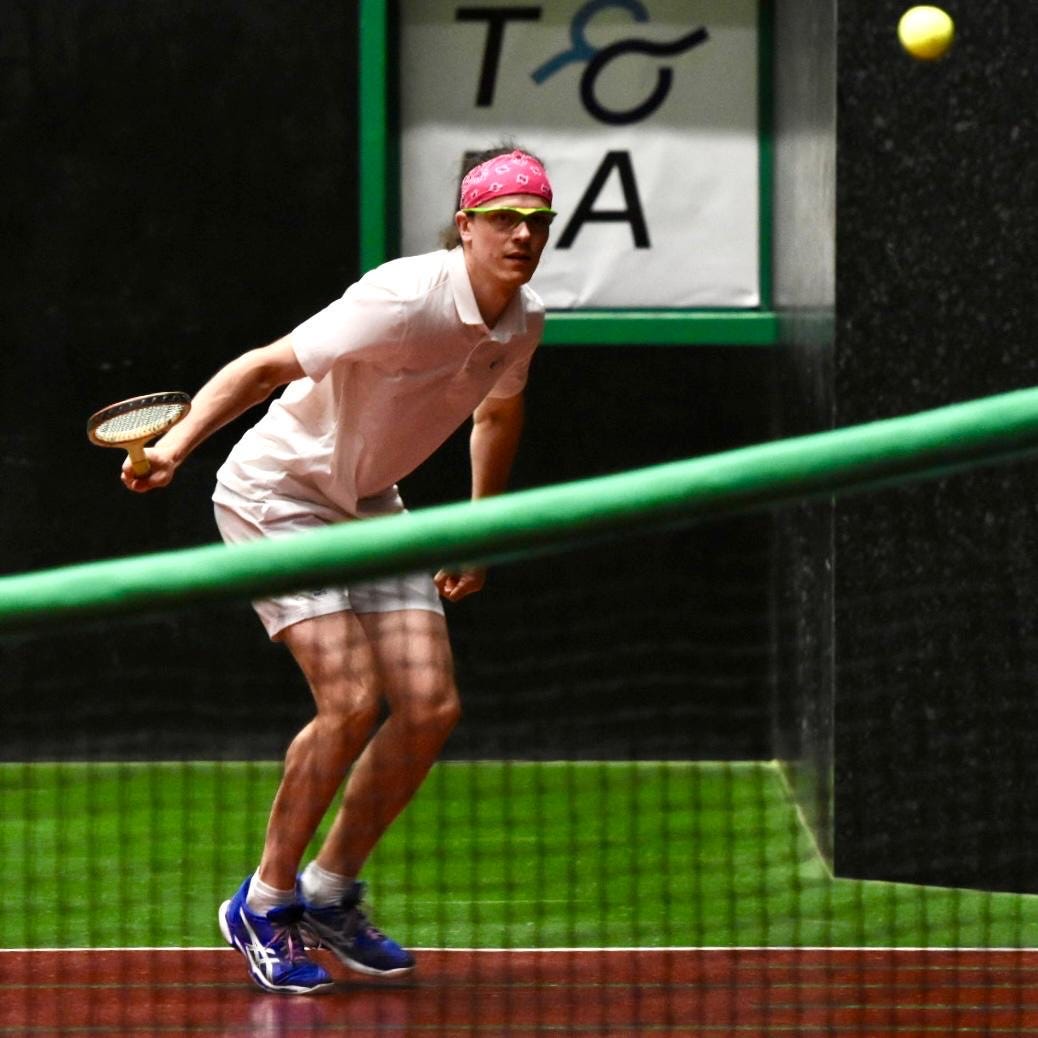
With the West court a set away from wrapping up for the day, the third match went onto the East court. Bertie Vallat and Benedict Yorston, both local amateurs and Oxford Blues, locked horns in their much-anticipated retrieving fiesta. Both players engaged in long rallies, with Vallat targeting Yorston’s backhand side shot after shot, and with Yorston scraping everything back. Vallat often found it hard to outright win points, having to pull Yorston deep out of position in order to slide a winner past him. Throughout the first set, the games were evenly exchanged all the way to a 5-all, deciding game. Vallat struck two innocuous-looking cut-volleys into the high part of the net, followed by an easy forehand and an easy backhand into the same location to give Yorston the set.
Despite the fallow final game of the first set, Vallat came out for the second very positively. He launched his attack, leaning into the ball a bit harder and looking to beat Yorston on the floor. More often than not, he could, eventually, extract a winner. From the hazard end, his cut-volley was sublime, getting chases and errors out of Yorston’s forehand. The set flew by without Yorston winning a single game. Vallat continued into the third set, though sustaining the intensity was proving tough. Yorston managed to pull back a couple of games as the rallies lengthened again. Even so, Vallat soon had a 2-1 lead in the match. With his tournament hanging by a thread, Yorston brought out one final push at the start of the fourth set. He held a narrow lead through the start of the set. The rallies reached their longest of the match, with long backhand duels only ending when one player made a rare error or found a lucky feature of the court. Eventually, Vallat broke away again, his grille hitting proving the highlight as he put on a three game streak to go 5/3 up. Yorston pulled back a game with a good string of play from the service end, but it was not enough to stop Vallat from winning the match and progressing to the second round.
Running four hours behind schedule, the last match of the day took to the East court. The Oratory pro, Henry Henman, fresh off his Eastern Open victory, took on the Bristol head pro, Zak Eadle. Compared with the match immediately prior, the ball was moving around the court at a much quicker pace. Both players were keen to hit the ball with pace, either driving for the low nick or hitting heavy cut. Henman was particularly adept at changes of pace, hiding soft drop shots down Eadle’s forehand side that pulled him out of position. Henman was not keen to stick around at the hazard end, sticking the ball into the galleries whenever possible. Eadle was happier to generate chases by long drives, but it meant that Henman could cover them more. Henman’s focus saw him break away early in the first set, building game after game having been 2/1 down. Soon enough, he had the decisive lead in the set, with Eadle throwing the kitchen sink at the ball to try and regain some initiative. Henman won the last five games to take the first set.
The second set proceeded much like the first, with Eadle going hard at the ball over the first couple of games and again establishing a 2/1 lead early in the set. The Bristol pro was dictating the tempo of the restes, but Henman’s determination and defences proved too strong. The young pro knew that if he survived long enough, then Eadle would eventually make an error. Eadle grew frustrated with the luck often not going his way, falling victim to a number of grille ledges or nick bounces. Henman took another five straight games to take the second set, and carried on into the third, pressing Eadle down the backhand side. In the third set, Eadle’s cut-volley was finding the net repeatedly, with his annoyance and vocalisation growing. Henman extended his run to nine games, finding himself 4/0 and 30-0 up in the set before Eadle had had enough. He threw in the towel and retired the match, leaving Henman slightly shocked and sitting in the door gallery unsure of whether to be celebrating his progression through to the second round.
Play continues on Monday with half of the second round matches, all played on the East court. The women’s draw also begins, with four qualifying matches to be played out on the West court.
Match results:
Queen’s East:
11:00 AM: Max Trueman lost to Levi Gale 1/6 6/5 6/5 4/6 1/6
1:00 PM: Nino Merola lost to James Medlow 3/6 6/4 2/6 6/4 4/6
3:00 PM: Benedict Yorston lost to Bertie Vallat 6/5 0/6 2/6 4/6
5:00 PM: Zak Eadle lost to Henry Henman 2/6 2/6 0/4 ret.
Queen’s West:
11:00 AM: Jamie Giddins def Alexander Marino-Hume 6/5 6/4 6/2
1:00 PM: Will Flynn lost to Vaughan Hamilton 1/6 4/6 2/6
3:00 PM: Darren Long lost to Oliver Pridmore 1/6 5/6 1/6
5:00 PM: John Woods-Casey def Claire Fahey 6/3 6/2 6/4
Order of play for Monday (all times GMT):
Queen’s East:
12:00 PM: Levi Gale vs Robert Shenkman (8)
2:00 PM: Ben Taylor-Matthews (4) vs Vaughan Hamilton
4:00 PM: Robert Fahey (6) vs Jamie Giddins
6:00 PM: Bryn Sayers (7) vs Bertie Vallat
Queen’s West:
1:00 PM: Alex Brodie vs Trudi Machin
2:30 PM: Sabrina Didizian vs Ulla Petti
4:30 PM: Izzy Marshall vs Winner Monday 1:00 PM
6:00 PM: Araminta Oldham vs Winner Monday 2:30 PM