


Freddie Bristowe has taken out Robert Shenkman in the final game of the final set in the first rubber of the Bathurst Cup final, saving match point in the process. Britain then recovered to 1-all courtesy of a heroic five-set performance by Bertie Vallat to overcome Noah Motz. Meanwhile, in the women’s event, the reverse doubles were split evenly, leaving the British team in prime position to take the title.
With the tournament entering its second half, Thursday began with the first rubbers of the third-place playoff between Australia and France. First was the reverse singles match between Australia’s Michael Williams and France’s Jean-Baptiste Rossi. Progress was slow, as each player opted to drive at the back wall, generating lots of long chases and changes of ends. They took over half an hour to wrestle the scoreline to 3-all, before Williams started finding a few targets, quickly streaking ahead to take the first set. He carried it on through the second set too. As the scoreboard pressure built on Rossi, his game started to unravel, growing impatient and frustrated as Williams honed his strokes. Rossi didn’t win another game until the second game of the third set. However, Williams struggled to maintain the intensity, while Rossi kept fighting hard for every ball, rarely missing the strings. He pulled out to a 5/1 lead, at which point Williams’s second wind hit. The Australian recovered a couple of games, but Rossi had enough buffer to secure the set. The fourth set was as close as the first but it was clear that Rossi had the better legs. The Frenchman did not give up on any ball — as exemplified by a rally where he managed two return full-stretch dives — meaning Williams had to hit his targets. Fortunately for him, he hit a good run towards the end of the fourth set, pushing on to the win.
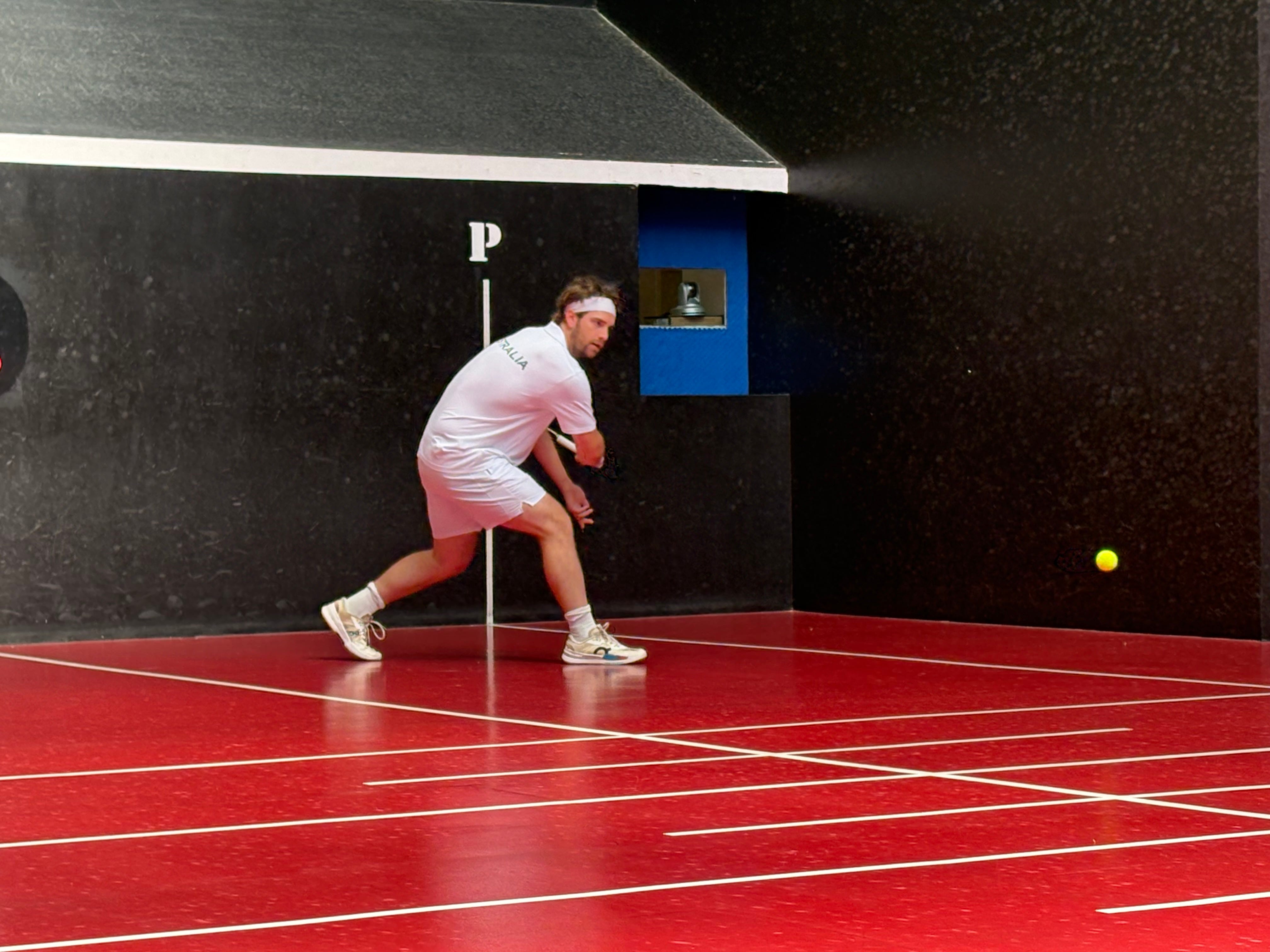
The other singles rubber was between the Australian first seed Oliver Pridmore and the French second seed Clément Depreeuw. Pridmore was keen to see the match off quickly, slotting two winning galleries for his first two points of the encounter. He didn’t let up, with around a third of the points he won during the set coming from winning openings. Depreeuw’s best counterplay came when Pridmore sprayed the ball onto the penthouse, especially above the grille, allowing him to attack the ball and try and beat Pridmore on the floor. Although Depreeuw had some early success in the second set, they reached the prearranged suspension time and walked off with the score at 3/2 to Pridmore.
The suspension allowed the women’s doubles to start on time, with Britain’s Tara Lumley and Nicola Doble playing the Rest of the World’s Saskia Bollerman & Xanthe Ranger. Bollerman sent Ranger forward to the galleries, taking on the Herculean task of attacking both Doble and Lumley from the back of the court. Despite backing herself to accomplish it, she too often found that the Brits had enough defensive might to see her off. Ranger’s railroad bought the Rest of the World pair a few early games, but the British pair quickly established control of the play. They won eight straight games, taking the first set in the process. Bollerman and Ranger managed one more game in the second set, their final tally of three being equal to their haul in the same match-up at the previous edition in Melbourne.
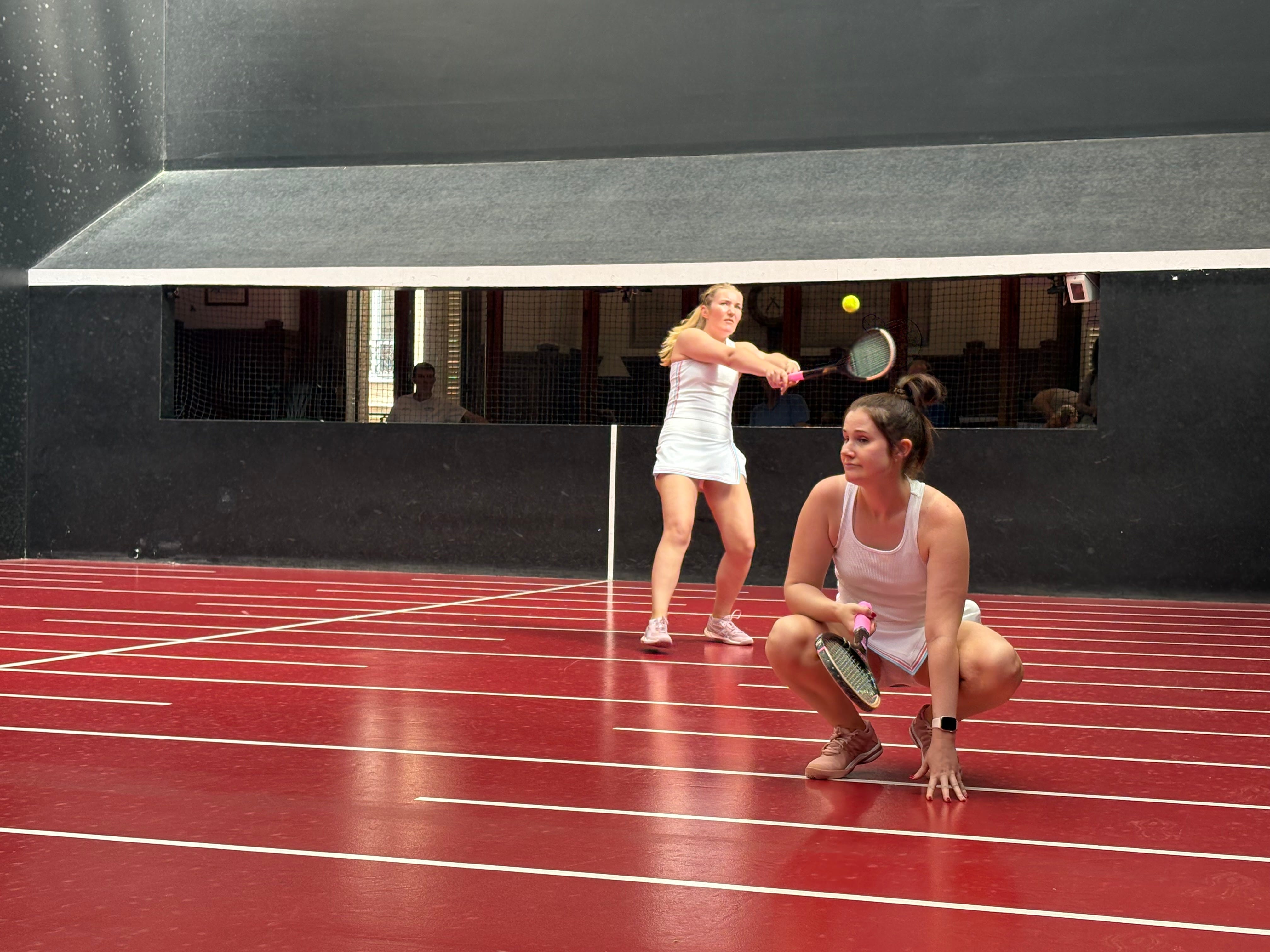
The last of the women’s doubles matches saw the British second seeds Georgie Willis and Jess Garside take on the Rest of the World’s first seeds, Lea Van Der Zwalmen and Frederika Adam. Van Der Zwalmen was not as clinical as she would normally expect of herself, with Willis and Garside testing out her forehand over and over again. It took Adam taking on a more active role to allow Van Der Zwalmen to ease into the play. After running them close through the first half of the set, Willis and Garside struggled to keep the ball fully under control, hitting hard on the back wall and out to many hazard chases. Van Der Zwalmen and Adam broke away at the end of the first set, their play becoming the most synchronised it had been in the competition. By the second set, they were giving Garside a serious workout in her role at the galleries. She found herself having to play her double-handed volley both on the forehand, backhand and everything in between. But she couldn’t hold back the storm, her vigil broken by the nagging consistency of Van Der Zwalmen and the round-arm volleys from Adam. Van Der Zwalmen and Adam led the second set from start to finish, keeping the Rest of the World with an outside chance of the overall victory.
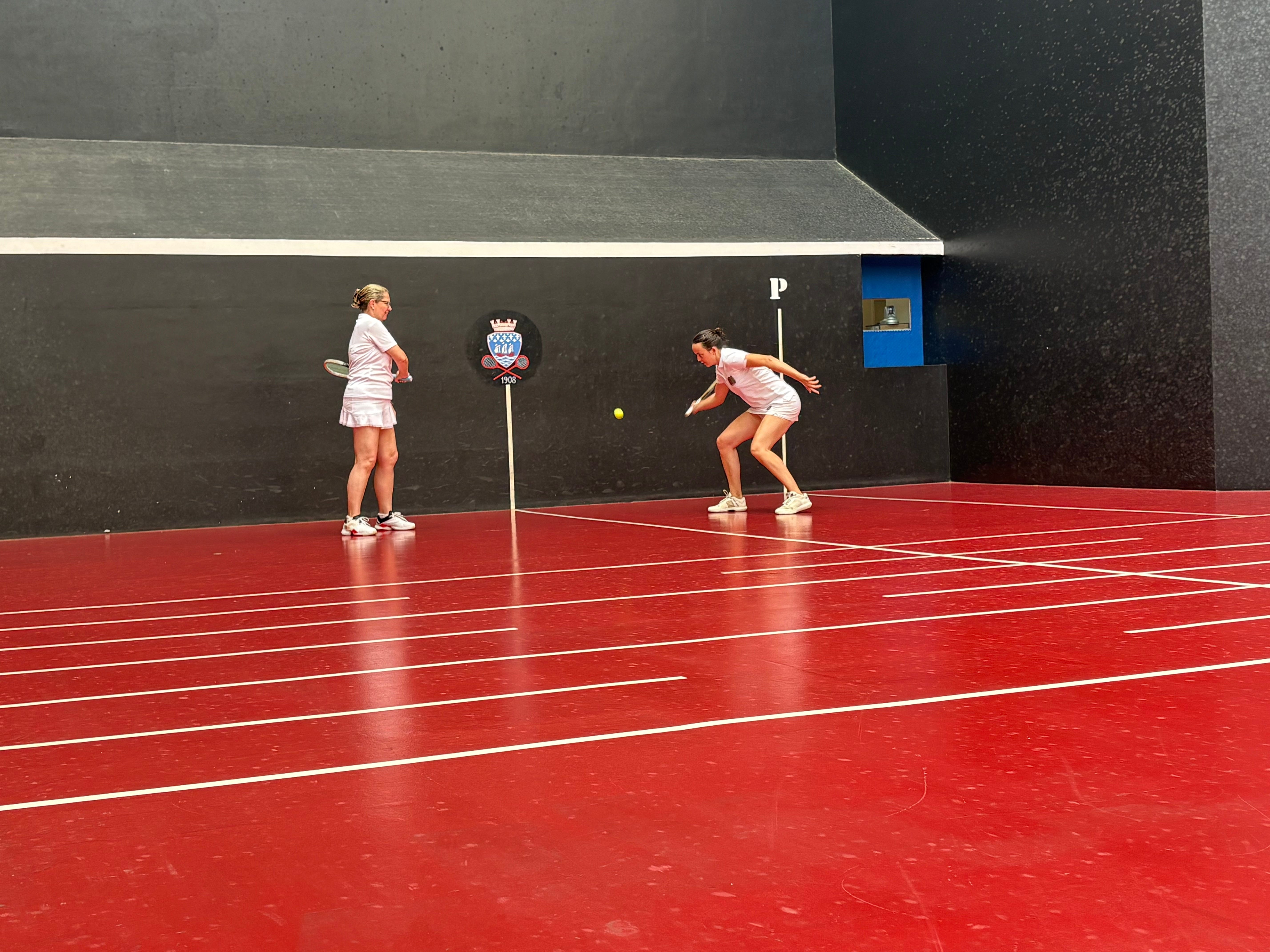
The evening session was the first rubbers in the Bathurst Cup final, with the first string pairs taking to the court. Britain were represented in the final by Robert Shenkman, while America’s champion was Freddie Bristowe. Both held the amateur championship titles of their respective countries. Bristowe opened the encounter by launching an all-out attack on Shenkman’s serve, knocking him off his line immediately and sending him searching for something else to serve. Shenkman’s best option seemed to be to go down the hazard end and counter-attack Bristowe’s serve instead. Bristowe kept attacking throughout the set, with Shenkman retreating into a defensive shell. There were several long rallies with Bristowe attacking again and again while Shenkman spooned everything back, each waiting for the other to crack. Bristowe held the advantage, winning the first set by a comfortable scoreline.
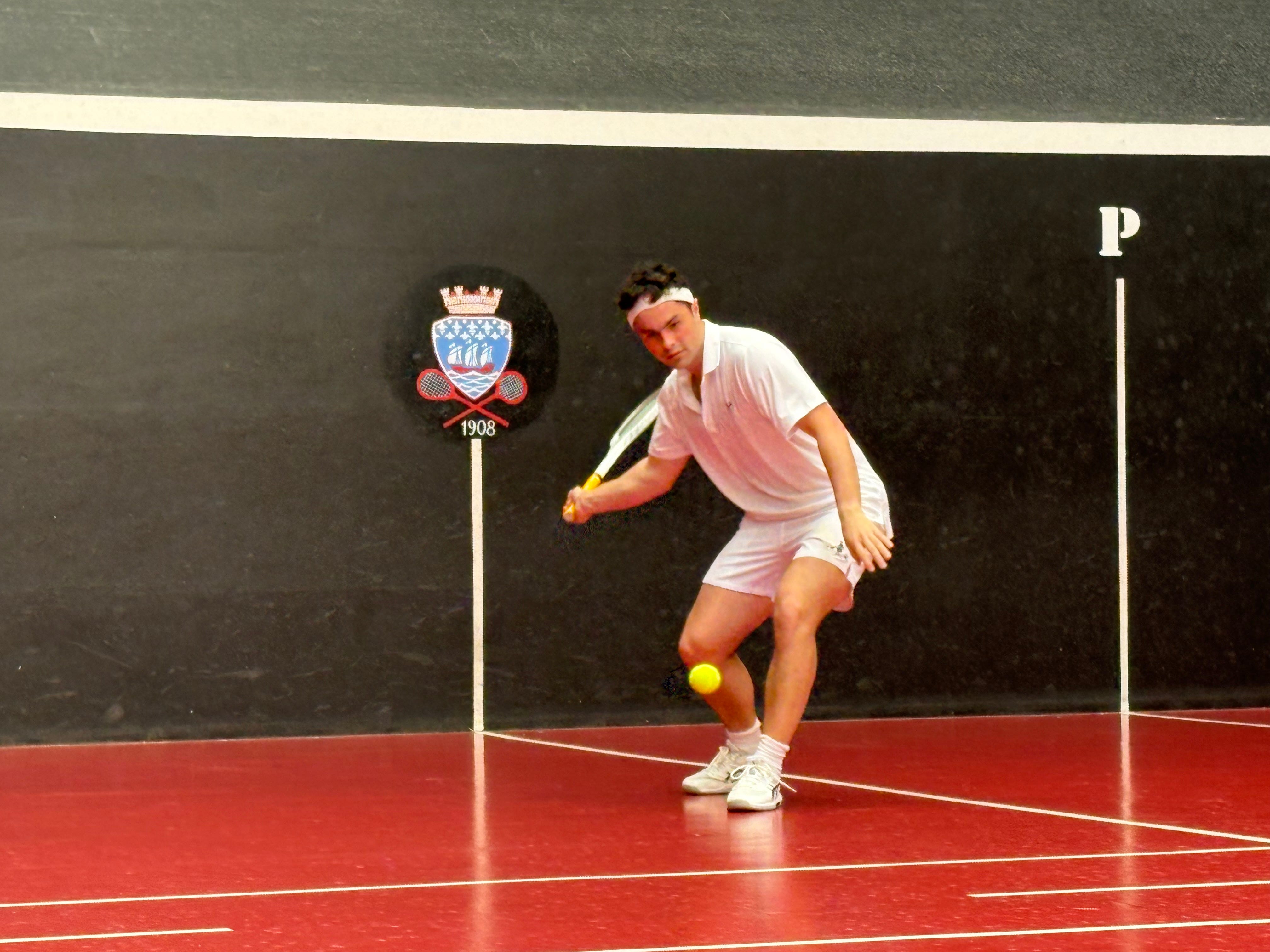
Bristowe began the second set with a flurry of dedans. Shenkman wasn’t doing enough with the free balls that Bristowe did give up, often opting to safely continue the rally in the hope that his opponent would eventually miss. Bristowe, on the other hand, made sure that every free stroke that he got that the ball he sent wasn’t coming back. Bristowe stretched out a two-game lead early in the second set. But then the cracks in Bristowe’s game that Shenkman had been betting on started to appear. The errors mounted, while the disciplined Shenkman tightened up his serve and refused to give Bristowe any opportunities to attack. Shenkman won four straight games to gain what proved to be the decisive lead in the second set.
The third set saw plenty of long, tough rallies. That fact alone favoured Shenkman’s play-style, but there were enough unexpected bounces and Bristowe was talented enough to keep it interesting. Neither player established a lead in the set until Shenkman broke away to 5/3 with a ball boasted into hazard the line, letting out an audible celebration that surprised even himself. He wrapped up the set moments later with a series of high-intensity rackets-style boasted rallies.
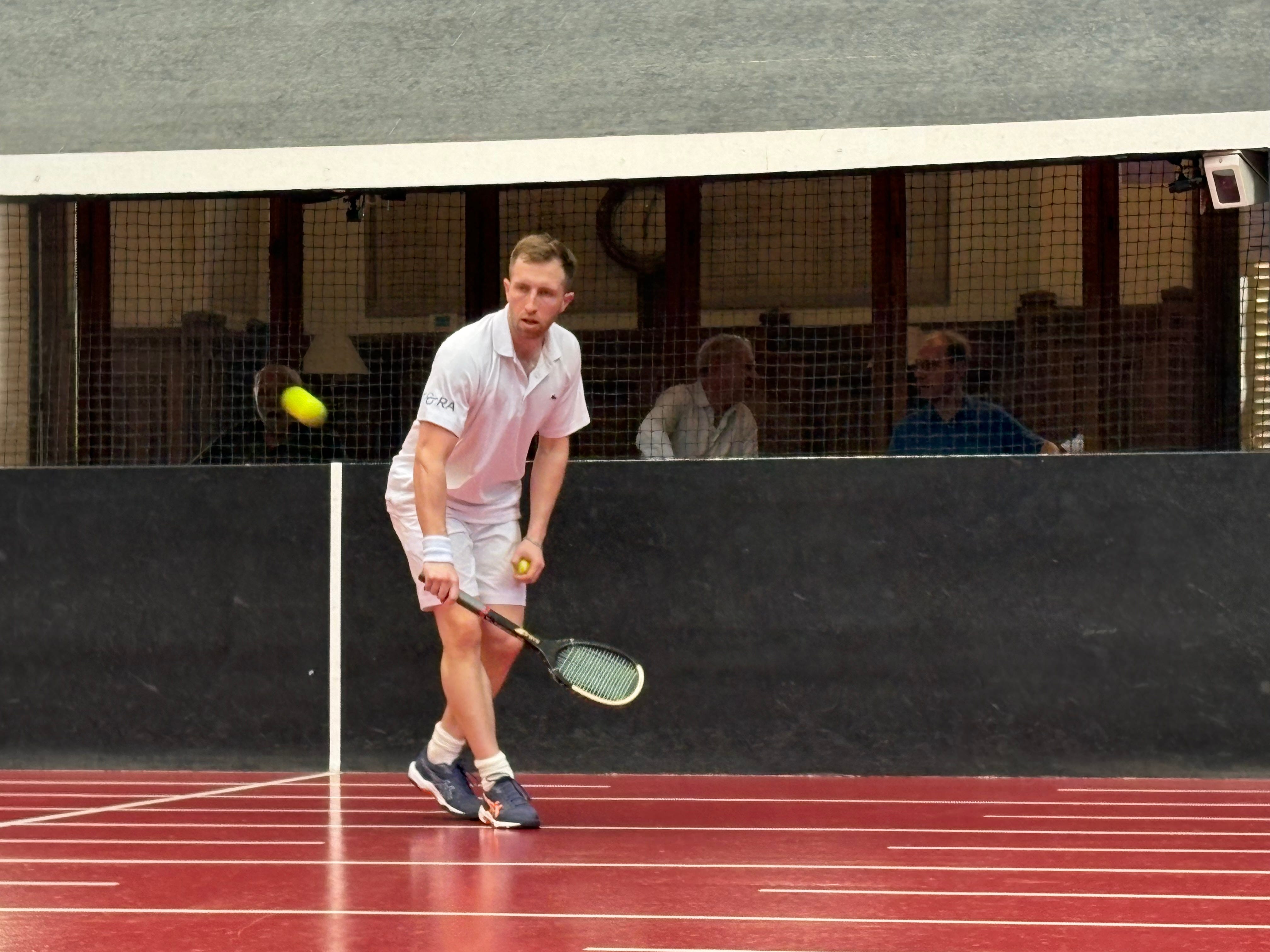
Shenkman’s serving continued to improve through the fourth set but Bristowe refused to give in. The American always had a way of releasing the pressure with a couple of back-to-back targets. He was fighting hard for every point, while Shenkman continued to try and work him over. Again, they were locked together through the first phase of the set until Bristowe broke away to 5/3. Earning the lead freed up Bristowe, as he battered three dedans in the last game alone to secure the set and send the match into a decider.
Bristowe stole an early march in the fifth set, stepping once again into his more aggressive posture. It seemed that the tennis gods were on his side, getting more than his fair share of fortunate bounces or lucky shots, not least a force into the dedans off the second gallery ledge. Still, he broke out a two-game lead on the back of his target hitting, knocking up a half-century of winning openings by the match’s end. Shenkman had to dig deep to pull the scoreline back to 3-all, backing his method to beat Bristowe’s brashness by the end. They exchanged games again to 4-all. With the tension mounting, every shot was vital. The margins were small: a nick railroad, a lucky net cord or a marginally high force onto the penthouse seemed to swing the favour of the match every moment. The 4-all game alone saw nine deuces, each player with several chances to take the lead. Shenkman took the game with a ball hitting the back ledge of the winning gallery to beat a chase.
Bristowe then sent the match into a deciding game, defending a chase while breaking a string. Both players were now at full stretch, refusing to let any ball die. Bristowe thought he had a 30-0 lead but for the ball hitting the bottom ledge of the dedans. Shenkman struck the grille two balls later to bring up the first two match points. Bristowe saved both, the second with a grille. A long rally at deuce followed, with Bristowe again finding the grille. Now with his own match point, Bristowe nailed a tight railroad — the only thing Shenkman could do was boast it into the net — putting to bed a three-and-a-half-hour epic and securing Bristowe’s first career victory over Shenkman. Bristowe turned to his supporters in the gallery and screamed, racing over to them to share in high-fives, the win giving the Americans a key advantage in the match.
Bristowe’s win is the third time a match has been won 6/5 in the fifth set in the last three times the Bathurst Cup has visited Paris. In 2017, France’s Nicolas Victoir defeated Australia’s Pete Boyles, while in 2008, Britain’s Spike Willocks overcame Australia’s Michael Happell. Such a scoreline happens, on average, twice a year, and it marked the second occasion for Shenkman in his career — being on the losing side of a deciding game against Jamie Douglas at the 2023 MCC Gold Racquet.
With the time approaching ten o’clock, Bertie Vallat stepped on court to recover the situation for Great Britain. Looking to seal the night for the Americans was Noah Motz. Vallat got down to business early, moving quickly through the points and depriving Motz of his biggest strength — his force. Vallat’s compact style and consistent length saw him quickly establish a three-game lead which he was able to hold on to for the rest of the set.
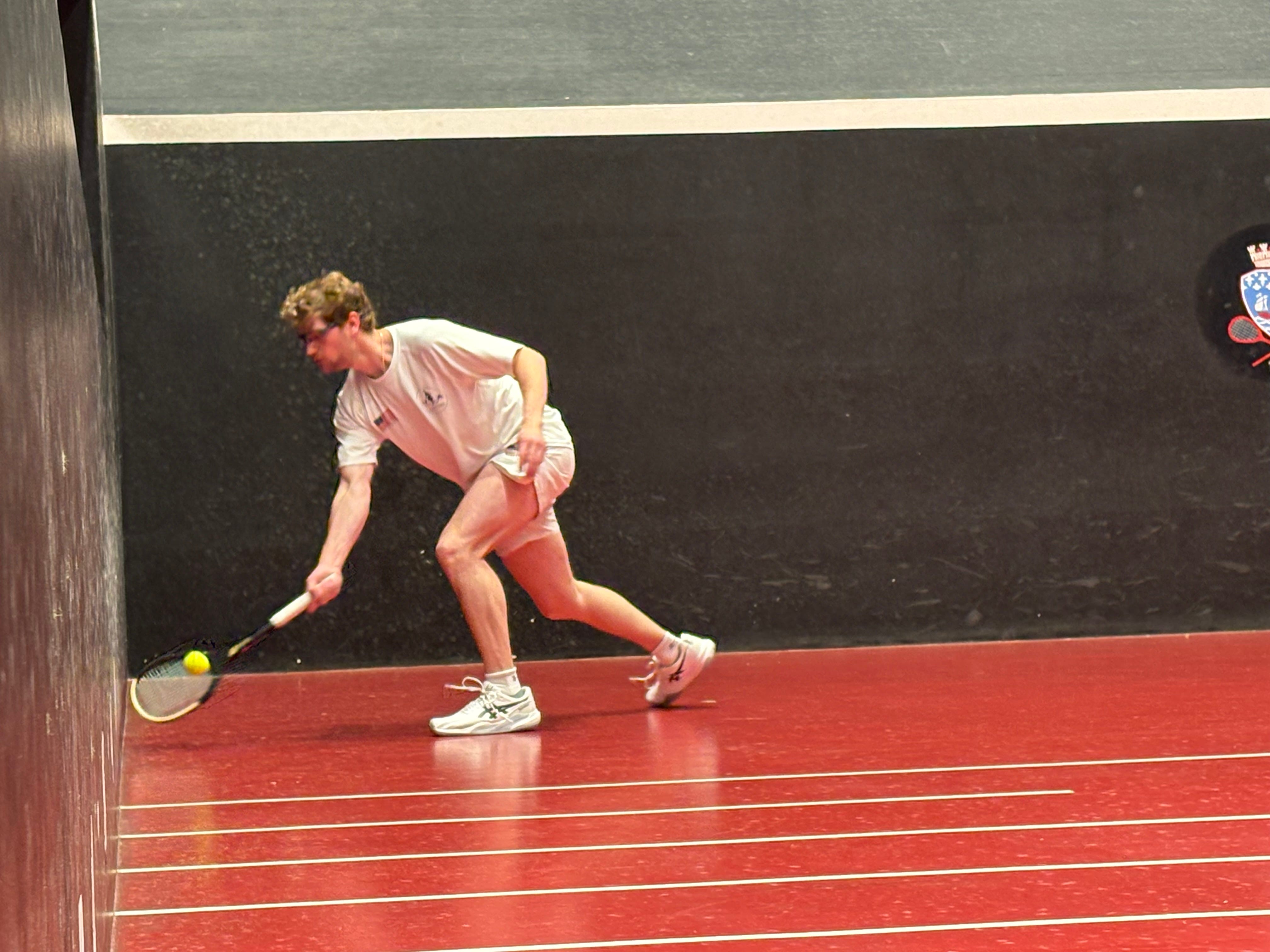
Motz finally got his force firing at the end of the first set and into the second. Soon they were flying past Vallat’s ears, leaving the Brit searching for a serve to contain things. Pulling his railroad back, Vallat weathered the storm, happily mopping up anything loose and seemingly being the only player of the week to be able to hit regular, short chases. Once Vallat was back in the lead, Motz started thrashing at the ball again, forcing Vallat to wait through six set points before eventually winning the set.
Motz kept fighting on, taking the first two games of the third set, meaning Vallat had to go back into a rebuilding phase. Even though he recovered to 2-all, Motz stole the initiative, once again finding his range on his force. Vallat then truly fell into a slump, and Motz was all over him. The American dictated the play, with Vallat lucky to scrap for whatever he could. Motz breezed through the last four games, sending the match to a fourth set.
Vallat built a solid foundation for the fourth set, winning the first two games. Then Motz hit yet another run of golden form, triggered by three back-to-back dedans and aided by three flush back walls from missed forces. With the Americans in the galleries getting vocal, the battle was on. Motz pushed ahead, as it wasn’t always clear where Vallat’s next point was coming from. Motz extended to 5/3 up, taking the set two games later with yet another main wall dedans.
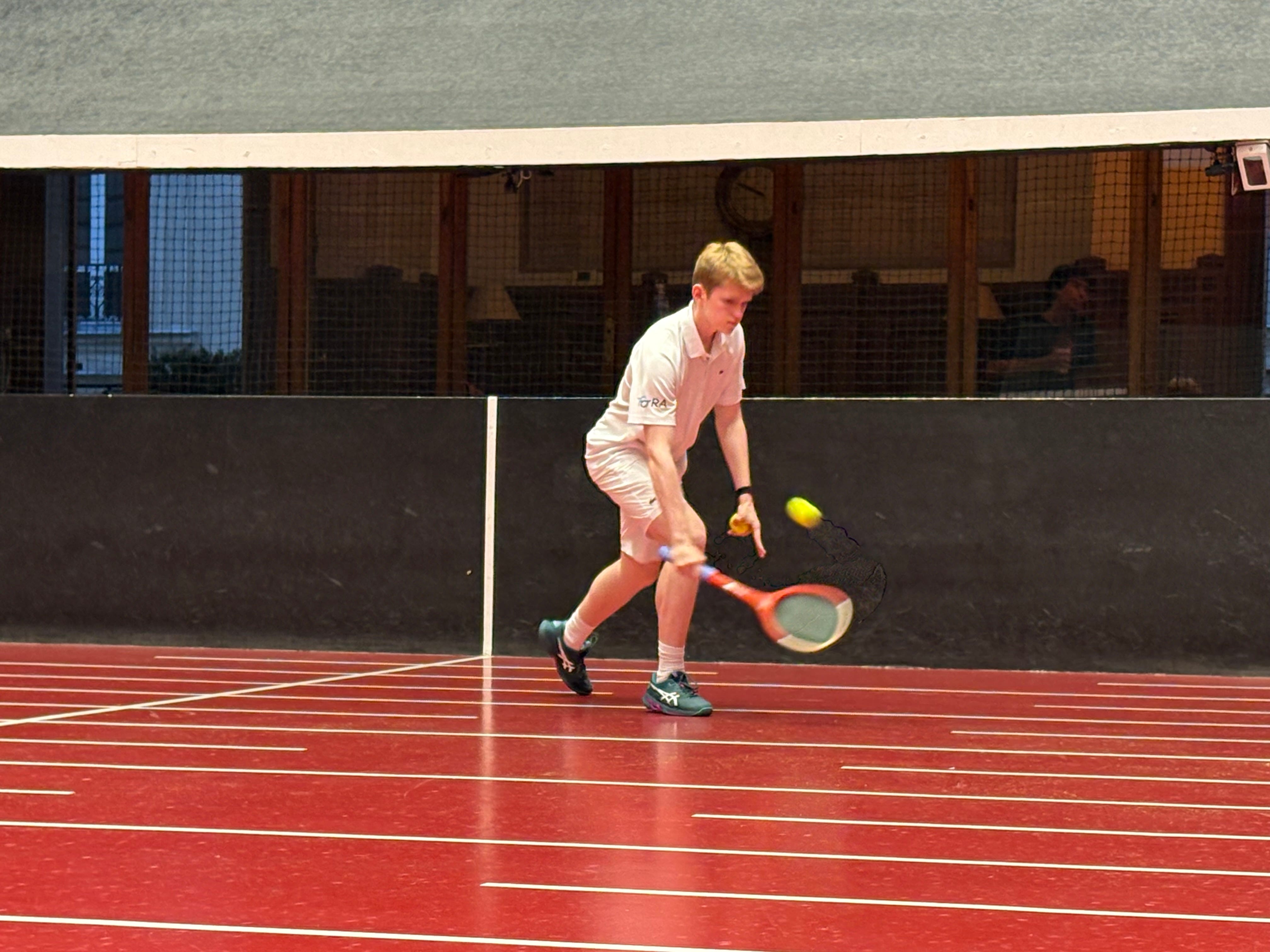
The match entered a fifth set, with the time well past midnight. Vallat found a confidence not seen since the second set, and started to muster an effective defence to Motz’s forces, even if he did have to contort into strange positions to get his strings to meet the ball. His play onto the tambour finally gave him a method for winning points, with Motz misreading the angled wall more and more. He rediscovered his length as well, pressuring Motz into both corners. By the end of the set, he finally broke Motz’s spirit, winning the set without dropping a game. At the end, he threw his head back at the heavens, relieved to have successfully accomplished his task.
Before the night could end there was still the loose end of the third place playoff match between Pridmore and Depreeuw — ten hours after it had been suspended. Depreeuw recommenced the same way he had left off: with a double fault. Pridmore saw the early hours of the morning as a chance for target practice. The Australian quickly mopped up the remaining games of the second set, but started spraying balls all over the place in the third, allowing Depreeuw to win a few games. But the result was never in doubt, with the Australians taking a 2-0 overall lead in the fixture.
Play continues on Friday. A winner of the women’s event is likely to be crowned. Britain need to win two rubbers to secure outright victory, whereas Rest of the World face the difficult challenge of needing to win three of the four reverse singles to force the match into a deciding doubles match on Saturday — though they could win it outright by winning all four matches. In the men’s competition, the doubles match will likely prove decisive for the direction of the trophy, as Saturday will see the two reverse singles matches, where the first seeds are favoured to win for their respective teams.
Match results:
3rd place playoff: Australia Men lead France Men 2-0 (three rubbers remaining)
11:00 AM (2 vs 1 reverse singles): Michael Williams (AUS) def Jean-Baptiste Rossi (FRA) 6/3 6/0 3/6 6/3
1:00 PM (1 vs 2 reverse singles): Oliver Pridmore (AUS) def Clément Depreeuw (FRA) 6/1 6/2 6/3
GB Women lead ROW Women 5-3 (four rubbers remaining)
3:00 PM (1 vs 2 reverse doubles): Tara Lumley & Nicola Doble (GBR) def Saskia Bollerman & Xanthe Ranger (ROW) 6/2 6/1
4:30 PM (2 vs 1 reverse doubles): Georgie Willis & Jess Garside (GBR) lost to Lea Van Der Zwalmen & Frederika Adam (ROW) 3/6 2/6
Final: GB Men level with USA Men 1-1 (three rubbers remaining)
6:00 PM (1st singles): Robert Shenkman (GBR) lost to Freddie Bristowe (USA) 3/6 6/4 6/3 3/6 5/6
8:00 PM (2nd singles): Bertie Vallat (GBR) def Noah Motz (USA) 6/2 6/3 2/6 4/6 6/0
Order of play for Friday (all times CEST):
GB Women vs ROW Women:
12:00 PM (2 vs 1 reverse singles): Georgie Willis (GBR) vs Saskia Bollerman (ROW)
1:30 PM (1 vs 2 reverse singles): Tara Lumley (GBR) vs Emma Clyde (ROW)
3:00 PM (4 vs 3 reverse singles): Jess Garside (GBR) vs Jo See Tan (ROW)1
4:30 PM (3 vs 4 reverse singles): Katherine Carney (GBR) vs Frederika Adam (ROW)2
Australia Men vs France Men:
6:00 PM: Oliver Pridmore & Rhys Williams (AUS) vs Nicolas Victoir & Michel Brunoro (FRA)
GB Men vs USA Men:
8:00 PM: Robert Shenkman & Will Flynn (GBR) vs Freddie Bristowe & Noah Motz (USA)
Lineup may change if match is a dead rubber
Lineup may change if match is a dead rubber